

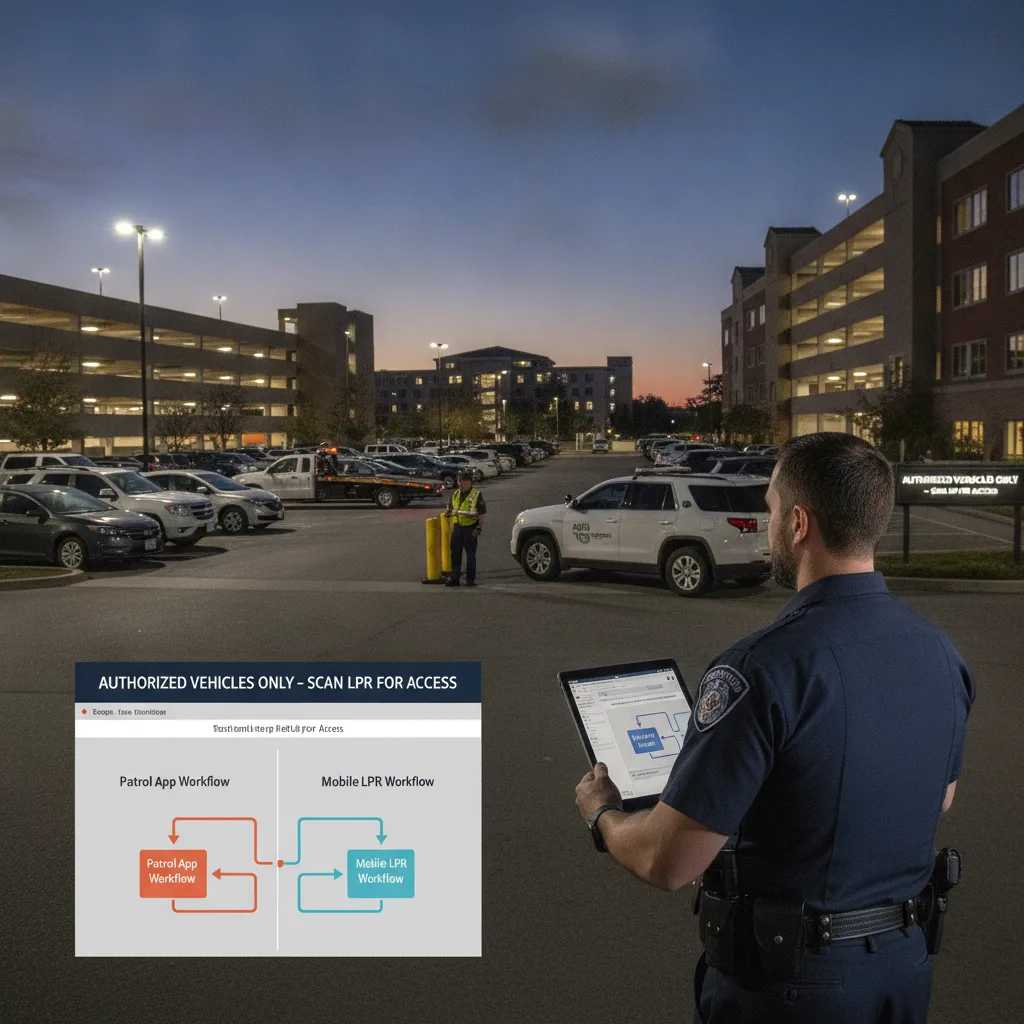
Direct answer: For a night patrol team, the real question isn’t “patrol software or mobile LPR” — most useful platforms today combine route tracking, incident logging, and plate recognition in one app. What actually separates products after dark is whether the camera reads plates reliably in low light and headlight glare, whether the app keeps a solo officer’s location and status visible to dispatch, and whether the permit list stays current when the leasing or HOA office is closed for the night. Test those three things before comparing feature lists.
This guide is written for patrol officers working solo or in pairs on overnight shifts — covering apartment communities, HOA properties, retail lots, and mixed commercial sites — plus the supervisors who schedule them and the property managers who review the morning’s activity log.
Two different tools, one overlapping job
“Patrol software” usually refers to the broader shift-management layer: route checkpoints, GPS breadcrumbs, incident and activity logs, photo notes, and a dashboard supervisors check in the morning. “Mobile LPR” refers specifically to plate capture and plate matching — reading a plate from a phone or windshield-mounted camera and checking it against a permit or violation list in real time.
On paper these sound like separate purchases. In practice, a night crew needs both working together: a patrol log that proves the route was actually walked or driven, and a plate tool that works when the only light source is a streetlamp or a parked car’s headlights. A platform that does LPR well but keeps no route or shift record leaves a gap when a resident disputes a tow the next morning and asks what time the lot was checked.
What to test in the dark, not the demo
Every vendor demo happens in daylight or a well-lit office. Before buying, run both finalist tools on an actual overnight shift and check the following.
Low-light and glare performance
Point the camera at a plate lit only by a security light, then at one lit by oncoming headlights. Note how often the app returns a usable read versus a blurred or partial one, and how long the officer has to stand still to get it. A tool that needs three attempts under a streetlamp will slow down every stop on a route with dozens of vehicles.
Solo-officer status and check-in
Most night patrol is a one-person job. Confirm the app shows a live location to dispatch or a supervisor, supports a check-in or duress prompt if an officer doesn’t move for a set period, and lets the officer log an incident without taking their eyes off the lot for long. This matters more at night than on a daytime patrol with more people around.
Permit and rule freshness after hours
Leasing offices and HOA management companies keep normal business hours; violations don’t. Check whether the permit list the app uses at 2 a.m. reflects a guest pass issued at 5 p.m. the same day, or whether it’s syncing from a stale export. A plate that reads correctly but checks against yesterday’s list produces a wrong call either way — a legitimate guest gets flagged, or an actual violation gets missed.
Offline behavior
Parking structures and interior lot corners are common dead zones. Confirm the app queues a capture and syncs it once signal returns, rather than losing the record or forcing the officer to redo the stop.
A one-week side-by-side to run before you commit
Put both tools on the same route for a week, ideally with the same officer running it, and track:
- Average time per plate check, including any manual retries
- Number of reads flagged as unreadable or unusable
- How long it takes a supervisor to find and confirm a specific stop the next morning
- Whether the permit list matched what the leasing or HOA office actually had on file that night
- Any point where the officer had to stop and radio dispatch because the app couldn’t resolve a case on its own
A short trial like this tells you more than a spec sheet. If one tool consistently needs manual review at the same spot on the route — a dim corner, a structure entrance — that’s the real cost you’ll be paying every night, not the list price.
Where the process should stop
No app should make the final call on a tow at 3 a.m. by itself. Build in a simple rule: if the plate read is unclear, the permit status is ambiguous, or the vehicle is in a spot that doesn’t match the violation type, the officer documents it and holds the case for a supervisor to confirm in the morning rather than escalating on uncertain evidence.
FAQ
Do we need separate patrol software and a separate LPR app?
Usually not. Most current platforms handle both in one app, which also keeps the route log and the plate evidence in the same case file — useful when a resident disputes a decision days later.
How much does low-light read quality actually vary between products?
More than most spec sheets suggest. Camera hardware, image processing, and even the phone-mount angle all affect it. That’s exactly why a real overnight trial matters more than a vendor’s daytime demo.
What’s the minimum record we should keep per stop?
A timestamp, the plate, a wide shot showing the vehicle’s location relative to a sign or space marker, and the permit or rule status at the time of the check. That’s enough for a supervisor to reconstruct the decision without having been there.
Ready to see how a route actually performs after dark before you commit to a platform? Learn more about mobile LPR for security patrol or compare it against a full towing enforcement workflow, then get in touch to set up a trial on your own route.
Data source: U.S. Department of Transportation