

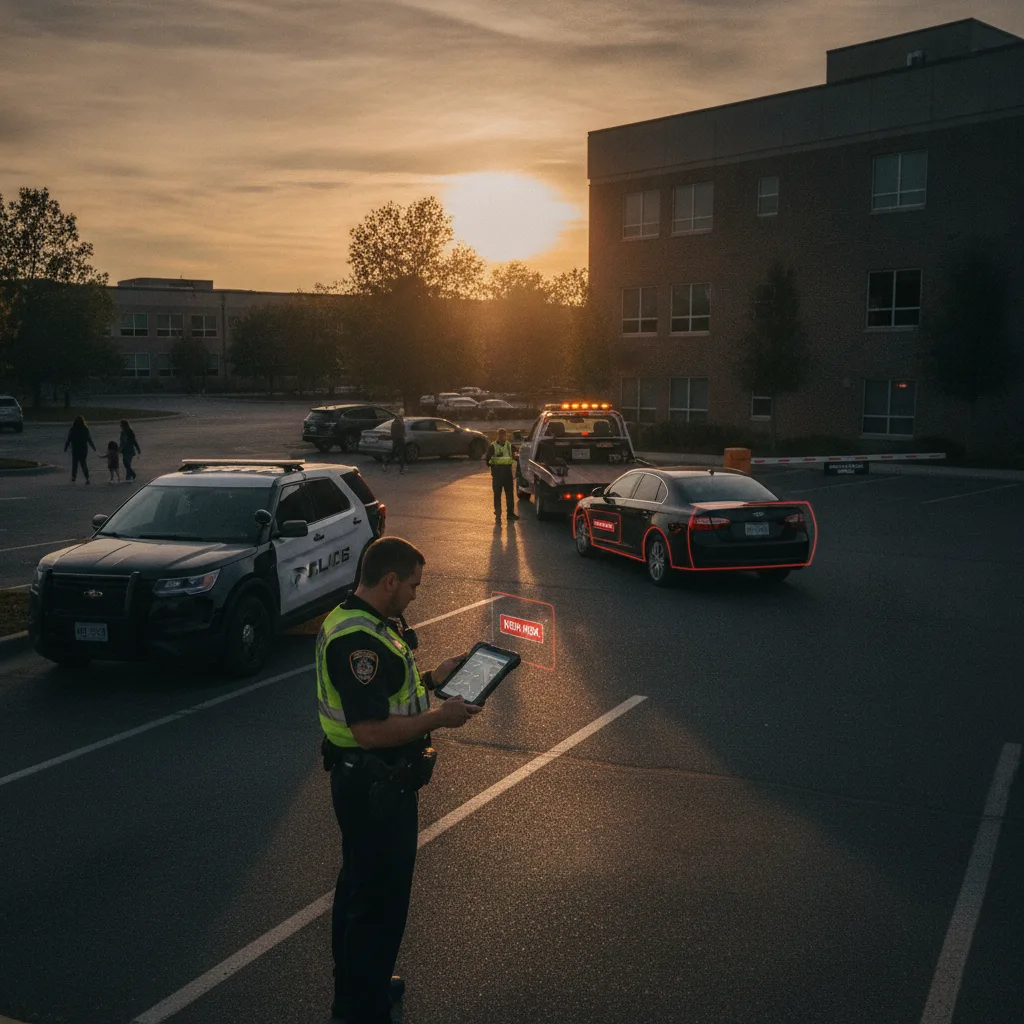
Short answer: Night patrol teams prioritize high-risk lots by ranking each property or lot section on recent scan history — repeat unpermitted vehicles, prior incident flags, and how long it’s been since the last pass — rather than patrolling every lot in the same fixed order every night. With one or two officers covering a route of properties, the lots that go unchecked longest are where problems accumulate, so the route itself needs to flex based on what’s actually happening, not a static schedule set months ago.
Most night patrol operations cover more ground than staffing really allows. The question isn’t whether every lot gets checked every night — it’s which lots get checked first, and which ones can safely wait until the second or third pass.
What actually makes a lot “high-risk” overnight
Not every lot on a route carries the same risk, and treating them equally wastes coverage on quiet properties while under-serving the ones that need it. A few signals are worth weighting into a nightly priority order:
- Repeat unpermitted vehicles. A lot where the same unmatched plates keep showing up night after night is a different problem than a one-off unpermitted car — it usually means someone found a gap in enforcement and is exploiting it.
- Recent incident history. Break-ins, vandalism, or trespassing reports at a property should push its lots up the list for the following weeks, independent of parking violations.
- Time since last pass. A lot that hasn’t been checked in three nights carries more unknown risk than one checked two hours ago, simply because more could have changed.
- Layout and visibility. Poorly lit lots, lots with blind corners, or lots set back from the street get used for things officers on a predictable schedule won’t catch — and they deserve variable timing, not just more visits.
Building the nightly route around risk, not habit
Use scan history instead of memory
If your team is using mobile LPR, every pass through a lot already generates a record of what was there and whether it matched. That history is the raw material for prioritization — a lot with a rising rate of no-match or repeat-offender plates over the last week or two should move up the list automatically, rather than relying on an officer’s gut sense of “this lot’s been bad lately.”
Vary the timing on the lots that matter most
A property that only ever gets checked at 11pm on the dot will eventually get tested by someone who’s watching for exactly that pattern. For the highest-priority lots, rotate the pass time across the shift — early, middle, late — so presence is less predictable without adding more total stops than staffing allows.
Keep a live “second pass” list
Not every issue gets resolved on the first pass — a flagged vehicle that needs a morning-review decision, a gate left propped, a lighting outage reported earlier. Keep a short running list during the shift of what needs a second look before the route is considered complete, rather than treating the first drive-through of each lot as the whole job.
Balancing coverage across a whole route
With a fixed number of officers and a fixed shift length, prioritizing high-risk lots always means deprioritizing something else. Make that tradeoff explicit rather than accidental:
- Rank every lot on the route weekly using recent scan and incident history, not a static list set at contract start.
- Guarantee a minimum check frequency for every property (even the quiet ones), so “low risk” doesn’t quietly become “never checked.”
- Allocate the extra passes — the second and third loop through the night — to whichever lots are currently ranked highest, and let that ranking shift week to week as conditions change.
This keeps the route defensible if a client property asks why their lot got less attention on a given night — there’s a documented reason, not just an officer’s personal routine.
Don’t let prioritization become a safety shortcut
A ranked list should change the order and frequency of stops, not the officer’s caution at any individual one. High-risk lots by definition are more likely to have an active situation when the officer arrives, which means backup awareness, lighting, and a clear disengage-and-call rule matter more there, not less. Route planning is about coverage efficiency; it isn’t a reason to rush the stops that carry the most actual risk.
FAQ
How often should the lot-risk ranking be updated?
Weekly is a reasonable baseline for most routes — frequent enough to catch an emerging pattern, infrequent enough that the team isn’t reshuffling the route every night based on noise.
What if a low-priority lot has an incident between review cycles?
Treat any confirmed incident as an immediate override — move that lot up regardless of where it sits in the current ranking, and note the reason so it factors into the next scheduled review.
Should quiet properties ever get dropped from the route entirely?
Generally no. A minimum check frequency keeps a currently-quiet lot from becoming a blind spot, and periodic presence is itself part of what keeps it quiet.
For the scanning workflow this relies on, see our mobile LPR planning guide, and for a broader look at enforcement software across a multi-property route, see our towing enforcement software guide. If you want help turning your route’s scan history into a working priority list, contact us.
Data source: U.S. Department of Transportation