

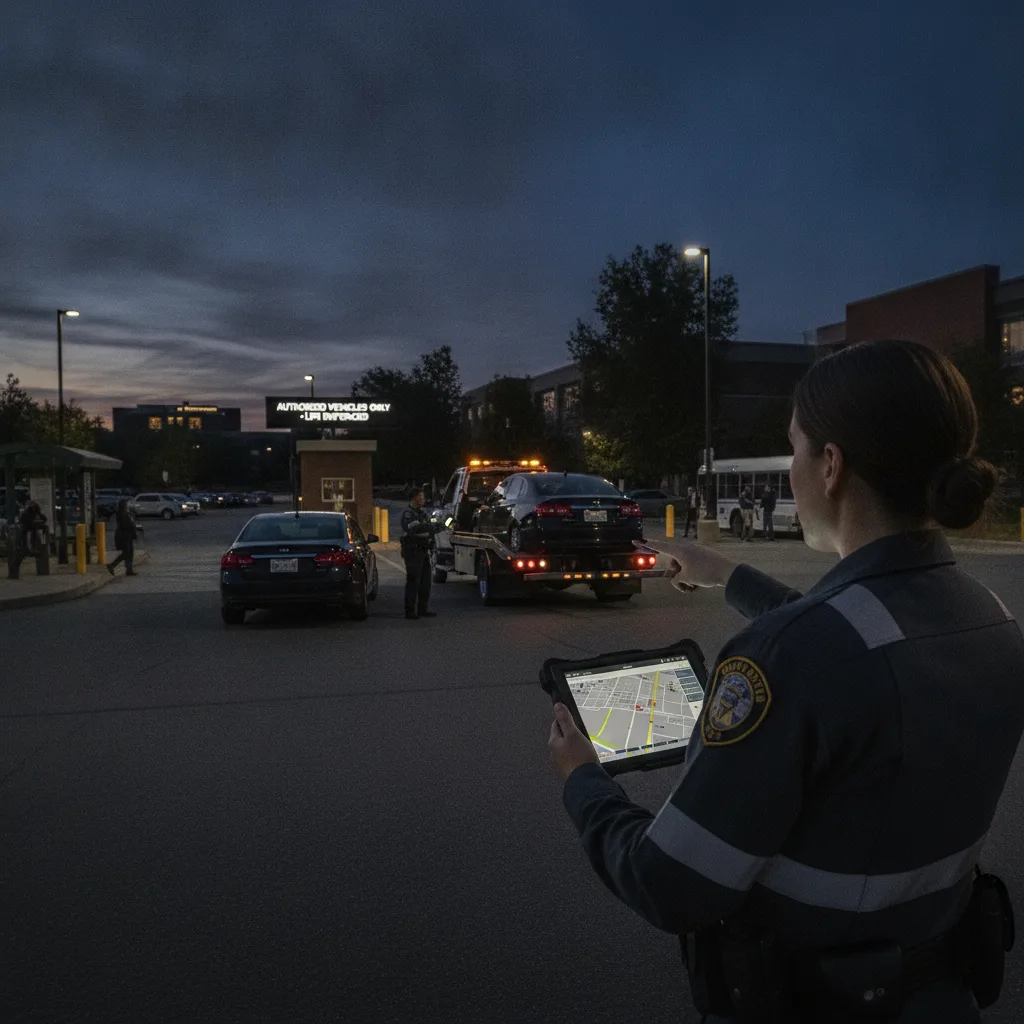
Direct answer: Night patrol teams reduce disputed tows mainly by building an evidence packet that survives the specific weaknesses of nighttime documentation: glare washing out a sign, a plate read that’s technically correct but was captured at low confidence, and a scene photo that’s harder to read than the same shot would be in daylight. A daytime tow and a nighttime tow can rest on identical facts and still produce very different dispute outcomes if the nighttime evidence doesn’t clearly establish what a reviewer — or a vehicle owner — can see in a well-lit photo taken hours later.
Why Nighttime Tows Get Disputed More Often on Evidence Grounds
Most successful tow disputes don’t argue that the vehicle wasn’t violating the rule — they argue that the evidence doesn’t clearly show it was. At night, that argument has more to work with: a posted sign that’s technically visible but poorly lit in a photo, a plate captured with headlight glare across part of it, or a wide shot that doesn’t make the restricted space or curb clearly identifiable once someone views it later on a screen in daylight. None of these mean the tow was wrong — they mean the record of it is weaker than it needs to be.
Where this shows up in practice: a vehicle towed from a fire lane at 2 a.m. gets disputed not because the fire lane marking was ambiguous on the ground, but because the photo taken to document it was underexposed and the marking is hard to make out in the file a reviewer pulls up later. The tow was correct; the evidence packet didn’t hold up as well as it should have.
Night Patrol Teams: Building an Evidence Packet That Holds Up
| Evidence element | Nighttime-specific risk | What closes the gap |
|---|---|---|
| Plate read | Glare or low-light conditions can produce a low-confidence read | Flag and manually confirm low-confidence reads before dispatch, don’t rely on the automated match alone |
| Scene / signage photo | Underexposed or poorly framed shots are hard to interpret later, even if the violation was clear in person | A wide establishing shot plus a close-up of the posted restriction, taken with enough light to be legible after the fact |
| Timestamp | Overnight-only rules depend entirely on the time being accurate and undisputed | Device-generated timestamp tied to the photo, not a handwritten log entered later |
| Permit/authorization check | Same-day or last-minute authorizations are easy to miss on a night pass | Check the live permit source at time of tow, not an end-of-day export |
Notification Requirements Don’t Pause for the Time of Night
Many states require a private-property tow operator to notify local police of a nonconsensual tow, often within a set window after the vehicle is removed — California’s Vehicle Code 22658 is a commonly cited example, requiring notification and specific evidence steps before a tow proceeds, and other states impose similar timing requirements. That obligation doesn’t relax at 3 a.m., but overnight staffing often makes it easier to fall behind on it — a single patroller working a route has less slack to also handle a notification call promptly than a daytime team might. Building the notification step into the same workflow as the tow itself, rather than treating it as an administrative task for later, keeps that requirement from becoming the actual point of dispute even when the tow itself was justified.
What a Reviewer Needs to See, Not What the Patroller Saw
The patroller on scene has context a later reviewer doesn’t — they can see the sign is legible even if a photo of it, taken at night, comes out dim. The evidence packet has to work for someone who wasn’t there: clear enough photos, a plate read with a stated confidence level, a timestamp, and a note on the current permit status checked at the time, not assumed from an earlier pass. Treating “the patroller was confident” and “the record clearly shows it” as two different bars is what separates a tow that survives a dispute from one that doesn’t, particularly at night when the gap between those two things is largest.
Nighttime Documentation Checklist
- Flag any low-confidence plate read for manual confirmation before the tow is authorized, rather than relying on an automated match alone.
- Take a wide establishing shot and a close-up of the posted restriction, with enough light or flash to keep both legible after the fact.
- Confirm the permit or authorization status against the live source at the time of the tow, not an earlier export.
- Log the required police notification as part of the same workflow as the tow itself, with a timestamp showing when it was made.
- Review a sample of nighttime tows weekly for evidence quality, separately from daytime tows, since the failure points are different.
Measuring Whether Nighttime Evidence Is Improving
Track disputes by cause — unclear signage photo, low-confidence plate read, missing or late notification, stale permit data — and track them separately for night shifts versus day shifts. If nighttime disputes cluster around one or two of those causes, that points to a specific fix (better lighting on the photo step, a stricter low-confidence review rule) rather than a general call for “better documentation.”
Related PLACA.AI planning resources
Questions before expansion
Why do nighttime tows get disputed more often than daytime tows for the same violation?
Not because the violation is less clear on the ground, but because photo evidence taken at night — glare, low light, underexposure — is often harder for a reviewer to interpret later than the same scene would be in daylight.
Does the police notification requirement change for overnight tows?
The underlying requirement doesn’t change, but overnight staffing makes it easier to fall behind on the notification window, since a single patroller has less slack to handle it promptly alongside the tow itself.
What should happen when a nighttime plate read comes back low-confidence?
It should be flagged for manual confirmation before a tow is authorized, rather than treated as either a clean match or ignored, since acting on an unverified low-confidence read is a common source of disputes.
Plan a limited workflow review
Bring the current rule, process, exceptions, and success criteria for reducing disputed tows for night patrol teams. PLACA.AI can help evaluate a bounded pilot without assuming another property’s workflow is the right answer.
Editorial refresh: July 22, 2026. Independently confirm current product capabilities, third-party features, pricing, contracts, governing requirements, and local rules before acting.
Data source: U.S. Department of Transportation