

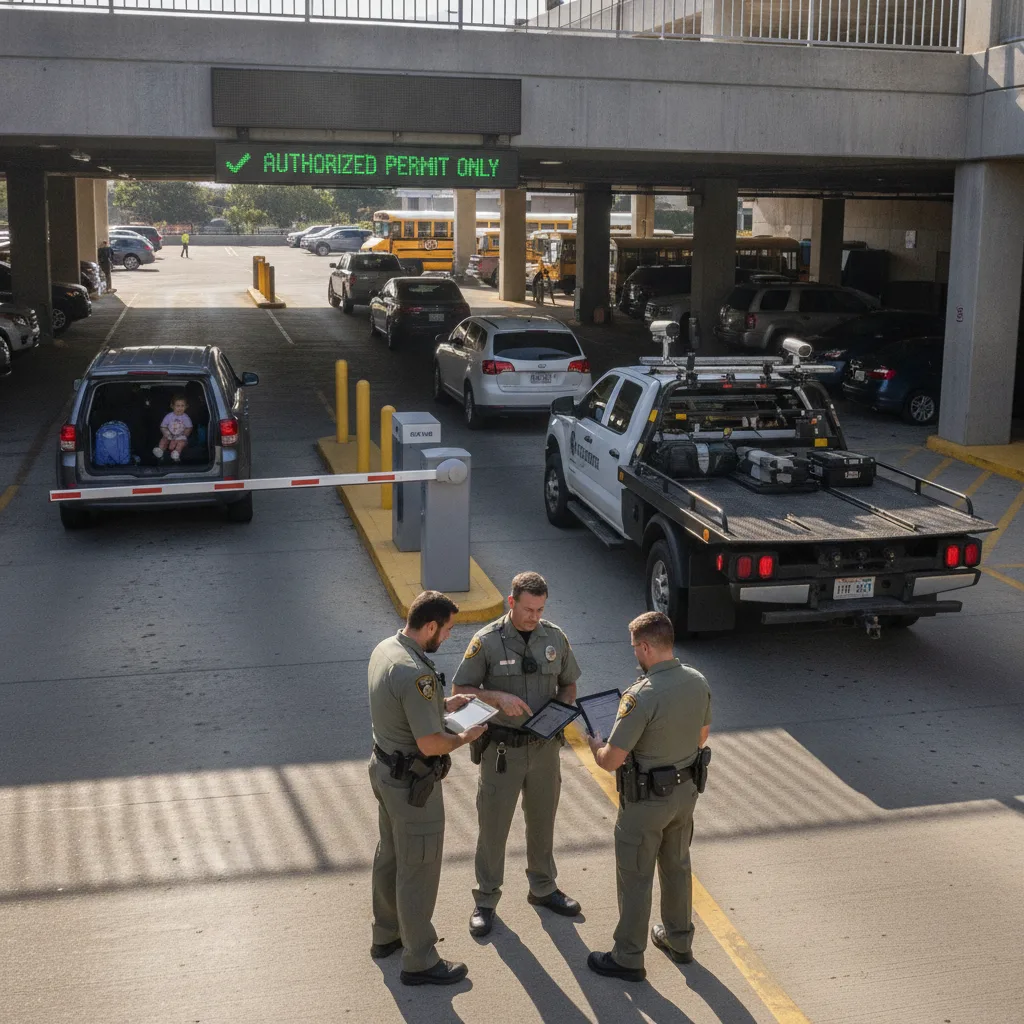
Direct answer: Permit enforcement teams training drivers on mobile LPR need to go deeper than a basic scan-and-match on one thing: multiple overlapping permit types and zone boundaries. A driver enforcing a multi-zone lot, campus, or municipal permit district has to know which permit category is valid in which zone, at which times, before a flagged plate means anything — and that’s a materially harder training problem than single-property enforcement with one permit list.
Why zone and permit-type complexity is the real training challenge
A single-property enforcement job usually has one permit list and one rule set. Permit enforcement teams working municipal districts, campuses, medical complexes, or event venues typically manage several permit categories at once — resident or employee permits, visitor permits, ADA permits, time-limited permits, reserved-space permits — each valid in different zones, sometimes at different times of day. A plate that’s perfectly valid in Zone A can be a violation in Zone B ten feet away, and a driver who doesn’t have that zone logic internalized will make wrong calls even with a fast, accurate scanner.
This is the training gap that actually matters. Teaching someone to aim a camera and read a match takes an afternoon. Teaching them to instantly recognize “this permit type isn’t valid here” or “this permit is valid but the time window has expired” takes deliberate, structured practice against your actual zone map.
Building zone and permit-type fluency
Start with the zone map, not the app
Before a new driver scans a single plate, walk the actual physical boundaries with them — where does Zone A end and Zone B begin, which permit types are valid in each, and where the ambiguous edges are (a shared lot split between two zones, a loading area that’s exempt at certain hours). A driver who’s only seen the zone map on a screen will misjudge boundary cases in the field.
Drill permit-type recognition as its own skill
Have new drivers practice sorting a batch of real (or realistic sample) scan results by permit type and validity before they’re evaluating live traffic — resident permit valid in this zone, visitor permit expired, ADA permit valid but vehicle not in a marked accessible space, time-limited permit outside its window. This kind of categorization drill catches confusion early, when it’s cheap to correct, rather than in the field where a wrong call becomes a citation dispute.
Teach time-window logic explicitly
Time-limited and shift-based permits (employee permits valid only during work hours, visitor permits capped at a few hours, evening or weekend-only zones) are a common source of driver error because the plate itself gives no indication of the time restriction — only the system does. Make sure drivers check the time condition on every flagged case in a time-restricted zone, not just the permit’s existence.
The scan-to-citation workflow for permit enforcement
- Confirm the zone before evaluating the permit. The same permit can be valid or invalid depending on exactly where the vehicle is parked — train drivers to check zone location first, since it changes what “valid” even means for that scan.
- Match permit type to zone rule, not just permit presence. A visible, unexpired permit that’s the wrong type for that zone is still a violation. New drivers often stop at “there’s a permit” without checking whether it’s the right permit for that specific space.
- Check time conditions where they apply. For time-limited or shift-based zones, confirm the current time falls inside the permit’s valid window before citing.
- Capture zone-specific evidence. A photo that clearly shows which zone or space the vehicle occupies (signage, curb markings, space numbers) matters more here than in single-zone enforcement, because a disputed citation often comes down to exactly where the line was.
- Escalate genuinely ambiguous boundary cases. A vehicle parked across a zone line, or in a newly repainted or recently changed zone, should go to a supervisor rather than a driver guessing which rule applies.
Situations that need dedicated training time
- Recently changed zone boundaries. Repainted lines, a reassigned lot, or a new permit category rolled out recently are common sources of driver confusion — and of confused drivers issuing citations that get reversed on appeal. Make sure the team gets a specific briefing whenever zone boundaries or permit categories change, not a general note buried in an email.
- Guest and temporary permits. Short-term or one-day permits (for a visitor, a delivery, a special event) often exist outside the main system or sync with a delay. Drivers need a clear, fast way to verify these in the field rather than defaulting to “no permit found means violation.”
- Multi-agency or shared-facility permits. Some permit programs recognize permits issued by a partner agency or a neighboring facility. New drivers need explicit training on which outside permits, if any, your program honors — this is easy to get wrong if it’s only covered verbally.
- ADA and reserved-space verification. A valid general permit doesn’t authorize parking in a reserved or accessible space. This distinction deserves its own drill, since the consequences of getting it wrong (citing or towing a legitimately accessible-permitted vehicle) are more serious than a routine misread.
Getting new drivers to independent enforcement
A structured path works better than a single training day, especially given the zone complexity:
- Zone map walkthrough and permit-type classroom review before any live scanning.
- Supervised ride-along covering all the zones and permit types the driver will actually enforce, not just the simplest one.
- Supervised solo shifts with every citation reviewed against the zone, permit type, and time-window rule that applied.
- Ongoing spot checks, especially after any zone or permit-category change, to confirm the update actually reached field behavior.
Site questions
How is permit enforcement training different from single-property towing training?
The core scanning skill is the same, but permit enforcement teams usually manage multiple zones and permit types at once, which means training has to cover zone boundary recognition and permit-type matching in addition to basic scan-and-decide skills.
What causes most disputed citations in multi-zone permit enforcement?
Boundary ambiguity and time-window misses — a vehicle parked near a zone line, or a permit that was valid earlier in the day but not at the time of the citation. Both are training issues, not scanner issues.
How often should drivers be re-briefed on zone changes?
Every time zone boundaries, permit categories, or time restrictions actually change — treat it as a mandatory short briefing before a driver’s next shift in that zone, not an optional update they can catch up on later.
Related PLACA.AI resources
- Parking enforcement software for towing companies
- Mobile LPR planning guide
- Parking enforcement LPR workflow guide
Want to see how PLACA.AI handles multi-zone permit types and time-restricted rules for permit enforcement teams? Get in touch or book a demo.
Data source: U.S. Department of Transportation