

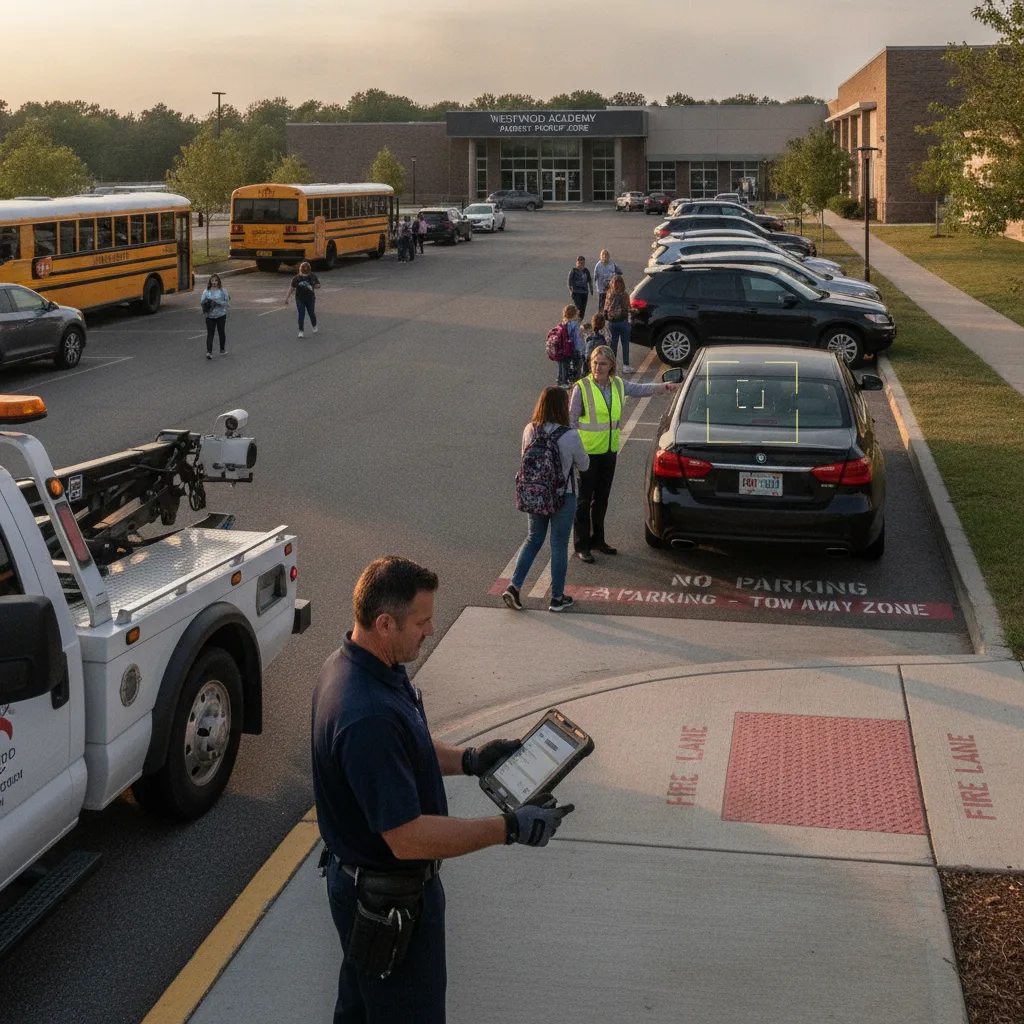
Short answer: Private-property towing companies capture better pre-tow evidence by documenting the violation, not just the vehicle — a wide shot showing the vehicle’s position relative to signage or the reserved space, a plate photo captured by mobile LPR with an automatic timestamp and GPS location, and a permit-lookup result showing what the system returned at that exact moment. A close-up of the plate alone proves a car was there; it doesn’t prove the car was in violation, which is the part that actually gets challenged in a dispute.
Most wrongful-tow disputes and chargebacks don’t come down to whether the vehicle was really parked there — that part is rarely in question. They come down to whether the company can show the violation itself, at the moment the tow decision was made, with evidence that holds up days or weeks later when someone disputes it.
What “evidence” needs to cover, beyond the plate
A plate scan tells you which vehicle it was. It doesn’t tell you why the tow was justified. Build the documentation habit around four separate things, captured every time:
1. The plate itself, with a verifiable timestamp and location
Mobile LPR handles this part well — the scan captures the plate image along with the time and GPS coordinates automatically, rather than relying on a driver to remember to note them separately. This becomes the anchor for everything else in the case file.
2. A wide shot proving the vehicle’s actual position
A plate close-up doesn’t show whether the vehicle was in a reserved spot, blocking a fire lane, or parked over a line. Get a second photo pulled back far enough to show the vehicle relative to the space, the curb marking, or the sign — the context that actually establishes the violation.
3. The signage or rule the vehicle violated
If the violation depends on posted signage (reserved parking, permit-only, no parking after a certain hour), photograph the relevant sign as part of the same case, not as an afterthought weeks later if someone disputes it. Signage condition and visibility are frequently the first thing challenged in a dispute, especially in states where towing statutes specify minimum signage requirements.
4. The permit or authorization check result, at that moment
A “no match” result from an hour before the tow isn’t the same as one at the moment of the tow. Capture the lookup result as part of the case record itself — what the system returned, when, and against which version of the permit list — rather than relying on a general claim that “we checked and it wasn’t permitted.”
Sequencing evidence capture so nothing gets skipped under pressure
Drivers are often working fast, sometimes with an angry vehicle owner walking up mid-hookup. A workflow that requires deliberate thought at every step will get shortcuts taken. Build a fixed, short sequence instead:
- Scan the plate first. This starts the case record and timestamps everything that follows.
- Take the wide shot before touching the vehicle. Once the truck is hooked up or the car has been moved, the original parked position is gone as evidence.
- Photograph the relevant signage, even if it feels redundant — it’s much easier to grab in the moment than to prove later that a sign was even there.
- Attach the permit-check result to the case automatically if your system supports it, rather than trusting a driver to remember to screenshot it separately.
A driver who runs this same four-step sequence on every tow, whether or not they expect a dispute, ends up with a defensible file on the cases that do get challenged — because there’s no way to know in advance which ones will be.
Handling the case where someone shows up mid-tow
If the vehicle owner arrives while the truck is hooking up, the priority shifts from more evidence to de-escalation and following your company’s documented release policy. Capture what you reasonably can (the situation as it stood before they arrived matters most), but don’t let evidence-gathering turn into an argument at the curb. Most disputes are resolved on paper afterward, not settled in the parking lot.
Storing and retaining the case file
Evidence that exists only on a driver’s personal phone is functionally not evidence — it needs to be attached to the case record in a system the office can retrieve without depending on that specific driver being reachable weeks later. Set a retention period long enough to cover your state’s typical dispute or claim window, and make sure photos, timestamps, and lookup results are stored together as one case, not scattered across separate systems.
FAQ
Is a plate photo enough to defend a tow if it’s disputed?
Rarely on its own. It proves identity, not violation. Pair it with a wide shot, signage documentation, and the permit-check result for a case that actually holds up.
Do state towing laws specify what evidence is required?
Requirements vary significantly by state and sometimes by municipality — some specify signage standards, notice periods, or documentation requirements directly. Confirm your specific state and local requirements independently rather than assuming a general standard applies everywhere you operate.
What’s the most common evidence gap that costs companies a dispute?
Missing or unclear signage documentation. It’s easy to skip in the moment because the driver already knows the rule, but it’s often the first thing a challenged case turns on.
For more on the scanning technology behind this, see our mobile LPR planning guide, and for how this fits into a full enforcement workflow, see our towing enforcement software guide and parking enforcement workflow guide. If you want to review your current evidence-capture process with us, get in touch.
Data source: U.S. Department of Transportation