

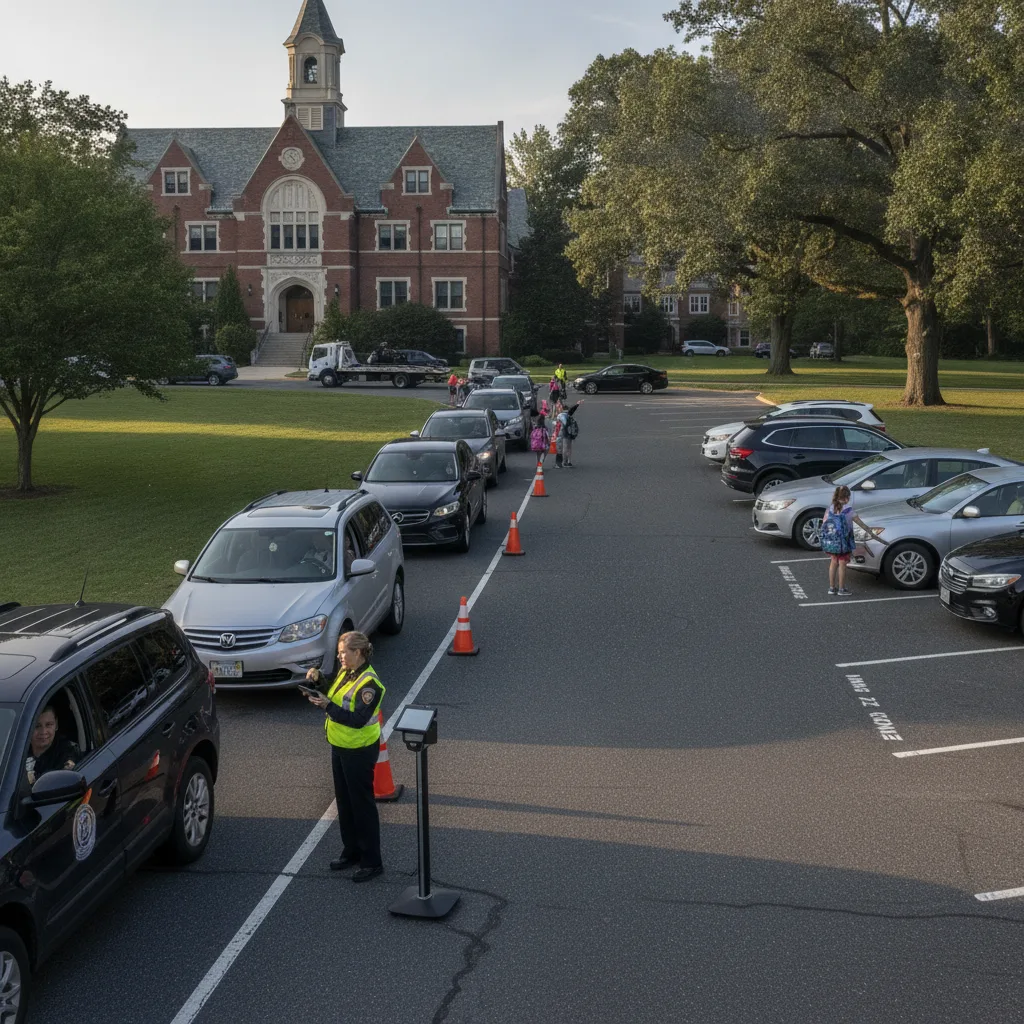
Direct answer: At a private school, a slow pickup line isn’t just an inconvenience — it’s the visible moment tuition-paying families judge the school’s polish against every other service they pay for. Shortening it means fewer minutes idling, not fewer standards: keep the same authorized-adult verification and custody controls, but move the friction earlier — students staged by division before the bell, a family’s car recognized and matched before it reaches the curb, one trained loader per car instead of a scramble. The line moves faster because less is being figured out in the thirty seconds a car is at the curb, not because anything got skipped.
This guide is for private-school leaders, dismissal teams, and admissions-adjacent staff who know that a chaotic carline shows up in parent satisfaction surveys and campus tour word-of-mouth just as much as academics do.
Why private-school pickup lines have their own bottleneck
Independent and parochial schools usually have a car-ownership rate near 100% — almost nobody is riding a bus — which means the entire dismissal load funnels through one curb instead of spreading across bus routes and a smaller car line. Add multiple divisions on one campus (lower school dismissing at 3:00, middle school at 3:10, upper school with a separate lot) and siblings who need to be coordinated across two release times, and the math gets harder than a single-building public school faces with the same enrollment.
Example: A family with a 2nd grader in the lower school and a 7th grader in the middle school wants both kids in one car. If the two divisions run separate, un-coordinated release times and separate loading staff, that family either waits twice or the office has to manually hold one sibling until the other is ready — multiplied across every multi-division family on the roster.
Private-school pickup flow
| Stage | What slows it down today | What actually fixes it |
|---|---|---|
| Student staging | Students still in aftercare, activities, or a different building when their car arrives | Stage by division and known car-arrival window, not a single all-school bell |
| Vehicle recognition at the curb | Loader has to check a paper tag or radio the office to confirm a car they don’t recognize | Match the car before it reaches the front of the line so the loader already knows who’s coming |
| Sibling coordination | Multi-division families held or split across two release times | One combined release record per family, shared across division offices |
| Handoff and close | Loader waits for a verbal confirmation from a supervisor on every car | Pre-cleared cars load on sight; only unmatched or flagged cars need a supervisor |
What a fast, still-safe line actually looks like
- Staging: Ten minutes before release, division staff confirm which students are ready at which door, so nobody is being tracked down while a car waits at the curb.
- Approach: As a family’s car turns onto the loop, the loader — or a vehicle recognition system feeding the loader’s tablet — already knows which student(s) that car is cleared for.
- Curb time: The loader calls the student(s) forward, confirms with a quick visual or badge check, and loads. No radio call, no flipping through a binder, unless something doesn’t match.
- Exception path: An unrecognized car, a late authorization change, or a sibling mismatch pulls off to a holding spot rather than stalling the whole line behind it.
The goal is that the only cars taking more than the standard curb time are the ones that genuinely need a second look — not every car, because every car requires the same manual lookup.
Where private schools can’t compromise
Custody restrictions, an unfamiliar driver, a student who isn’t at the door when called, or a medical situation all move to a staff member with authority to handle it — never resolved by a loader trying to keep the line moving. Families expect discretion here as much as speed: a custody issue or an unfamiliar pickup shouldn’t be handled in a way that’s visible or embarrassing to the family from the cars behind them.
Piloting the change without disrupting the whole campus
Run the new staging and vehicle-matching process in one division for two weeks before extending it campus-wide. Track:
- Average curb time per car, and how many cars exceed it
- Multi-division families still waiting on a sibling
- Cars requiring a manual lookup versus pre-matched
- Exceptions resolved away from the loading curb
- Parent-reported wait time versus measured wait time (these are often different, and the gap matters for how the change is perceived)
A private school’s placement office and admissions team often hear about carline frustration secondhand during tours or re-enrollment conversations — worth looping them in on what “better” should look like before you start measuring.
Before rolling this out school-wide
- Confirm the rule is the same across divisions even if the buildings and staff aren’t — families shouldn’t get a different experience at lower school than at upper school.
- Assign one owner for exceptions per release window, not a rotating volunteer who may not know the custody list.
- Test the least convenient case — a last-minute driver swap, a forgotten pickup tag — not just the smooth-day scenario.
- Confirm any vendor’s pricing, data handling, and integration claims independently before committing budget.
Placa.ai’s school pickup line LPR guide and visitor management walkthrough for school car lines both cover how vehicle matching plugs into this without adding a second system for staff to check.
Related PLACA.AI planning resources
Decision questions
What’s the first change a private school should make to shorten its pickup line?
Stage students by division and known arrival window before the bell, so the curb isn’t also serving as the moment a student is located.
How do multi-division families factor in?
Coordinate a single release record across the divisions a family touches, so siblings aren’t held twice or missed by one office’s separate list.
When should the rollout stop expanding?
Stop if a division’s exception owner is unclear, if custody or authorized-adult data is out of date, or if curb times are dropping for matched cars but rising for exceptions — that usually means the exception path itself needs work before scaling further.
Plan a limited workflow review
Bring the current rule, process, exceptions, and success criteria for shortening pickup lines at a private school. PLACA.AI can help evaluate a bounded pilot without assuming another property’s workflow is the right answer.
Editorial refresh: July 22, 2026. Independently confirm current product capabilities, third-party features, pricing, contracts, governing requirements, and local rules before acting.
Data source: National Center for Education Statistics