

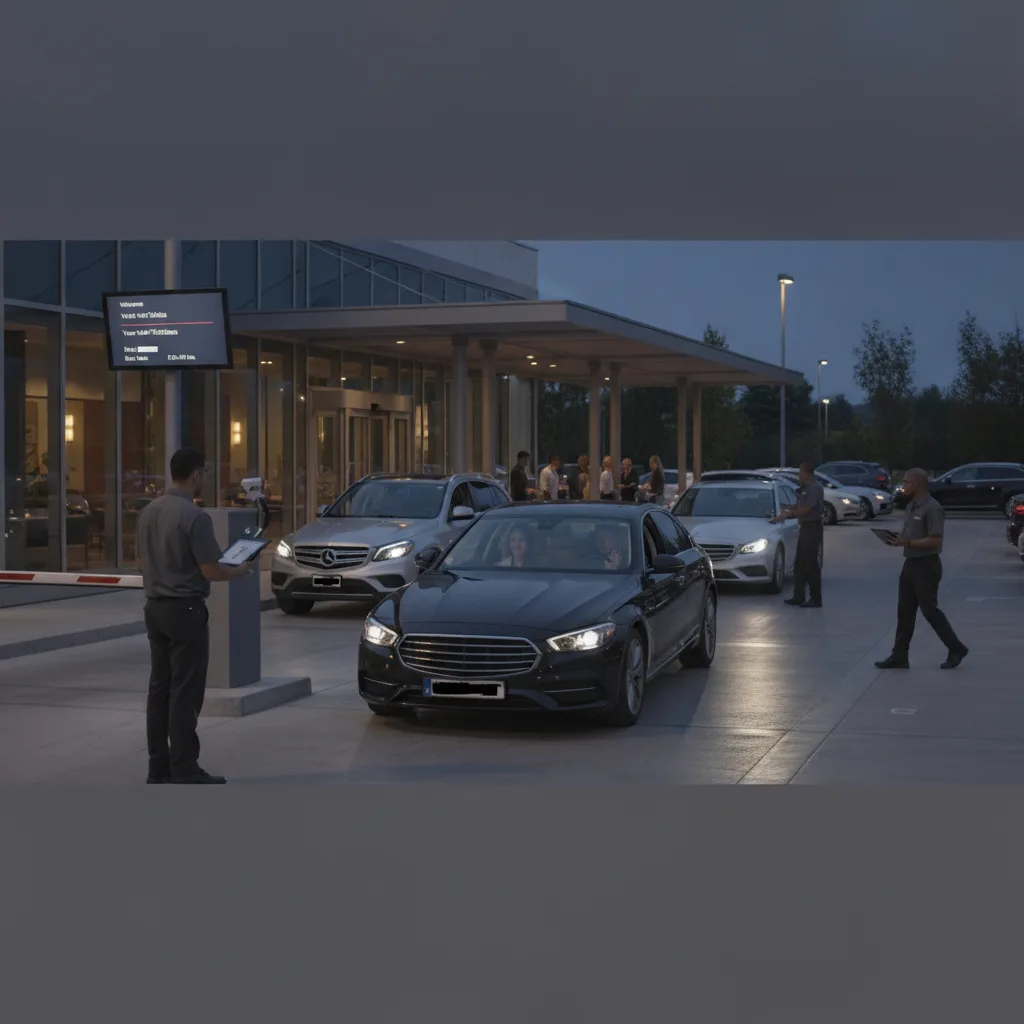
Direct answer: Restaurant valet wait-time complaints usually trace back to one thing: the curb outside a restaurant is small, shared with rideshare and delivery traffic, and guests expect their car within a couple of minutes of paying the check — not the 10-15 minutes a hotel guest might tolerate. Ticketless vehicle recognition helps by starting the retrieval the moment a guest signals they’re wrapping up (closing out the check, requesting via app or text) instead of only after they physically walk up to the valet stand, buying back the two or three minutes that make the difference between an acceptable wait and a complaint.
Why restaurant valet complaints are a curb-space problem first
Restaurant valet has none of the built-in slack that hotel or venue valet has. There’s usually one narrow curb cut, shared with rideshare pickups, delivery trucks, and sometimes street parking enforcement, and it can’t be widened. Dining parties don’t trickle out evenly either — a restaurant’s busiest exit window is compressed into the last 45 minutes of dinner service, when several tables close out around the same time. If the valet stand only starts looking for a car after the guest is standing at the podium, that guest is now watching a runner walk to a garage two blocks away while their rideshare-clogged curb makes the wait feel even longer than it is.
The highest-leverage fix isn’t more runners — most restaurant valet operations can’t add headcount to their margins — it’s shaving the dead time between “guest is about to leave” and “runner starts moving.”
Where the wait actually happens
The gap between check close-out and car request
Most complaints aren’t about how fast the car physically gets from the lot to the curb — they’re about the total time from “we’re ready to go” to “car is here.” If the valet team only learns a guest wants their car when that guest walks outside, the whole retrieval clock starts late. Letting guests request via a text link or app at the point they ask for the check, rather than requiring a walk-up request, moves the start of that clock earlier.
Off-site or overflow parking
Many restaurant valet operations don’t park on-site — they use a nearby lot, a garage down the block, or overflow spaces a few minutes’ walk or drive away. That travel time is largely fixed, so the only lever is how much of it happens before the guest is standing at the curb watching the clock. A clear vehicle location lookup lets the runner leave immediately instead of spending the first 30-60 seconds figuring out where the car actually is.
Curb contention with rideshare and delivery
Even a fast retrieval can look slow if the runner can’t get the car to the curb because a rideshare pickup or a food delivery double-park is blocking the valet zone. This isn’t solved by the recognition system alone, but knowing exactly when a vehicle will arrive lets staff proactively hold or clear the curb spot rather than discovering the conflict when the car is already idling around the block.
No update during a longer-than-usual wait
A three-minute wait with no communication reads as slower than a five-minute wait with a staff member who says “your car’s two minutes out.” Restaurant guests, especially on a tight schedule before a show or another reservation, complain more about being ignored than about the wait itself.
A practical plan for dinner service
- Let guests signal “wrapping up” before they reach the podium. A text-to-request or app option tied to the table lets retrieval start while the check is being paid, not after.
- Stage runners against the reservation book, not just walk-up volume. If you know four tables have an 8:30 reservation elsewhere, expect a retrieval cluster around 8:15 and staff accordingly.
- Keep a live view of what’s blocking the curb. Coordinate with the host stand or door staff so a returning vehicle isn’t stuck waiting behind a rideshare pickup that could have been waved off two minutes earlier.
- Give front-of-house a wait estimate they can actually share. A host who can tell a guest “about three minutes” because the system shows the runner already en route reduces complaints even when the wait itself doesn’t change.
- Review complaint patterns by night and hour, not in aggregate. Friday 8-9pm and a slow Tuesday shouldn’t be judged by the same benchmark — most restaurants have one or two predictable crunch windows worth solving specifically.
What to measure
- Time from request signal to vehicle at the curb, tracked separately for the peak closing window versus the rest of service.
- Guest-facing wait vs. actual retrieval time — if guests routinely feel the wait is longer than the timestamps show, the problem is communication, not speed.
- Curb-blocked incidents where a retrieved vehicle had to wait for space, separate from retrieval delay itself.
FAQ
Does this help if we don’t have on-site parking?
Yes — off-site parking is where the time savings matter most, since a runner who already knows the exact spot can leave the second the request comes in instead of losing time locating the car first.
How do we handle guests who don’t want to use an app?
Walk-up requests still work the same as always; app or text requests are an additional channel that starts the clock earlier for guests who use them, not a replacement for staff-taken requests.
What’s the fastest fix if we can’t change our curb layout?
Start retrieval earlier in the guest’s dining timeline and keep front-of-house staff able to give an accurate wait estimate — both reduce complaints without touching the physical curb.
For more on ticketless valet setups for restaurants, see the valet parking knowledge hub, the ticketless valet system overview, and valet parking software for restaurants.
Want fewer wait-time complaints during your peak closing window? Book a demo and see how the request-to-curb time can be shortened on your setup.
Data source: U.S. Department of Transportation