

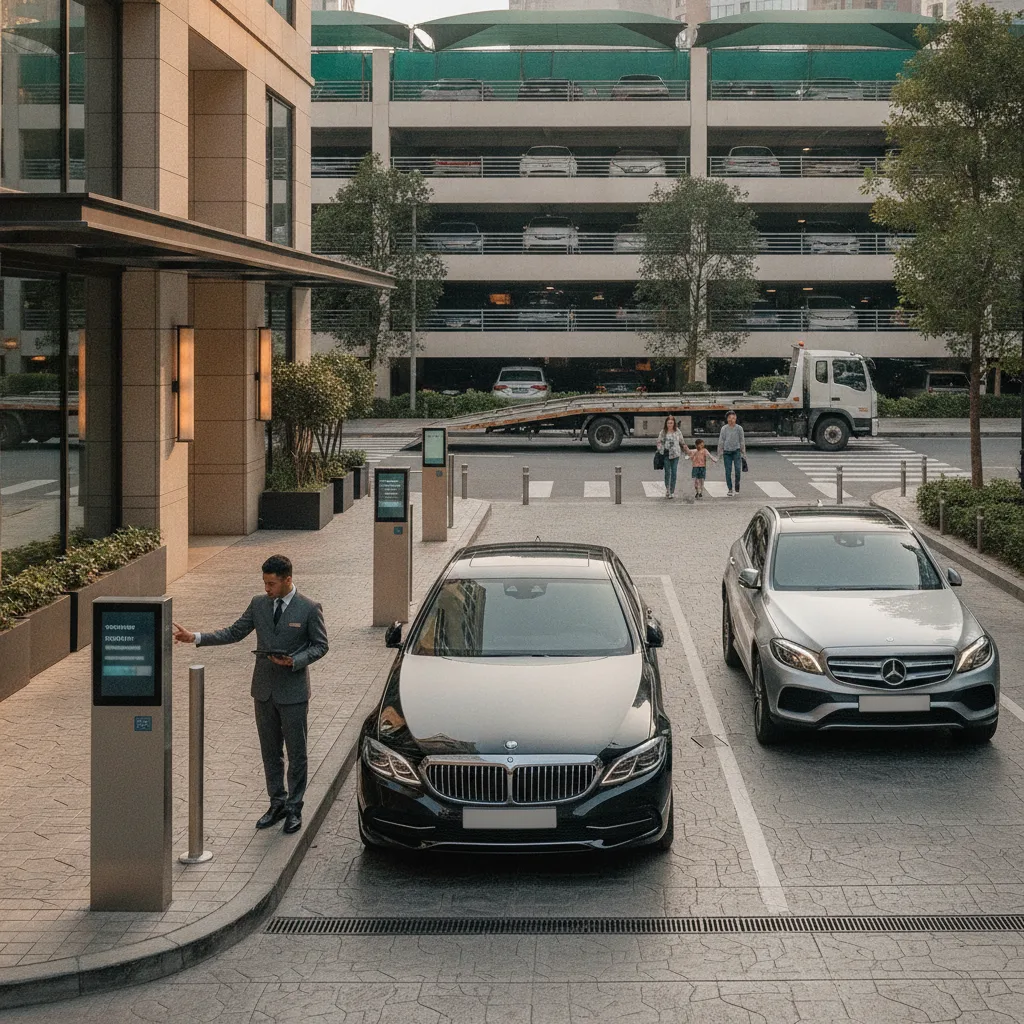
Short answer: Restaurant valet operators speed up vehicle retrieval by getting advance notice of a departure before the guest reaches the door — from the host stand, a check-closed signal, or a simple “getting my car” heads-up — so a runner is already moving before the guest is standing at the curb waiting. The biggest retrieval-speed gains come from earlier notice, not faster running.
On a busy dinner shift, vehicle retrieval speed is really about two separate things people tend to lump together: how fast a runner can physically get to a car and bring it back, and how much advance warning that runner had before the request came in. Most restaurants have already optimized the first one — experienced runners know the lot. The bigger, cheaper win is almost always the second.
The problem isn’t the sprint, it’s the start time
A runner who gets a request the moment a guest walks up to the valet stand is starting from zero, even if they’re fast. A runner who gets a heads-up two or three minutes earlier — because the host saw the table close out, or the guest mentioned “we’re about ready” on the way out — can have the car staged at the curb before the guest even arrives. That gap, multiplied across a full dinner service, is where most of the perceived wait time comes from.
Illustrative example: if a typical retrieval takes four minutes door-to-curb, a guest who gives no advance notice waits close to the full four minutes. A guest whose departure was flagged two minutes earlier by the host stand might only wait two.
Build a simple departure signal into service, not just valet
The fix doesn’t require new technology at the front of house — it requires a habit. A few ways restaurants create this signal without disrupting service:
- Host-to-valet heads-up. When the host sees a table ask for the check or stand up from the table, a quick radio call or app notification to valet starts the clock early.
- Payment-stage cue. If checks are closed out at the table, that moment is often the single best predictor of a departure request in the next several minutes.
- Guest-initiated notice. A simple “let us know when you’re ready and we’ll have it waiting” trained into the closing interaction, rather than waiting for the guest to walk up cold.
None of these need to be perfect predictors — even a rough two-minute head start on most departures meaningfully reduces the wait the guest actually experiences at the curb.
Stage cars for groups instead of dispatching all at once
When a large party is leaving together, the instinct is to send every available runner at once. That often backfires — multiple runners converging on the same section of the lot, or too many cars arriving at the curb simultaneously with nowhere to stage them. A better approach for group departures:
- Get a rough headcount and confirm whether everyone’s leaving together or staggered.
- Sequence retrieval so the first car or two is ready at the curb while the next is being pulled, rather than pulling all vehicles simultaneously into a curb with no room for them.
- Assign one runner to coordinate the staging order if more than two or three vehicles are involved, so cars aren’t queuing up blocking each other.
Know which vehicle you’re retrieving before the guest describes it
A meaningful chunk of retrieval delay on a busy night isn’t the walk to the car — it’s confirming which car belongs to which guest, especially when a runner didn’t personally park that vehicle earlier in the shift. If arrivals are recorded by plate at drop-off, a runner can look up the exact vehicle and location the moment a request comes in, instead of asking the guest to describe their car and then searching the lot. This matters most during a shift change or when the runner retrieving the car isn’t the one who parked it hours earlier.
What actually slows retrieval down
- No advance signal. Every request starting from zero notice.
- Poorly organized parking. Vehicles parked without a logical retrieval order relative to likely departure timing.
- Curb congestion. No staging space for a car that’s ready, so it sits blocking the lane while waiting for the guest.
- Unclear vehicle identification. A runner spending time confirming which car belongs to which guest instead of already knowing.
Most restaurants find that fixing the first and last items on this list — earlier signal, faster identification — produces a bigger improvement than adding staff.
A worked example
A Friday night with back-to-back reservations means the valet stand rarely has an idle moment. The host stand starts flagging tables as they close out checks, giving valet a rough two-to-three minute window before most departures. Combined with a plate-based lookup that tells the runner exactly where a specific guest’s car is parked without needing a description, the runner is often staged at the curb by the time the guest walks out — turning what used to be a four-minute wait into something closer to a walk-up handoff.
FAQ
Do we need to change our POS system to get a departure signal?
No — a simple verbal or radio cue from the host stand when a check closes out is enough to start; formal POS integration is a later optimization, not a prerequisite.
How do we avoid annoying guests by asking when they’re leaving?
Frame it as a convenience during the closing interaction (“we’ll have your car ready when you are”) rather than a direct question — most guests appreciate the offer.
What’s the single highest-impact change for a restaurant that wants faster retrieval?
Getting even a rough advance signal of departure timing from the host stand or closing interaction — it consistently produces a bigger improvement than adding another runner.
See PLACA’s valet parking software for restaurants, the ticketless vehicle recognition system overview, and the valet parking knowledge hub for more on speeding up retrieval without adding headcount.
Want to see how plate-based lookup fits into a busy dinner service? Contact PLACA or book a demo.
Data source: U.S. Department of Transportation