

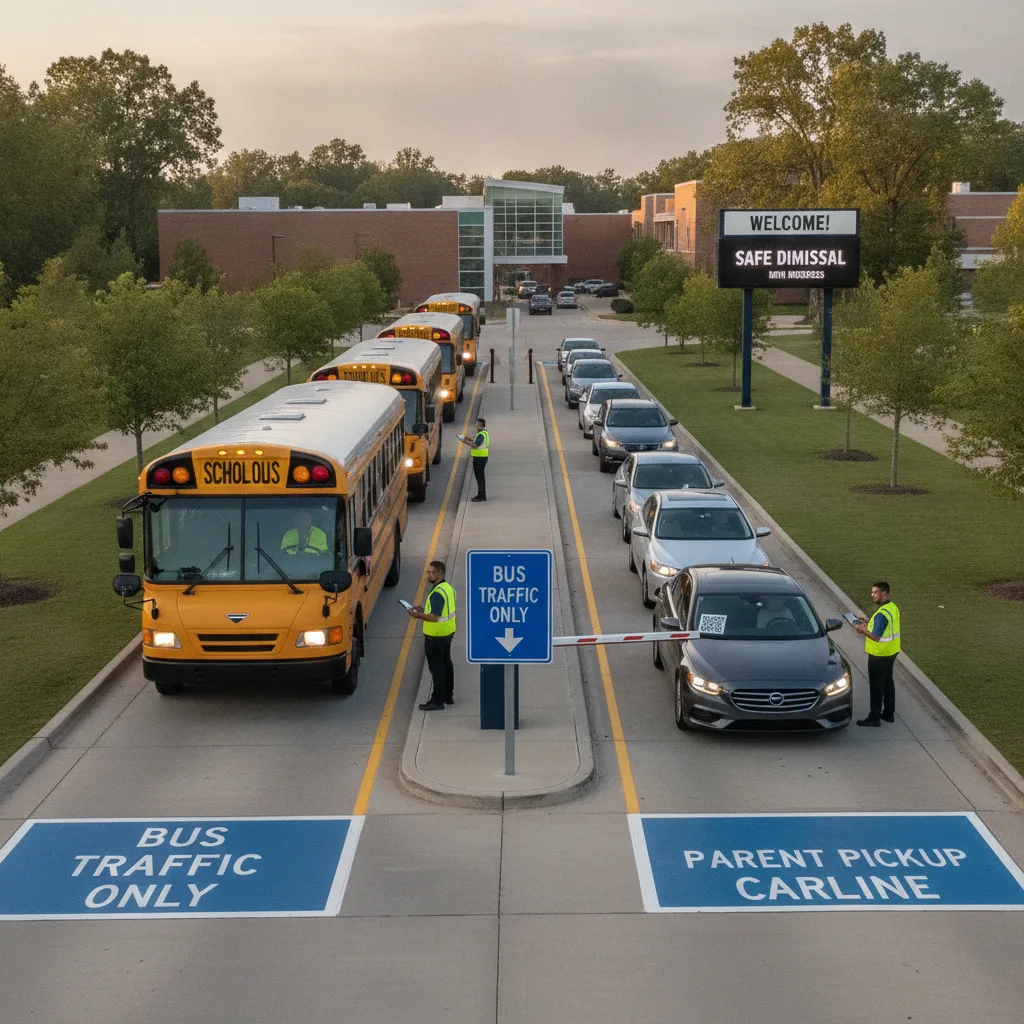
How School Transportation Directors Can Separate Bus And Carline Traffic With Better Vehicle-Based Workflows
Direct answer: Separating bus and carline traffic is a sequencing and geometry problem before it’s a technology problem. Buses need a loading zone with no parent-vehicle crossing traffic, a release order that gets them out before or after the carline peak (never during it), and drivers — including substitutes who don’t know your lot — who can read the traffic plan in under a minute. Vehicle-based workflows help once the physical plan is right: they confirm which staff and district vehicles belong in the bus lane, flag a car that’s drifted into it, and give you a timestamped record when a near-miss happens.
Key Takeaways
- Fix the loading-zone geometry and release sequence first; software can’t compensate for a bus lane that parent cars can physically cut through.
- Build the plan around your worst day — a late bus, a sub driver, a fire drill running into dismissal — not your best one.
- Use vehicle recognition to confirm which vehicles belong in the bus zone and to document incursions, not to replace radio coordination with drivers.
- Track on-time bus departure, lane incursions, and driver confusion incidents as your core metrics — not just total dismissal time.
Why bus and carline traffic collide in the first place
On most campuses, buses and parent cars weren’t given separate infrastructure — they were given separate paint. A single access road often feeds both a bus loop and a car loop, and the point where they merge or cross is where the real risk sits. It gets worse at the transitions: the five minutes when buses are pulling in while the first parent cars are already staging, or the moment a late bus has to load after the carline has already started moving and now needs to cross it to exit.
Example: A campus runs bus dismissal at 3:05 and carline release at 3:10. On a normal day the five-minute gap is enough. On a day with a delayed bus (mechanical issue, traffic, a sub driver who doesn’t know the lot), that bus is still loading when the first carline vehicles start moving — and now a 40-foot bus is trying to merge into a lane full of cars that have no reason to expect it.
Building the separation plan
| Question | Why it matters | Useful metric |
|---|---|---|
| Do buses have a loading zone with zero parent-vehicle crossing traffic? | Most incursions happen at merge or crossing points, not in the middle of a dedicated lane. | Documented lane incursions per week |
| What’s the release order, and what happens when it breaks? | A late bus that has to load after carline has started is your highest-risk scenario. | On-time bus departure rate |
| Can a substitute driver understand the plan without a staff escort? | Regular drivers learn the lot by repetition; subs don’t have that context on day one. | Sub-driver incidents or wrong-lane loading |
| Which vehicles are authorized in the bus zone besides buses? | Maintenance trucks, district vehicles, and staff cars in the bus lane create the same conflict as a parent car. | Unauthorized vehicles flagged in the zone |
What a workable rollout looks like
Start with the transition points, not the whole lot. Walk the loading zone at the exact minute buses and cars overlap and mark where a driver would have to guess. Put that in writing as a one-page diagram — not a policy memo — that a substitute driver can read in the seat before their first run. Pair it with a radio or app-based signal so a delayed bus can tell the carline team to hold release for two minutes instead of both traffic streams converging blind.
Vehicle recognition earns its place here as a documentation and verification layer, not a traffic cop. A camera on the bus-zone approach can confirm that the vehicles entering are actually buses and authorized district vehicles, and log the timestamp and plate whenever something else — a parent car, a rideshare, a delivery van — enters that zone. That gives you an actual incident count instead of driver anecdotes when you’re deciding whether the geometry needs to change. Compare that against your school pickup line LPR deployment on the carline side, since the two zones usually share an entrance road even when their internal traffic doesn’t cross.
Coordinating with the people who aren’t looking at a dashboard
Bus drivers, especially substitutes pulled in with a few hours’ notice, need the plan communicated in a format they’ll actually use — a laminated card clipped near the mirror, not a district policy PDF they saw once in onboarding. If your district uses a sub-dispatch system, attach the campus-specific loading diagram to the assignment itself so it travels with the driver rather than living in a binder in the transportation office. Placa.ai’s writeup on a bus app failure during dismissal covers the related problem of what your loading plan needs to fall back to when the tracking app itself goes down — worth reviewing alongside this, since a sub driver with no app and no paper backup is the exact scenario that produces a lane incursion.
Measuring whether the separation is actually working
- On-time bus departure rate, broken out by whether a sub was driving that route
- Number of documented incursions into the bus zone by non-bus vehicles
- Minutes of overlap between bus loading and carline release on a normal day versus a delayed day
- Driver-reported confusion or near-misses at the merge/crossing point
- Time from “bus running late” notification to carline hold signal reaching the curb team
Run this for at least two full weeks that include one irregular day — a delayed bus, a sub driver, a weather delay — since the normal-day numbers rarely reveal where the plan actually breaks.
Where the exception path has to be explicit
Emergency vehicle access, a bus mechanical failure mid-route, a fire drill that runs into dismissal, or a driver who genuinely doesn’t know the lot all need a documented fallback that doesn’t depend on the regular sequence holding. Write down who has authority to hold carline release, how that instruction reaches the curb team, and how long a hold can run before it needs an administrator’s sign-off.
Internal Resources
Related Resources
For a deeper commercial overview, see Placa.ai’s student pickup / school dismissal solution. Transportation teams may also want to review related dismissal automation workflows and compare them with supporting use cases.
Field Questions Transportation Directors Ask
What should we fix first — the schedule or the physical lane separation?
The physical separation, if you have to pick one. A well-timed schedule still fails on the day a bus runs late, and that’s exactly when a shared lane becomes dangerous. Fix the geometry so a delayed bus has somewhere to go that doesn’t cross active carline traffic, then tune the schedule around it.
How do we handle substitute bus drivers who don’t know the lot?
Give them a one-page diagram of the loading zone and the transition points, attached to the route assignment itself rather than buried in a district handbook. A five-minute walkthrough with a staff member before their first run catches most of the confusion that otherwise shows up mid-dismissal.
What counts as a real incursion versus a minor one?
Any non-bus vehicle entering the active bus loading zone while a bus is loading or unloading counts, even if nothing happens. Logging every instance — not just the close calls — is what lets you tell whether a redesign is actually needed or whether it was a one-off.
Where does vehicle recognition actually help in this workflow?
It confirms which vehicles entering the bus zone are authorized (buses, maintenance, district vehicles) and creates a timestamped record when something else enters. That record is what turns “drivers say this happens a lot” into a number you can act on.
How should we coordinate a hold between the bus loop and carline when a bus is delayed?
Name who has authority to call the hold, how that instruction reaches the carline curb team (radio, app signal, or a visual cue like a cone), and a maximum hold time before an administrator gets pulled in. Test it with an actual delayed bus, not a drill.
What data should we track month over month?
On-time bus departure rate, documented lane incursions, and confusion incidents involving substitute drivers. Those three tell you whether the separation plan is holding up as staffing and weather change, better than total dismissal time alone.
Plan Your School Pickup Line Automation Rollout
If your team is evaluating how to separate bus and carline traffic, Placa.ai can help map the loading-zone plan, vehicle data, and operating workflow before you roll it out.
Data source: National Center for Education Statistics