

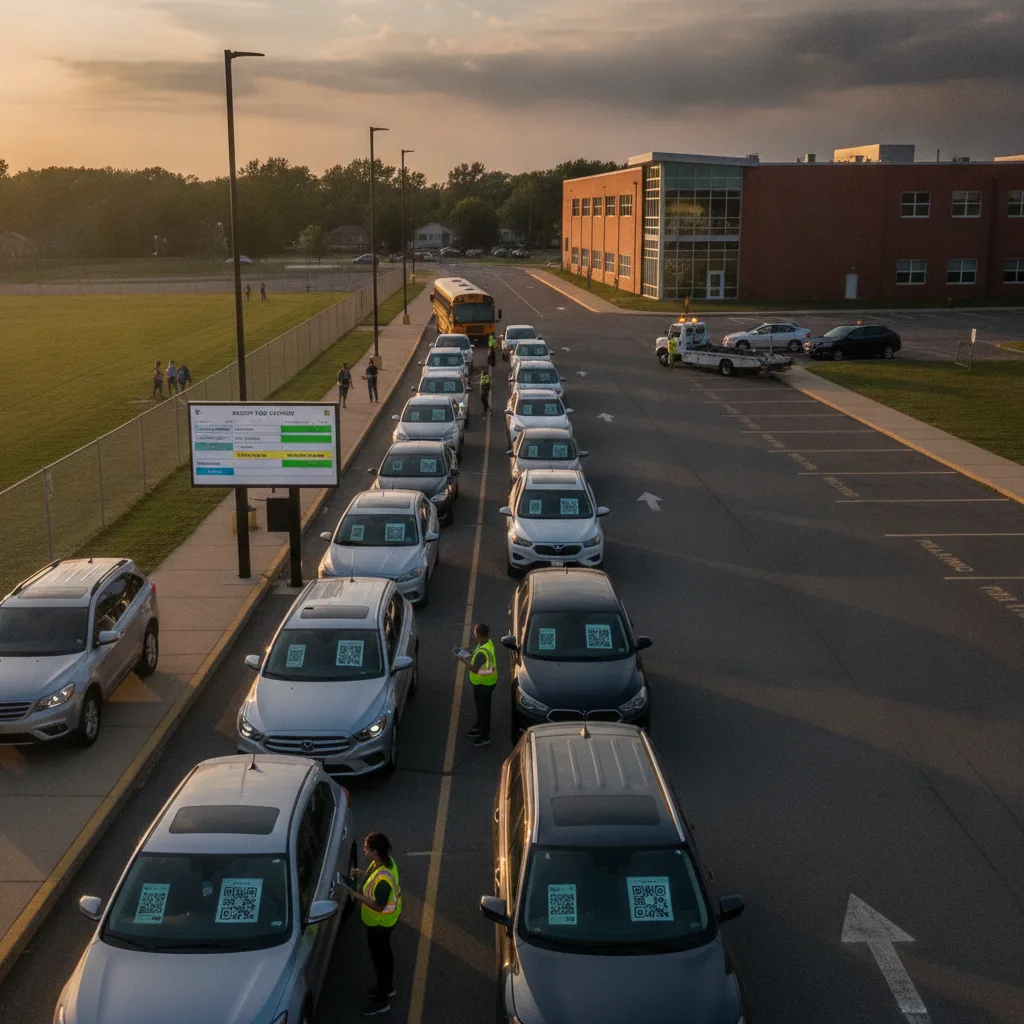
Direct answer: For transportation directors, a slow carline is usually a throughput problem, not a total-time problem: how many vehicles per minute can move through the loading zone once they’re staged, verified, and matched to a waiting student. Fix that rate — not just the overall dismissal window — by measuring each stage separately (student staging, vehicle arrival, verification, physical loading), staffing to the stage that’s actually constrained, and keeping the improvement from coming at the cost of identity or safety checks. A campus that shaves two minutes off average time by skipping verification on familiar-looking cars hasn’t fixed the line; it’s created a liability problem that hasn’t shown up yet.
This guide is for school transportation directors who own the loading-zone operation, coordinate staff positioning at the curb, and answer for both the safety and the speed of dismissal.
Where the time actually goes
Total dismissal time is a poor diagnostic on its own because it hides which stage is the actual constraint. A campus might have fast vehicle throughput but slow student staging — kids not at the curb-ready point when their car arrives — which looks identical to a slow loading zone from a parent’s seat in a fifteen-car line, but requires a completely different fix.
Example: If vehicles are being identified and verified quickly, but students are arriving at the curb in uneven, unpredictable groups because classrooms release on a general bell instead of a staggered signal, the bottleneck is staging — not the loading zone, and not the technology at the curb.
Transportation pickup-stage dashboard
| Stage | How to isolate it | Typical fix if it’s the constraint |
|---|---|---|
| Student staging | Timestamp when a student reaches the curb-ready point versus when their car arrives | Staggered classroom release tied to typical car-arrival order, not one bell for everyone |
| Vehicle arrival and lane assignment | Timestamp when a car enters the loop versus when it reaches the active loading position | Second staging lane so cars aren’t queued single-file waiting for the curb to clear |
| Verification | Time between a car reaching the curb and the loader confirming the correct student | Vehicle matched before arrival so the loader isn’t doing a manual lookup at the curb |
| Loading and release | Time from confirmed match to the car pulling away | Consistent loader positioning and a clear “go” signal instead of an informal wave |
Staffing to the actual constraint
- Time each stage separately for a week before changing anything — most campuses are staffed based on tradition, not on where the current delay actually sits.
- Move staff to the constrained stage, even if that means fewer loaders at the curb and more staff on staging inside the building.
- Fix one stage at a time and re-measure, so you know which change actually moved the number rather than crediting an unrelated day-to-day fluctuation.
- Re-test after the fix holds for at least a week, including one irregular day, before declaring the constraint resolved and moving attention elsewhere.
Where speed can’t come at the cost of safety
An unrecognized vehicle, a late transportation-mode change, a custody flag, or a student who isn’t at the curb-ready point all need to leave the standard flow rather than being pushed through to protect the average time. If your data shows time improving alongside fewer flagged exceptions, verify that exceptions are actually decreasing — not just going unreported by staff under pressure to keep cars moving.
Baseline and test
- Students at the curb-ready point before their car arrives, by stage
- Vehicles per minute through the loading zone at peak
- Time from car-at-curb to confirmed match
- Cars requiring a manual lookup versus pre-matched on arrival
- Unresolved handoffs remaining at the close of dismissal
Run the test for at least two weeks including one weather day and one day with a known staffing gap — those are when a staged process either holds up or reveals it depends on a specific person being present.
What to verify before scaling a fix district-wide
- Confirm the constraint you’re fixing is the same at every campus you plan to roll the change out to — a fix for a staging bottleneck won’t help a campus whose constraint is loading-zone throughput.
- Assign a stage owner for each of the four measured stages, not one generalist responsible for the whole line.
- Test with real conditions — a full car count, not a light day — before publishing a new expected time to families.
- Independently confirm any vendor’s throughput or accuracy claims for vehicle matching before relying on them for staffing decisions.
Vehicle matching that confirms a car before it reaches the curb — covered in placa.ai’s school pickup line LPR guide — moves work out of the verification stage specifically, which is where a lot of transportation teams find their real constraint once they start timing stages separately instead of just the total.
Related PLACA.AI planning resources
Frequently asked questions
What should transportation directors measure first?
Time each of the four stages — staging, arrival, verification, loading — separately for at least a week before changing staffing or process. The total time alone doesn’t tell you which stage to fix.
What’s the most common hidden constraint?
Student staging. Teams often assume the loading zone is the bottleneck and add curb staff, when the real delay is students not being ready when their car arrives.
When should rollout of a fix stop expanding to other campuses?
When the receiving campus’s constraint doesn’t match the one the fix was designed for, when a stage owner can’t be named, or when the time improvement can’t be reproduced without an unusual level of staffing that isn’t sustainable district-wide.
Plan a limited workflow review
Bring the current rule, process, exceptions, and success criteria for shortening pickup lines through school transportation leadership. PLACA.AI can help evaluate a bounded pilot without assuming another property’s workflow is the right answer.
Editorial refresh: July 22, 2026. Independently confirm current product capabilities, third-party features, pricing, contracts, governing requirements, and local rules before acting.
Data source: National Center for Education Statistics