

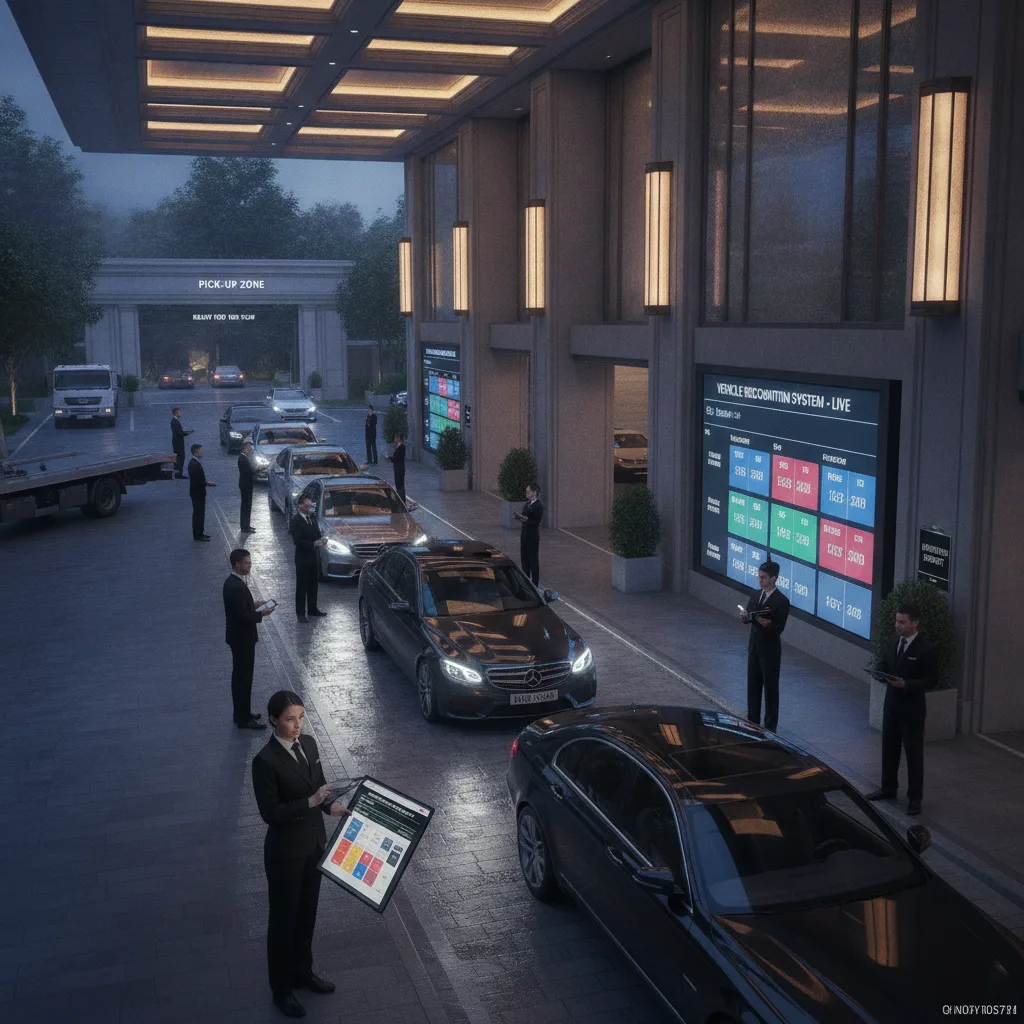
Short answer: Venue staffing is an on/off problem, not a steady-state one — you need to go from a skeleton crew to full event capacity and back down again within a single evening, and the shape of that surge is different for every event on your calendar. The most reliable approach is to build your staffing plan from the event’s actual timeline (doors, program length, expected exit pattern) rather than a generic “busy night” headcount, and to have a clear trigger for scaling up mid-event when arrivals or departures run ahead of plan.
Why venue staffing is different from hospitality valet staffing
A hotel or restaurant deals with steady, if uneven, traffic spread across hours or days. A venue deals with a single, sharp surge: doors open, thousands of vehicles arrive within a defined window, the event runs, and then most of that same volume tries to leave within thirty to sixty minutes of the final buzzer, encore, or closing session. That means your staffing plan has to scale dramatically for a short period and then scale back down just as fast — there’s no “average” traffic level to staff toward, only a predictable spike shaped by that specific event.
No two events surge the same way. A concert’s departure is nearly simultaneous — everyone leaves within minutes of the final song. A multi-session conference has staggered breaks throughout the day. A sporting event’s departure curve depends heavily on the score — a blowout empties the building early, a close game holds the crowd until the final minute. Your staffing plan needs to account for which kind of event you’re running, not apply the same template to all of them.
Building a staffing plan from the event timeline
Start with doors, not headcount
Work backward from the actual schedule: door time, expected program length, and historical exit pattern for that type of event. A staffing plan built around “we need 20 people on a busy night” misses that those 20 people need to be concentrated very differently for a hockey game than for a trade show.
Separate arrival and departure crews where volume allows
Arrival traffic tends to spread over a longer window than departure traffic, especially for ticketed events with staggered entry times. If your team size allows it, plan for a smaller, steadier arrival crew and a larger, concentrated departure crew, rather than splitting the same headcount evenly across both.
Plan for the exit surge specifically
Departure is almost always the harder staffing problem — more vehicles requested in less time, less daylight, and a crowd that’s tired and ready to leave immediately. Build in extra retrieval and traffic-direction staff specifically for the last 30–45 minutes of the event, even if arrival staffing was lighter.
Setting triggers to scale mid-event
Even a good forecast can be wrong — a game runs into overtime, an opening act runs long, a concert lets out early. Rather than relying on a supervisor to notice the queue is building, set explicit, written triggers: a queue length that calls in overflow staff, a curb occupancy threshold that opens an additional retrieval lane, or a specific point in the event program (start of the final period, house lights up) that signals it’s time to move staff from arrival roles to departure roles. Triggers work better than judgment calls because they don’t depend on one person catching the shift in real time while also managing traffic.
Coordinating staffing across departments
Venue parking staffing rarely operates in isolation — it needs to sync with security’s crowd control plan, box office door times, and sometimes the promoter’s own event-day requirements. A departure surge that isn’t coordinated with security’s egress plan can create a bottleneck where parking is ready to move cars but the crowd flow out of the building is the actual constraint. Share your staffing trigger points with your security and operations counterparts ahead of each event, not just internally within the parking team.
Using temp or event-staffing agencies effectively
Many venues supplement a core parking team with event-day staff from a labor agency, since full-time headcount for peak capacity doesn’t make sense for a building that isn’t always at capacity. The key operational risk here is training consistency — temp staff who’ve never worked your specific gate layout or traffic pattern before are more likely to create bottlenecks under pressure. Build a short, repeatable orientation (gate assignments, retrieval process, who to radio for a floater) that any agency staff member can run through in ten minutes before doors, and keep a record of which agency staff have worked your venue before so you can request them again for future events.
Practical steps for your next event
- Build a staffing plan specific to the event type — concert, sporting event, conference — rather than one generic “busy night” template.
- Concentrate extra staff on the departure window specifically, since exit surges are almost always harder to manage than arrivals.
- Set written triggers for calling in overflow staff or opening additional lanes, rather than relying on a supervisor’s judgment in the moment.
- Coordinate your staffing and trigger plan with security and event operations before the event, not during it.
- Build a fast, repeatable orientation for temp or agency staff working an unfamiliar gate layout.
Frequently asked questions
How far in advance should we finalize event staffing levels?
Set your baseline plan once the event schedule and expected attendance are confirmed, then adjust in the final days based on ticket sales, weather, or any changes to doors and program timing.
Should arrival and departure staffing always be equal?
Not necessarily — departure surges are typically more concentrated and harder to manage, so many venues weight staffing more heavily toward the exit window even if arrivals ran with a lighter crew.
How do we know if our staffing plan actually worked after an event?
Track how often overflow triggers were used, how long queues ran past your target wait time, and where staff felt short-handed, then adjust the plan for the next similar event rather than treating every event as a one-off.
PLACA.AI’s valet parking software for venues gives your team real-time visibility into vehicle volume and queue status during an event, and the valet parking knowledge hub has more on planning staffing around event surges. To talk through your venue’s specific event calendar, get in touch and we’ll walk through it.
Data source: U.S. Department of Transportation