

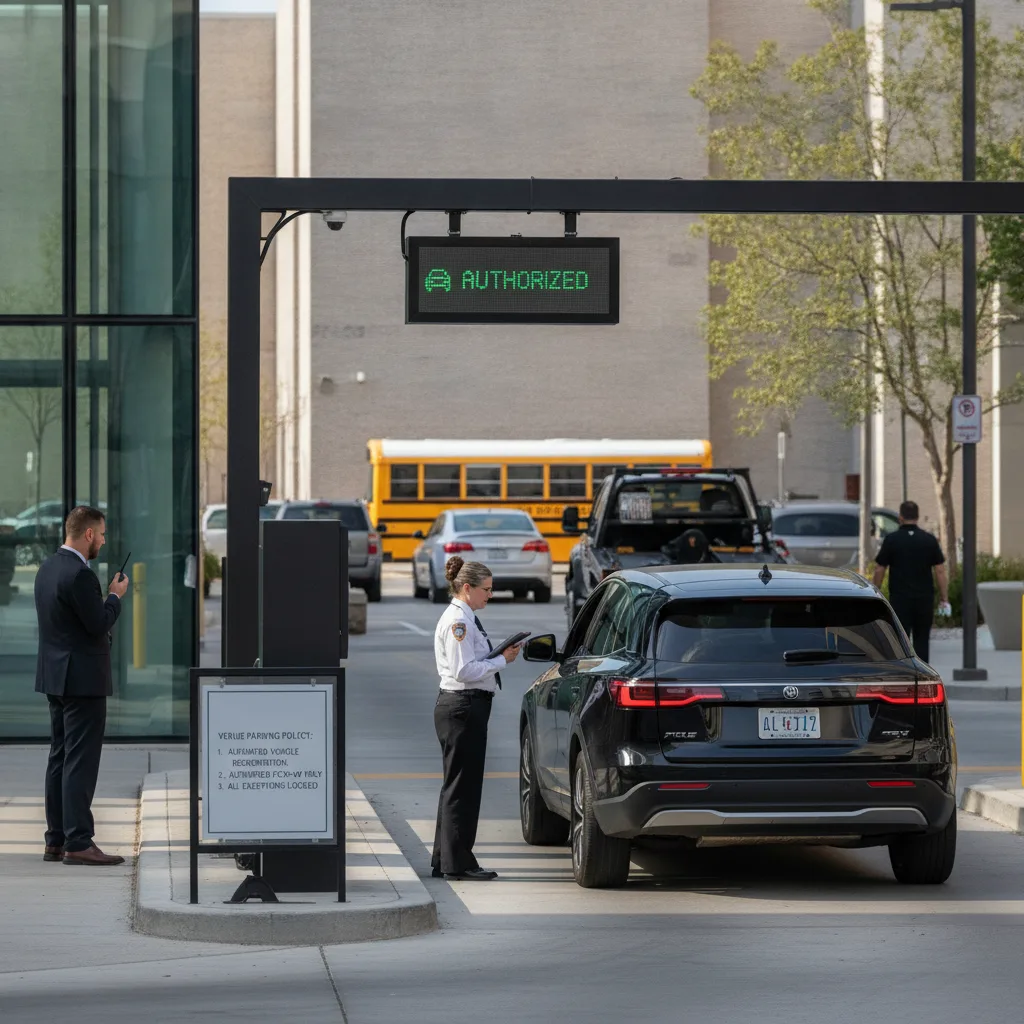
Short answer: Venue liability questions are shaped by scale and compression — thousands of vehicles moving through a lot or garage in a two- or three-hour window around a single event, often with a mix of self-park, valet, ADA, and VIP lanes running at once. The way to handle liability questions at that scale is a vehicle-level record that survives the surge: who parked where, when, and under whose direction, so that when a claim comes in Monday morning you’re not relying on an usher’s memory of a sold-out Saturday night.
Why venue liability is a scale problem, not a custody problem
Hotels and restaurants deal with liability questions one car at a time, spread across a shift. A venue handling a concert, game, or convention session compresses that same volume of traffic — sometimes several thousand vehicles — into arrival and departure windows measured in minutes. That compression changes what actually causes claims: not long custody periods, but high-density movement, lane changes made on the fly by staff directing traffic, and vehicles parked by whoever’s closest rather than a dedicated attendant.
Venues also mix parking types in ways hotels and restaurants don’t. A single event might run general self-park, a premium valet lane for suite holders, an ADA section with its own access rules, and a rideshare/pedestrian zone all inside the same footprint — each with a different liability profile and, often, a different staffing team.
Where venue parking liability claims come from
Surge-directed parking
During ingress, staff sometimes direct vehicles into rows or lanes that weren’t the vehicle’s assigned or “official” spot, just to keep traffic moving. That’s a reasonable operational call, but it makes “where exactly was my car parked” harder to answer after the fact unless the actual location gets logged, not just the intended one.
Mixed self-park and valet exposure
When a venue runs valet for premium ticket holders alongside general self-park, liability questions often start with confusion about which category a given vehicle falls into. A clear plate-level record of whether a vehicle was valeted or self-parked resolves that immediately instead of leaving it to a dispute over ticket tier.
ADA and accessible parking access
Accessible parking sections carry their own compliance and liability considerations, and disputes here often involve both a parking claim and an accessibility complaint. Clean, timestamped records of who accessed ADA spaces and when support both the operational response and any compliance review.
Post-event egress incidents
The rush to exit after a game or show ends is when fender-benders and pedestrian near-misses are most likely, simply because everyone is leaving at once. Vehicle-level records that show timing and location during egress help reconstruct what happened without relying on which staff member happened to be standing nearby.
Third-party operator contracts
Many venues contract parking and valet operations to a specialized operator rather than running it in-house, sometimes with a different vendor for valet, general lot management, and event-day traffic control. When a claim arrives, sorting out which vendor’s insurance applies starts with knowing which vendor actually had the vehicle or was directing that lane at the time.
Building a record that works at event scale
- Automated plate capture at entry. Recognition at the gate or lane logs every vehicle without requiring a staff member to hand-write or scan a ticket during a surge, which is where paper-based systems break down first.
- Zone and lane tagging. Tie each vehicle’s actual parked location — not just the intended one — to the record, especially when staff redirect traffic during high-volume ingress.
- Valet vs. self-park flag. Make it immediately clear from the record which service category a vehicle falls under, so disputes about which policy or vendor applies don’t start from scratch.
- Egress timestamping. Capture exit times and lanes so post-event incidents can be placed in the actual crowd-flow timeline, not reconstructed from guesswork.
Coordinating across event-day teams
Liability incidents at venues get handled by whoever’s on shift that night — often security, guest services, or an event operations manager, not necessarily the person who runs parking day to day. Make sure the vehicle record is accessible to whoever fields the complaint in real time, not locked in a system only the parking operations office can reach on a weekday. A security supervisor who can pull up a plate’s arrival zone and timestamp during the event itself can resolve a dispute on the spot instead of promising a callback that takes a week.
Working with insurers and event promoters
This is operational guidance, not legal or insurance advice — actual claims should go through your risk manager, broker, and legal counsel. What matters operationally is that your records are structured in a way an adjuster or promoter’s risk team can actually use: which vendor had which lane, what service category the vehicle was in, and the entry and exit timestamps. For touring events or one-off bookings where a promoter’s insurance may also be involved, confirm ahead of time in the venue rental agreement who’s responsible for parking-related incidents and make sure your record-keeping supports whichever policy ends up responding.
Practical steps for your next event
- Confirm plate capture is active and functioning at every active gate before doors open, not just the main entrance.
- Assign a named point of contact for parking-related incidents during the event, with real-time access to vehicle records.
- Tag valet, self-park, and ADA zones distinctly in the system so vehicle category is never ambiguous.
- Review each event’s incident log within 48 hours while staff memory is still fresh enough to add context to the record.
- Reconfirm third-party operator insurance certificates and lane assignments before each major event, not just at contract renewal.
Frequently asked questions
How do we handle liability when a vehicle is parked by staff during a surge, not by the driver?
Log who directed or moved the vehicle and to where, the same as you would for valet. Surge-directed parking is still an operational decision your staff made, and it should be documented as such.
What’s different about liability for premium valet lanes versus general self-park?
Valet involves direct custody of the vehicle and keys, which generally raises the operator’s exposure compared to self-park, where the driver retains control. Your records should make it unambiguous which category applied to a given vehicle.
How quickly should a post-event parking incident be logged?
As close to real time as possible. Event-day memory fades fast across a large staff, and same-night documentation is far more reliable than a report filed days later.
PLACA.AI’s valet parking software for venues is built to handle exactly this kind of high-volume, mixed-zone event environment, and the valet parking knowledge hub has more on structuring incident records across large teams. To talk through how this fits your gate layout and event calendar, reach out and we’ll set up a walkthrough.
Data source: U.S. Department of Transportation