

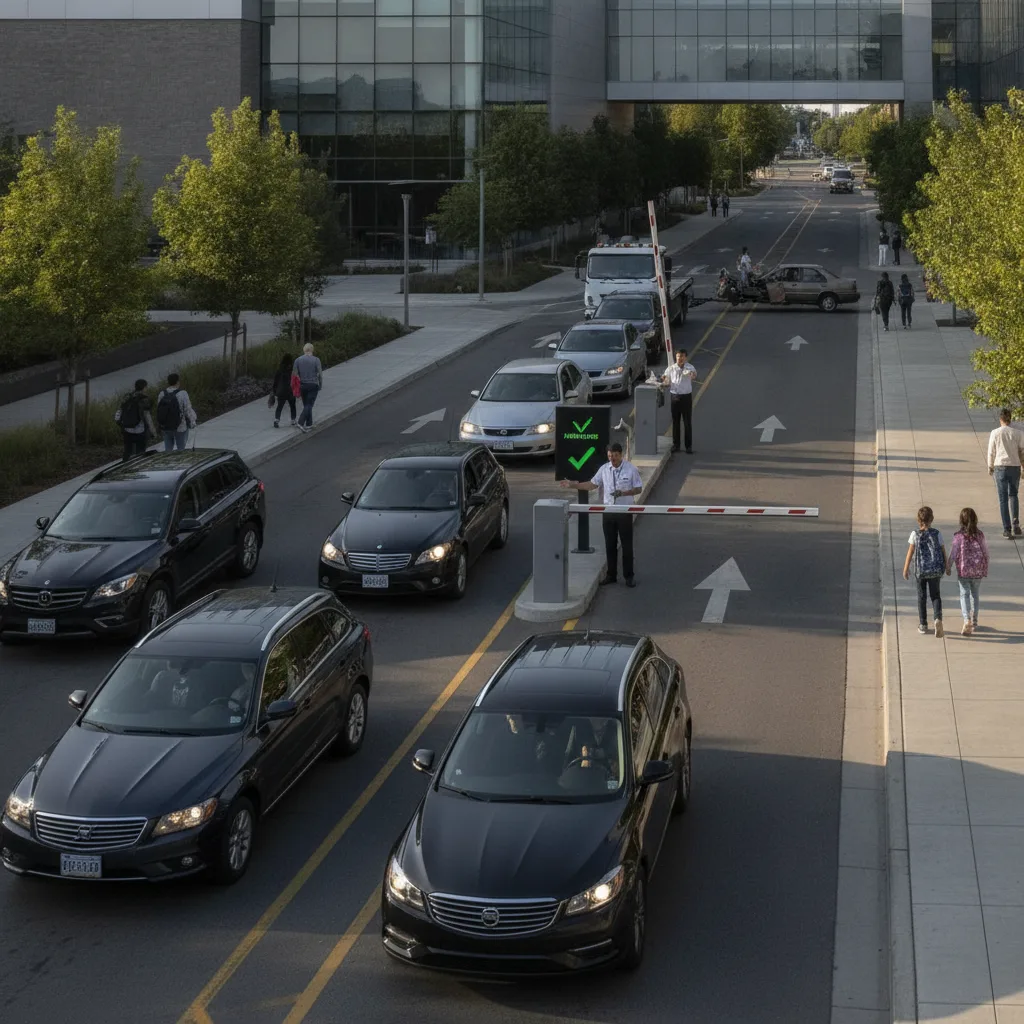
Direct answer: Venue parking managers handle peak arrival surges by treating ingress and egress as two separate problems with different failure modes — ingress is about lane throughput and payment friction in the hour before doors, egress is about clearing a full lot in a tight window right after the show or game ends — and by using ticketless vehicle recognition to cut per-vehicle processing time at both ends, since even a few extra seconds per car compounds fast when thousands of vehicles are moving through the same gates.
Venue parking is a scale problem that hotel, restaurant, and residential valet don’t really face: you’re not managing dozens of cars an hour, you’re managing a lot or garage system that needs to absorb several thousand vehicles in a compressed window, then release nearly all of them again within an even shorter window. The core planning task is capacity and flow, not staffing headcount alone.
Ingress and egress are different engineering problems
Ingress: the surge you can partially smooth
Arrivals for most events follow a predictable shape — a slow build starting an hour or more before doors, then a hard peak in the last 20–30 minutes before start time as people try to avoid missing the opening act, kickoff, or curtain. Because arrival times are somewhat spread across that window, ingress is the more manageable half of the problem: you can add lanes, stagger gate openings, and use pricing or messaging (early-bird lot pricing, gates-open notifications) to pull some arrivals earlier.
Egress: the surge you mostly can’t smooth
Departures are far more concentrated. When an event ends, a large share of the crowd wants to leave within the same 15–20 minutes, and there’s little you can do to spread that out — nobody wants to be told to wait an extra half hour in their seat. This is why egress is usually the harder operational problem and the one that generates the most complaints, even at venues that run ingress smoothly.
What actually moves the needle at each gate or lane
- Reduce per-vehicle processing time. At the scale of a venue, shaving even 3–5 seconds off each transaction at a gate compounds into meaningfully more throughput per hour. Ticketless vehicle recognition removes the stop-and-hand-over-a-ticket step for pre-paid or credentialed parking, letting a vehicle roll through at a walking pace instead of stopping completely.
- Separate payment/transaction lanes from pre-paid lanes physically, not just by signage. Mixing guests who still need to pay with guests who already have a reservation or pass creates unpredictable lane speeds. A driver stuck behind someone fumbling for a card slows an entire lane that should be moving continuously.
- Stage attendants at decision points, not just entrances. The biggest ingress delays often happen at the moment a driver has to choose a lane or a level, not at the gate itself. A staff member directing traffic at that decision point prevents the kind of hesitation that backs up an entire lane.
Planning egress before the event, not during it
Pre-stage the exit sequence
Know in advance which sections of the lot or garage empty fastest and in what order, and have staff and signage ready to route traffic accordingly the moment the event lets out — not figuring it out in real time while thousands of people are already walking toward their cars.
Coordinate with local traffic control
For venues near public roads, egress timing usually depends on coordination with local traffic officers or a contracted traffic management team as much as it does on internal lot design. Confirm this coordination and signal timing plan well before event day, especially for venues that host events large enough to affect surrounding streets.
Set a clear overflow and gridlock trigger
Define, in advance, the specific condition that triggers an overflow plan — a secondary lot opening, a rerouted exit path — rather than waiting until traffic has already locked up to make that call. The team on the ground during a surge doesn’t have time to improvise a new plan from scratch.
FAQ
Does vehicle recognition actually help with egress, or just ingress?
Both, though differently. At ingress it speeds up gate transactions; at egress it can speed up exit validation (confirming a vehicle is authorized to leave a given area without a manual ticket check) and give staff a real-time count of how many vehicles remain in each zone, which helps decide when to open or close specific exits.
How far in advance should we plan for a known large event?
Ideally weeks out for major events — lane assignments, staffing, traffic-control coordination, and signage all take real lead time. Use your own arrival and departure timestamp data from comparable past events as the planning baseline rather than starting from scratch each time.
What’s the most common mistake venues make with peak surges?
Over-investing in ingress smoothness while under-planning egress. Ingress problems are visible and annoying; egress problems are the ones that generate real safety concerns and the worst guest complaints, because they happen when everyone is trying to leave at once.
For more on venue parking operations, see the valet operations knowledge hub, valet parking software for venues, and the ticketless valet system guide.
Plan your venue’s next high-volume event
Talk to PLACA.AI about setting up ticketless vehicle recognition to speed up both ingress and egress at your next large event.
Data source: U.S. Department of Transportation