

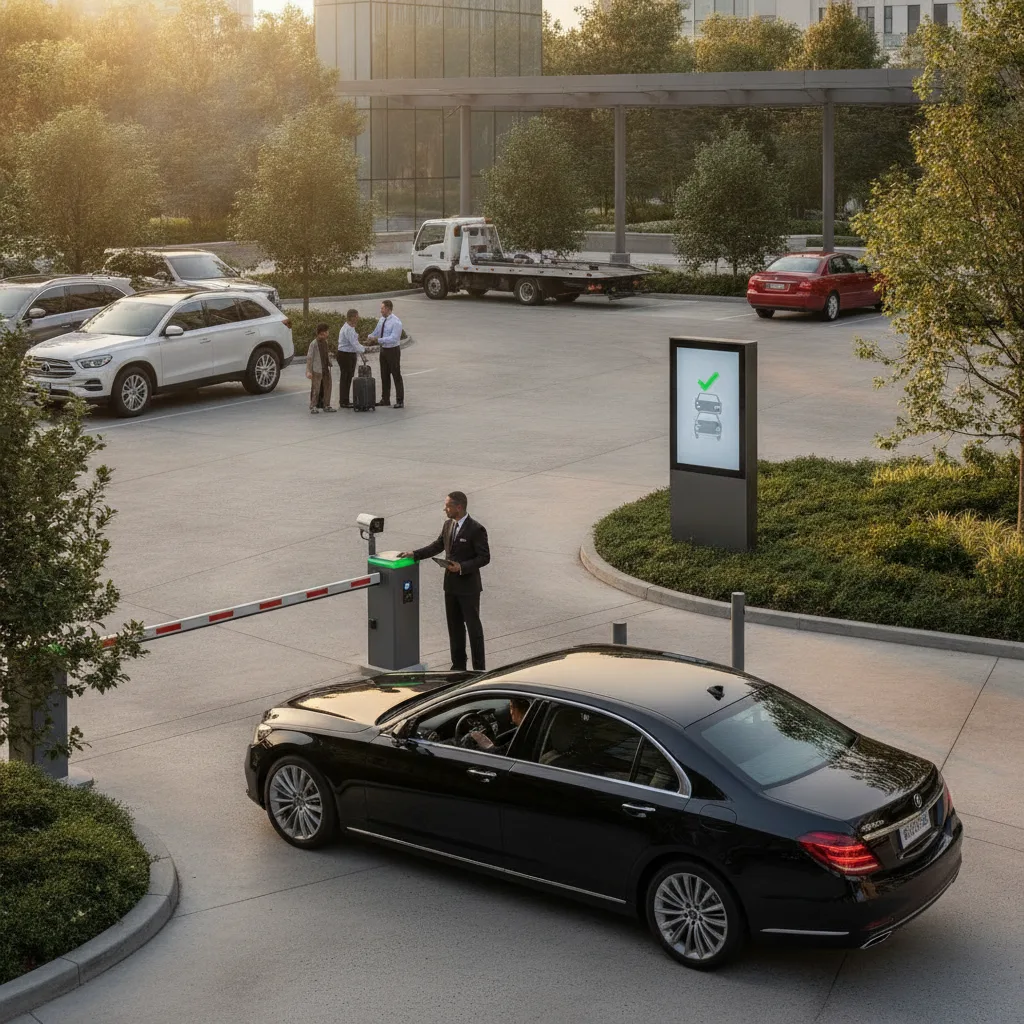
Direct answer: Wait-time complaints at venues are rarely just about how long retrieval actually takes — they’re about the gap between what a guest expected and what happened, multiplied by volume. When 5,000 people leave at once, even a well-run retrieval process produces a real queue, and complaints spike when guests have no idea where they stand in it. Ticketless vehicle recognition helps most by feeding an accurate, updating wait estimate to guests and staff, so the venue can manage expectations during the exodus instead of just managing cars.
Why venue complaints are a volume-and-communication problem, not just a speed problem
A venue can run a genuinely efficient retrieval operation and still generate a wave of complaints if guests are standing in an unmarked line with no sense of how long they’ll wait. At event scale, some queue is unavoidable — you can’t retrieve 5,000 cars in five minutes no matter how good the process is. What turns an unavoidable queue into a complaint is uncertainty: guests who don’t know if they’re 3 minutes or 30 minutes out tend to assume the worst, get frustrated, and take it out on whichever staff member is closest, or on a post-event review.
This is different from the retrieval-speed problem covered elsewhere — speeding up the average doesn’t fix complaints if guests still have no visibility into where they are in the process. The fix is giving guests (and staff) a live, honest estimate, and updating it as conditions change instead of repeating a static “10 minutes” that stops being true the moment the curb backs up.
Where venue wait complaints actually come from
No visible queue, no visible progress
Unlike a restaurant where a guest can see the valet stand and watch cars come and go, a large venue’s retrieval often happens out of sight — cars are staged in a distant lot or garage level guests can’t see. Without a status update, a five-minute wait feels indistinguishable from an abandoned request. A system that shows “your vehicle is being retrieved” and updates to “your vehicle is arriving” gives guests a reason to trust the process is working, even during a genuinely busy stretch.
Promises that don’t survive the first surge
Staff who tell every guest “about ten minutes” because that’s the standard answer will be wrong for most of the exodus wave — badly wrong during the first 20 minutes, and needlessly conservative during the tail. An estimate tied to the actual current queue depth and bottleneck, not a fixed number, keeps staff from making promises the curb can’t keep.
VIP and accessible-parking complaints escalate fastest
A general-admission guest waiting in a slow line generates one complaint. A VIP guest, a sponsor, or a guest using accessible parking who experiences the same delay is far more likely to escalate to management or leave a public review naming the venue specifically. Complaint review should separate these segments — a five-minute wait might be acceptable in general queue and a real problem in a segment where expectations (and contracts) are higher.
No record when a complaint does happen
Without stage timestamps, a post-event complaint turns into “the guest says 40 minutes, staff remembers it differently.” A system that logs request time, queue position, and delivery time gives venue management something concrete to respond with — an apology grounded in an actual timeline, or evidence that the wait was in line with the exodus volume that night.
A complaint-reduction plan for event exit
- Give guests a live status, not a one-time estimate. “Requested,” “being retrieved,” “arriving” — even without an exact minute count, visible progress reduces the anxiety that drives complaints.
- Base staff scripts on the actual queue, not a house-standard number. Train staff to check current status rather than reciting a default wait time that’s often wrong during peak.
- Route VIP, accessible, and general queues separately, with separate monitoring. Track and staff these differently since the complaint risk and expectations differ.
- Log every stage so post-event complaints can be answered with facts. A concrete timeline resolves most complaints faster than a guess, and helps identify whether a specific complaint reflects a real service failure or normal exodus volume.
- Review complaints by event type, not just by month. A sold-out concert and a half-full weekday convention session have different baselines — judge each against its own volume.
What to measure
- Complaint rate relative to exodus volume, not complaint count alone — five complaints on a 200-person exit is worse than five on an 8,000-person one.
- Estimate accuracy — how often the wait guests were told matched what actually happened, and by how much it missed during the first 30 minutes of exit specifically.
- Time to resolve a post-event complaint, and whether staff had timeline data available or had to reconstruct events from memory.
FAQ
Can we reduce complaints without actually speeding up retrieval?
Partially — accurate, updating communication reduces complaints even when the underlying wait doesn’t change, because uncertainty (not just delay) is what drives frustration. It’s not a substitute for genuinely fixing a slow process, but it closes a real gap.
How should VIP complaints be handled differently?
Route VIP and accessible requests into a separately monitored queue with tighter service expectations, and make sure staff handling those lines have visibility into actual wait status rather than a general estimate.
What’s the fastest way to respond to a post-event complaint?
Pull the logged timeline for that specific vehicle and request — it turns a guessing match into a factual response, whether that response is an apology or an explanation grounded in actual volume that night.
For more on managing high-volume valet operations, see the valet parking knowledge hub, the ticketless valet system overview, and valet parking software for venues.
Looking to cut down on post-event wait-time complaints? Book a demo and see how live status updates work during an exit surge.
Data source: U.S. Department of Transportation