

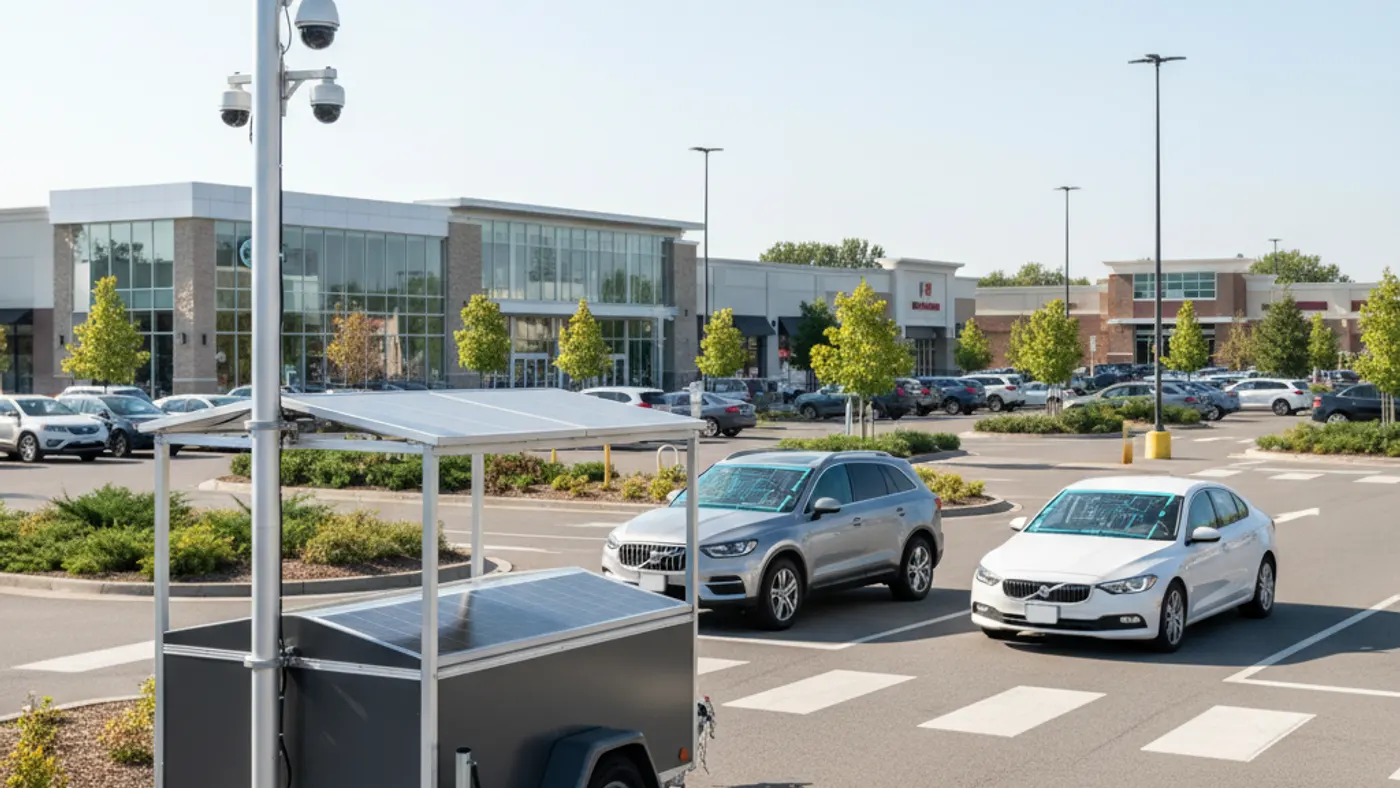
Direct answer: Treat a mobile LPR trailer as a temporary deployment with a written purpose, approved placement, capture-zone test, power and connectivity plan, access rules, retention period, relocation checklist, and end-of-deployment review.
This guide is for security teams, parking operators, integrators, property managers, and privacy reviewers and focuses specifically on planning LPR on a mobile surveillance trailer. Use this guidance to frame the review, then validate it against the property, organization, devices, and rules actually in scope.
What creates avoidable disputes
Mobility can tempt teams to move a trailer wherever visibility is poor without revalidating angle, traffic flow, signage, network quality, or the authorized monitoring purpose.
Example: A trailer moved from a private entrance to an overflow lot has a different approach angle and a different monitoring context. The original acceptance test and notice plan should not be assumed to carry over.
Mobile-trailer governance matrix
| Decision point | Evidence or control | Required response |
|---|---|---|
| Purpose | Name the incident, access, parking, or traffic question | Do not reuse data for an unrelated purpose without review |
| Placement | Map approach angle, speed, lighting, public/private boundaries | Re-test after every relocation |
| Access and sharing | List authorized roles and request documentation | Review user access during deployment |
| Retention and removal | Set a period tied to the temporary purpose | Confirm deletion/export and close the deployment |
Decision path and ownership
- Step 1. Approve the temporary purpose and deployment dates.
- Step 2. Test day and night captures at the actual trailer position.
- Step 3. Verify power reserve, connectivity, tamper response, and manual recovery.
- Step 4. Close the project with access, retention, incident, and performance review.
For planning LPR on a mobile surveillance trailer, the named owner should document the approved rule, baseline, and result of each test. Field verification should challenge the proposed process instead of confirming only the easiest scenario.
When the normal path cannot be used
Network loss, power depletion, weather movement, vandalism, blocked views, and unintended public-area capture need defined stop, correct, and document procedures.
Every off-normal case needs a traceable end state rather than an informal promise to fix it later.
Measure before expanding
Limit the first run to a manageable cohort and document both successful cases and the work that still required manual intervention.
- usable test captures by planned lane
- hours of power and connectivity interruption
- relocations completed with a new checklist
- authorized searches with documented purpose
- records removed at deployment close
A metric becomes useful only when its source and comparison period are known.
What the owner must confirm
- Write the purpose and non-goals for planning LPR on a mobile surveillance trailer and name the accountable owner.
- Verify the process with the actual security teams, parking operators, integrators, property managers, and privacy reviewers who will use, administer, or review it.
- Test a correction, an unavailable-system path, and the exception described on this page.
- Confirm current pricing, contract terms, support, integrations, and data handling directly with each provider.
- Use usable test captures by planned lane as one acceptance signal and record what evidence can stop the rollout.
Related PLACA.AI planning resources
Decision-specific FAQs
Can the same trailer move between properties?
Yes if the deployment model supports it, but each property needs a new purpose, placement, capture, access, and notice review.
Should the trailer record continuously?
Choose recording and event behavior based on the approved purpose, technical design, and retention policy rather than assuming more data is better.
Who should approve relocation?
Assign a role that can evaluate both technical capture conditions and the authorized monitoring scope.
Plan a temporary mobile-LPR deployment
Bring the rules, current process, known exceptions, and success criteria for planning LPR on a mobile surveillance trailer. PLACA.AI can help evaluate a limited pilot without presuming that another property’s hardware or workflow is the right answer.
Editorial refresh: July 22, 2026. Before using this framework for planning LPR on a mobile surveillance trailer, independently confirm current product capabilities, third-party features, pricing, contracts, governing requirements, and local rules.
Data source: Electronic Frontier Foundation: License Plate Readers