
FOR IMMEDIATE RELEASE
Grand Prairie, Texas — June 23, 2026 — PLACA.AI, developer of AI-powered license plate recognition systems for K-12 schools, today detailed how its patent-pending student dismissal platform is transforming school pickup lines — reducing carline wait times by 50% or more while generating a comprehensive, tamper-evident safety log of every child’s release from the moment a vehicle enters campus to the moment a student is confirmed in the car.
The company filed a provisional patent application (35 U.S.C. § 111(b)) with the U.S. Patent and Trademark Office covering the full student release orchestration architecture — an end-to-end system that automates identification, authorization, staff approval, student staging, and safety logging in a single, continuous workflow. The result is a school pickup line that moves faster, runs on fewer staff, and produces an unbroken chain of custody documentation for every student released.
Why School Pickup Lines Are Slow — And What PLACA.AI Does Differently
The carline bottleneck in most K-12 schools is not the number of cars — it is the time each car spends waiting while staff manually identify who is arriving, locate the right student, verify authorization, and communicate dismissal to the classroom. In a typical elementary school dismissal, each of these steps happens sequentially, by hand, with staff calling names over radios or scanning paper cards in car windows.
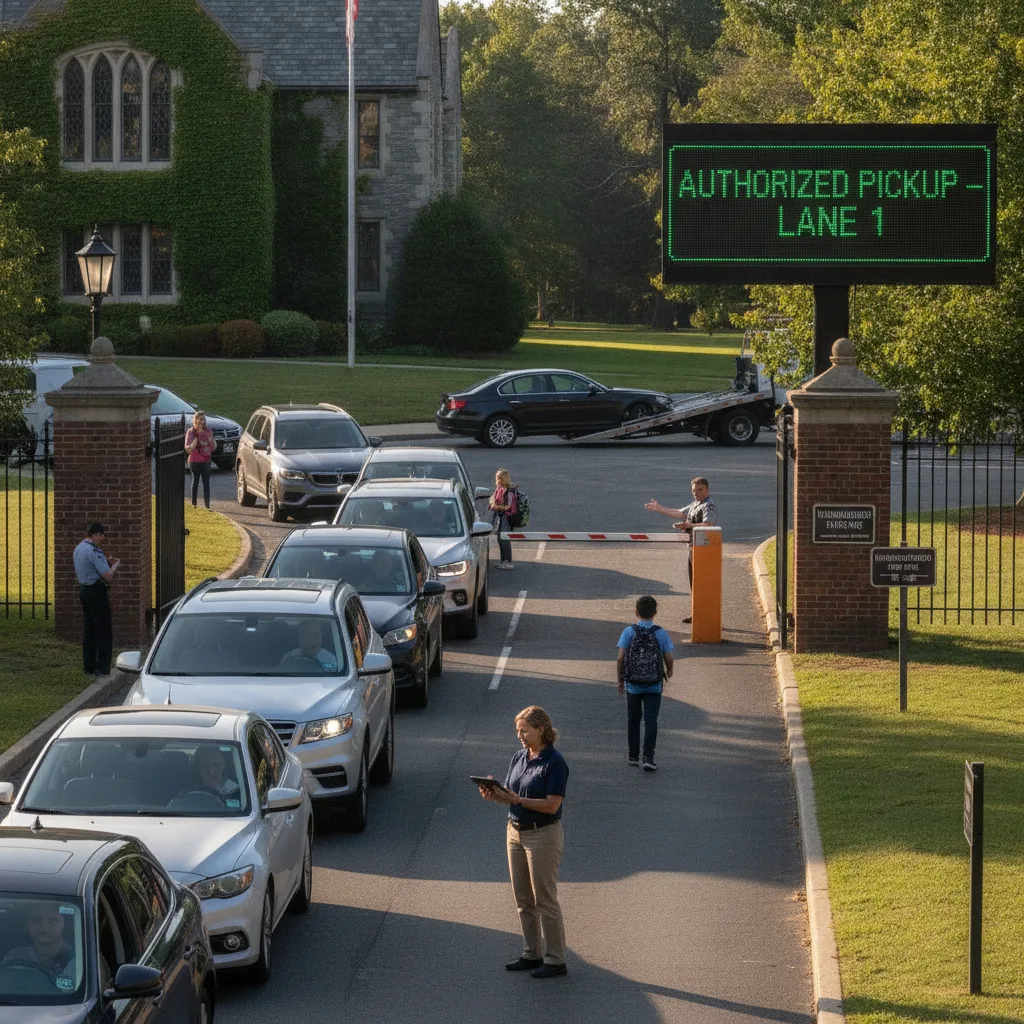
PLACA.AI’s patent-pending system eliminates the sequential delay entirely. The moment a vehicle enters the school’s detection zone — often 200 to 400 feet before the pickup point — the system has already identified the vehicle, matched it to students, evaluated authorization rules, surfaced a dismissal card to staff, and begun staging the student for release. By the time the car reaches the front of the line, the student is already moving.
“The old model is: car arrives, staff reads a card, staff radios a room, teacher walks a child out. Every step is a delay,” said Dr. Suhayb, founder and CEO of PLACA.AI. “Our system inverts that. The student is staged before the car stops. Staff aren’t reacting — they’re confirming. That’s how you cut wait times in half without adding a single person to the carline.”
The Full Streamlined Workflow: From Arrival to Confirmed Release
PLACA.AI’s patent-pending student release orchestration system operates as a continuous, automated pipeline across six stages — each one documented in real time for safety and accountability:
Stage 1 — Vehicle Detection and Identification
As a vehicle enters the school’s pickup zone, PLACA.AI’s LineCam system captures the license plate across multiple frames and computes a high-confidence plate read using AI-powered optical character recognition. The system simultaneously accepts four identification modalities — license plate recognition, QR code token scan, parent geofence arrival signal, and manual staff plate entry — ensuring no vehicle is turned away due to a camera read failure. All four modalities produce the same downstream workflow.
Stage 2 — Authorization Request Object (ARO) Construction
The identification signal — regardless of its source — is normalized into a unified Authorization Request Object (ARO). The ARO carries the vehicle identity, identification method, confidence score, timestamp, and a pointer to every student linked to that vehicle in the school’s records. This normalization step is what allows the system to process plate reads, QR scans, and manual entries identically — eliminating the inconsistency of mixed-modality manual workflows.
Stage 3 — Eight-Level Rule Evaluation
Each ARO is independently evaluated against every student’s full pickup authorization profile through an eight-level rule precedence framework. The evaluation engine checks, in order: emergency override flags, active custody blocks, court-ordered pickup restrictions, watchlist status, authorized persons, one-time pickup permissions, standard vehicle authorization, and default school policy. This evaluation happens in milliseconds — before the car reaches the front of the line — and surfaces any flags, holds, or alerts to the staff dismissal interface in real time.
Stage 4 — Staff Dismissal Card and Human Approval Gate
The evaluation result is presented to the on-duty staff member as a dismissal card: a real-time display showing the arriving vehicle, the matched student or students, the rule evaluation outcome, any active flags, and a one-tap approval control. The staff member reviews and approves — or holds — the release with a single authenticated action. This human approval gate is the core of PLACA.AI’s patent-pending architecture: no student is staged or released without an authenticated staff member making an active, deliberate decision. The approval is cryptographically signed and bound to the staff member’s identity and active session.
Stage 5 — Student Staging and Carline Flow Management
Once a staff member approves a dismissal card, the system immediately triggers student staging — notifying the classroom teacher or hallway monitor that the student is cleared to move to the pickup point. Because staging begins before the vehicle reaches the front of the line, students and vehicles arrive at the pickup point simultaneously. There is no waiting for a child who hasn’t been called yet, and no vehicle blocking the line while a student is located. This synchronization is what produces the dramatic reduction in carline wait times seen in PLACA.AI deployments.
Stage 6 — Release Confirmation and Tamper-Evident Safety Log
When the student enters the vehicle, the release is confirmed and recorded. Every event in the full workflow — vehicle detection, ARO construction, rule evaluation, staff approval, student staging, and release confirmation — is written to a tamper-evident, hash-chained audit log. Each log entry is cryptographically linked to the one before it, making it impossible to alter or delete a record without breaking the chain. Schools can produce a complete, court-admissible record of any student’s dismissal history on demand — including who approved the release, what rules were evaluated, and what time each step occurred.
What the Numbers Look Like in Practice
Schools deploying PLACA.AI’s system have reported dismissal times dropping from 35–45 minutes to 15–20 minutes for a typical elementary school of 400–600 students. Staff requirements at the pickup point drop from three to four people to one or two, as the system handles identification and authorization automatically. Parent wait times in the carline — often 15–25 minutes under manual systems — are reduced to five to ten minutes or less.
Beyond speed, the safety log eliminates a category of administrative risk that manual systems cannot address. When a parent, attorney, or district administrator asks who authorized a student’s release and when, PLACA.AI’s system produces a complete answer in seconds. No manual system — paper cards, walkie-talkies, sign-out sheets — can match that level of accountability.
Patent-Pending Protection for Schools and Partners
The provisional patent filing establishes a priority date for PLACA.AI’s student release orchestration architecture. Schools deploying the system today are building their dismissal operations on protected intellectual property. EdTech companies and student information system vendors interested in licensing the technology can learn more at PLACA.AI’s EdTech licensing page.
“We filed the patent because this architecture is genuinely novel,” said Dr. Suhayb. “Nobody else has built student dismissal as a staff-controlled orchestration system with a human approval gate, an eight-level rule engine, and a hash-chained audit log at every step. That combination is what makes it safe, fast, and legally defensible — and it’s what we’re protecting.”
About PLACA.AI
PLACA.AI is an AI-powered license plate recognition company headquartered in Grand Prairie, Texas. Its school campus solutions include the LineCam student pickup line system — the only school dismissal platform with a patent-pending, staff-controlled student release orchestration architecture. PLACA.AI serves schools, HOAs, commercial parking operators, and towing companies across the United States with purpose-built LPR cameras, cloud software, and end-to-end support.
To schedule a walkthrough of PLACA.AI’s student dismissal system, visit www.placa.ai/lpr-camera-demo.
Media Contact:
Dr. Suhayb
Founder & CEO, PLACA.AI
sales@placa.ai
www.placa.ai
Grand Prairie, TX 75050
Data source: National Center for Education Statistics