
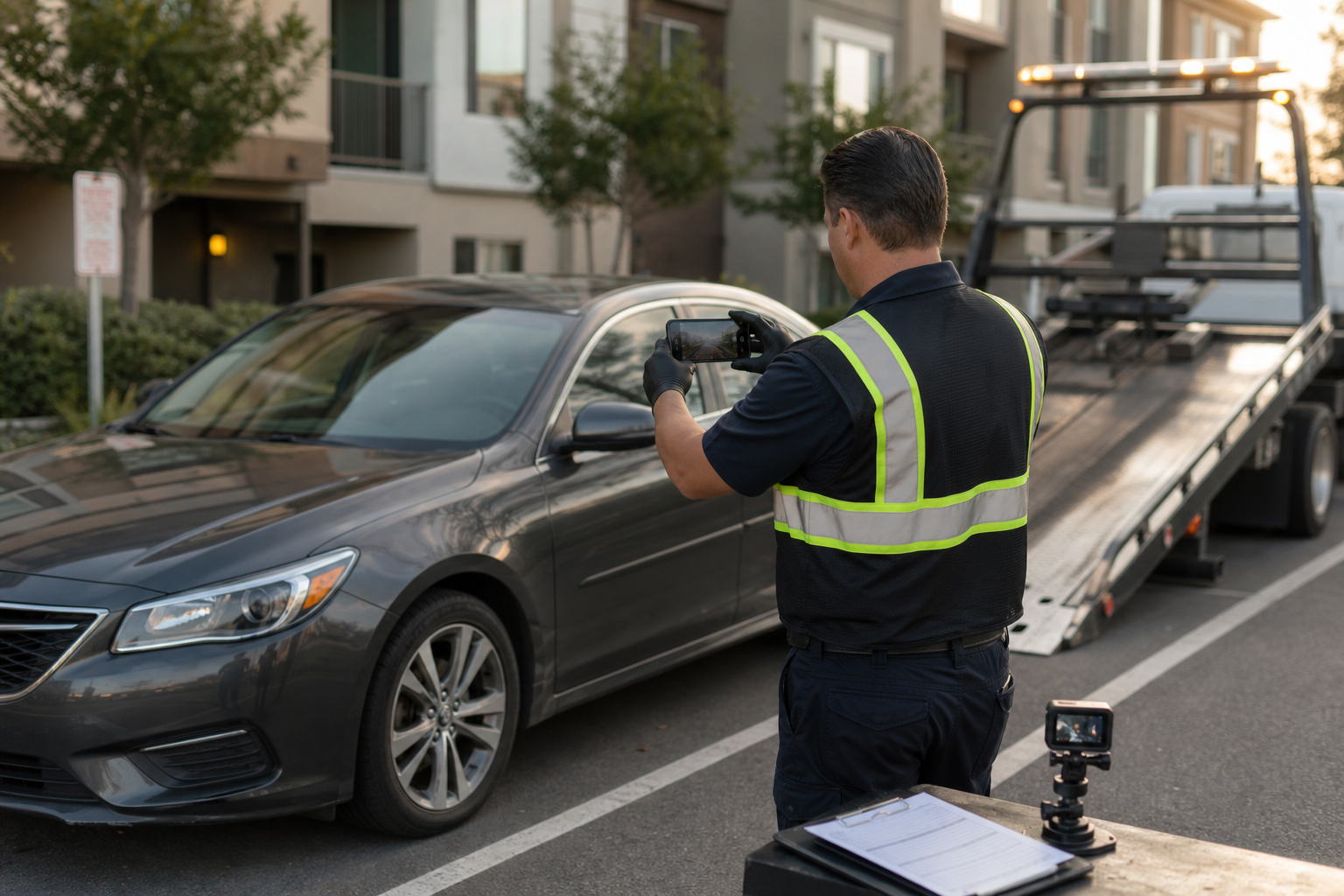
Before a private-property tow, the patrol record should show who authorized the action, what rule was violated, what evidence was captured, how the vehicle owner can retrieve the vehicle, and which fees or itemized charges will be disclosed. Treat the record as a review packet, not just a dispatch note.
Key Takeaways
- New towing transparency rules make weak patrol records more expensive to defend.
- The evidence packet should connect authorization, location, rule, plate or permit status, photos, timestamps, fees, and retrieval instructions.
- Mobile LPR can support repeatable documentation, but it should not be the only basis for a tow.
- Legal requirements vary by state and city, so counsel should review the final policy before enforcement changes.
- The safest workflow separates field capture, supervisor review, dispatch, release, and dispute response.
What This Workflow Involves
This workflow gives a towing or patrol team a complete case file before an enforcement action turns into a complaint. The field operator records the property, posted rule, vehicle location, plate or permit status, visible condition, time observed, time cleared for action, and the person or system that authorized the tow.
The dispatch record then carries that evidence into the truck assignment, storage destination, fee notice, retrieval instructions, and release process. A supervisor should be able to open the case later and answer five questions without relying on memory: why was this vehicle towable, who approved it, what did the driver see, what was the owner told, and what changed if the owner disputed the action?
For teams using mobile LPR, the scan is one part of the record. It can help confirm plate, location, time, permit state, prior observations, and repeat activity. It should be paired with rule-specific evidence such as signage, zone, permit expiration, blocked access, fire lane status, abandoned-vehicle notes, or property authorization.
Why This Problem Is Showing Up Now
On July 20, 2026, Pennsylvania Senate Bill 779 became Act 46 of 2026. The Pennsylvania General Assembly page describes the law as addressing unlawful towing and towing storage facility practices. The bill history shows approval by the governor on July 20 and Act 46 status the same day.
The Pennsylvania Motor Truck Association summarized the bill as creating statewide expectations around towing-company business locations, truck identification, posted fees and hours, written retrieval information, itemized charges, accepted payment methods, and release during posted business hours unless law enforcement has directed a hold. The association also noted that the law takes effect 150 days after enactment.
That is a Pennsylvania law, not a national rule. Still, it reflects a broader operational pressure: towing and storage decisions are being judged by whether the vehicle owner can understand what happened, where the vehicle went, what it costs, and how the tow was authorized.
The Core Operational Problem
The core problem is not only whether the vehicle was parked incorrectly. It is whether the towing team can reconstruct the decision after the owner, property manager, carrier, insurer, police officer, or regulator asks for proof.
Thin notes create avoidable risk. A case that says only “no permit” may not show whether the sign was visible, whether the permit was expired or absent, whether a grace period applied, whether the property authorized removal, or whether the owner received clear retrieval instructions. When fees, release access, or itemized billing are questioned, the patrol note alone is not enough.
PLACA.AI’s parking enforcement software for towing companies resource is built around this operations problem: turning field observations into a consistent review record before enforcement expands.
Evidence Packet Before Dispatch
| Decision point | Evidence to capture | Reason for review |
|---|---|---|
| Authority | Property, contract scope, authorized requester, rule category | Shows the tow was not initiated outside the approved relationship |
| Vehicle status | Plate read, state, permit result, vehicle image, observed location | Connects the enforcement rule to the specific vehicle event |
| Site condition | Signage photo, zone marker, fire lane or reserved-space context, timestamps | Helps a reviewer see the same conditions the patrol operator saw |
| Owner path | Storage destination, hours, payment options, retrieval instructions, invoice route | Reduces confusion after the tow and supports release compliance |
| Exception status | Warning period, temporary permit, data correction, manager override, hold reason | Prevents a routine violation from swallowing legitimate exceptions |
Supervisor Review Checklist
- Confirm that the current property rule is written and active for the zone where the vehicle was observed.
- Check that the field record includes a plate, image, location, timestamp, and the reason the vehicle matched the tow rule.
- Review whether the case involves a safety issue, blocked access, abandoned vehicle, permit violation, payment issue, or repeat event.
- Look for exceptions before dispatch: recent registration correction, temporary permit, vendor authorization, disability accommodation, emergency access, or property-manager hold.
- Confirm the storage location, business hours, accepted payment options, and release contact that will be given to the owner.
- Make sure itemized charges can be produced from the case file instead of reconstructed after a complaint.
- Record who approved the action and whether the approval came from the property, supervisor, law enforcement, or another defined authority.
- Preserve the evidence packet even if the owner pays without dispute.
Risks, Limits, And Legal Review
This article is not legal advice. Towing law changes by state, municipality, property type, vehicle type, and the reason for the tow. A process that is acceptable for a blocked fire lane may not be acceptable for a resident permit problem, a commercial-carrier storage dispute, or an abandoned vehicle.
Do not treat automation as permission to tow faster. A plate read can identify a vehicle event, but it cannot decide whether signage was adequate, whether a property manager gave valid authorization, whether the owner is entitled to release, or whether a fee schedule complies with local law. Those are policy and legal questions.
ProPublica and the Connecticut Mirror reported in April 2026 that some towing companies were accused of continuing practices residents believed conflicted with a newer Connecticut towing law. The useful lesson for operators is practical: a law on paper does not protect trust unless the field workflow makes compliance visible in the actual case file.
Worked Example: Permit Lot With A New Release Rule
Consider a towing company that patrols a private apartment lot with numbered resident spaces and a separate visitor area. A patrol driver scans a vehicle in a resident zone at 11:20 p.m. The permit database shows no match, but the plate image is clear and the vehicle is not blocking emergency access.
Under a better workflow, the driver does not simply mark “no permit” and dispatch. The case file also captures the nearest sign, the zone marker, the observed space, the property rule, the last permit update time, and whether the vehicle appears in recent visitor or resident correction records. The supervisor checks whether the property requires a warning period or manager authorization for non-safety tows.
If the tow is approved, the release record already contains the storage facility, retrieval hours, payment methods, itemized charge path, and property contact. If the owner later says the permit was valid or the vehicle could not be retrieved during posted hours, the team can review the original source, correction history, and release notes without reconstructing the event from calls and screenshots.
Frequently Asked Questions
Does a new state towing law automatically change every private-property patrol workflow?
No. Each jurisdiction has its own effective dates, definitions, exemptions, and enforcement process. A new law should trigger a workflow review, but counsel should decide exactly what must change for each property and tow category.
What is the minimum record before dispatching a tow truck?
At minimum, capture the property, rule, vehicle identifier, location, time, field evidence, authorization source, exception check, and retrieval information that will be provided after removal. Some jurisdictions or contracts may require more.
Can mobile LPR replace manual photos and supervisor review?
No. Mobile LPR can improve consistency and timestamps, but towing teams still need rule-specific photos, authorization, exception handling, and human review for cases where the evidence is unclear or the consequence is severe.
How should itemized fees be handled in the workflow?
The team should be able to produce an itemized statement from the same case file that records the tow, storage, release, payment, and authorized services. Fees should not depend on staff reconstructing the case after the owner asks.
When should a patrol operator pause before towing?
Pause when the sign is unclear, the plate or permit record conflicts, a temporary authorization may apply, the property authority is missing, the vehicle type changes legal treatment, or the retrieval and fee information cannot be provided cleanly.
Related PLACA Resources
- Start with parking enforcement software for towing companies when mapping dispatch, patrol, and evidence workflows.
- Use the Towbook alternative LPR workflow page to compare how mobile plate capture can support case documentation.
- Review the PLACA.AI vs PatrolWorks comparison when evaluating patrol software, evidence review, and private-property enforcement fit.
Next Step
Pull five recent disputed towing cases and ask whether each file shows authority, rule, evidence, exception review, fees, retrieval instructions, and final release. If those answers live in separate texts, spreadsheets, and photos, the workflow needs cleanup before enforcement expands.
Data source: U.S. Department of Transportation