

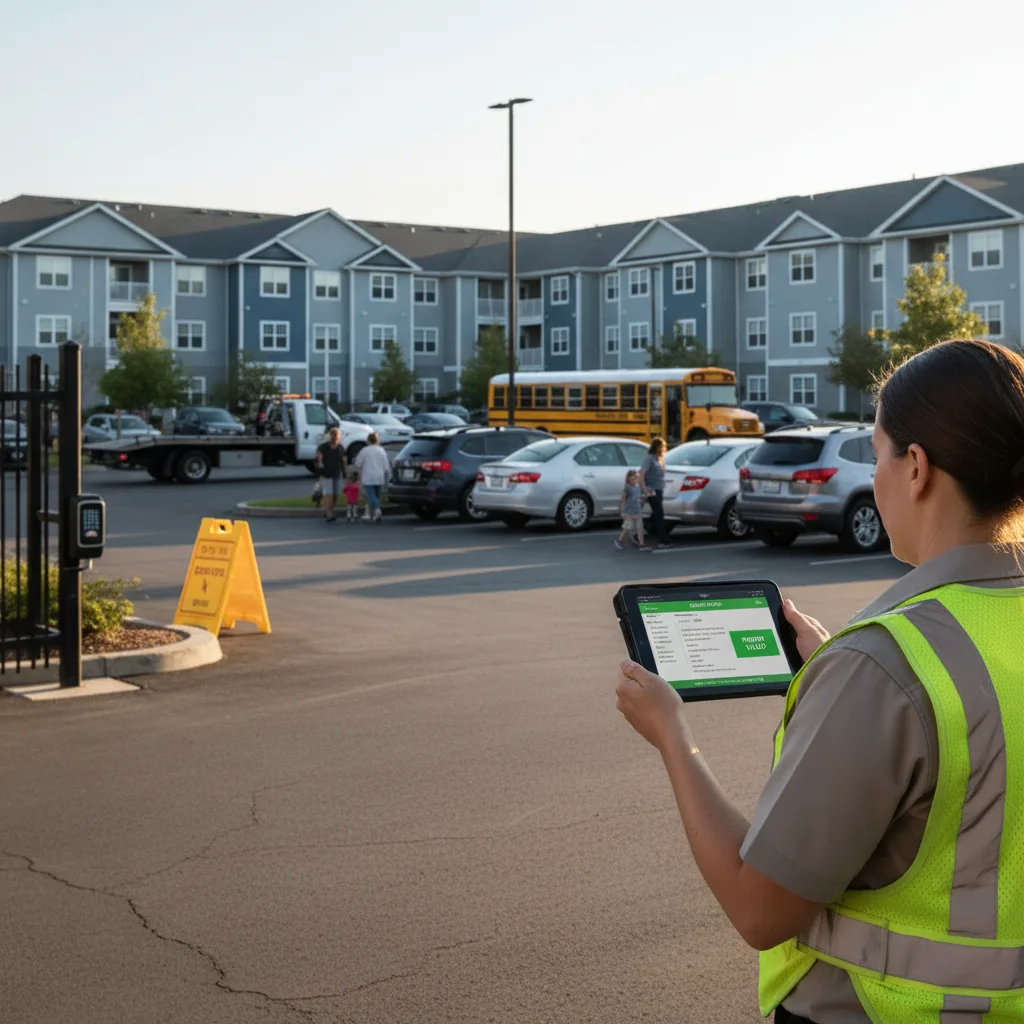
Direct answer: Replace paper only after the digital workflow accounts for route coverage, property rules, vehicle and location context, plate confidence, permit lookup, observation timing, exceptions, approval, dispatch, corrections, and retention. Pilot one property before changing the fleet. For moving private-property towing from paper patrols to mobile LPR, record the responsible owner, the accepted outcome, the reason for each correction, and the measured result for patrol events with complete fields before expanding the process.
This guide is for private-property towing companies, patrol drivers, dispatchers, property owners, and compliance teams and addresses moving private-property towing from paper patrols to mobile LPR. The scope is deliberately narrow so the difficult cases can be tested before rollout.
Start with the failure
Digitizing plate lists without redesigning evidence and approvals can make incomplete cases move faster.
Example: A driver should record why a zone was skipped and why a plate mismatch was corrected, not simply upload a list of reads.
Paper-to-mobile transition map
| Decision point | Evidence or control | Required response |
|---|---|---|
| Current paper control | route, log, evidence, approval, archive | identify purpose |
| Digital equivalent | required fields, timestamps, users, edits | preserve control |
| Pilot | one property, trained drivers, exception cases | test workflow |
| Rollout | acceptance result, training, support, retention | expand deliberately |
Assign the handoffs
- Step 1. For current paper control, verify route, log, evidence, approval, archive and then identify purpose.
- Step 2. For digital equivalent, verify required fields, timestamps, users, edits and then preserve control.
- Step 3. For pilot, verify one property, trained drivers, exception cases and then test workflow.
- Step 4. For rollout, verify acceptance result, training, support, retention and then expand deliberately.
A reviewer should be able to reproduce the decision later.
When the normal path stops
Keep a bounded outage method and do not discard records until contractual, legal, and operational retention duties are reviewed.
Correct the record, approve a bounded exception, deny under the written rule, or escalate to the named authority; do not leave the case unresolved.
Field test
Run a limited test long enough to observe the recurring pattern and at least one correction or fallback.
- patrol events with complete fields
- paper controls mapped
- exceptions reproduced in pilot
- driver corrections documented
- dispatches blocked for missing approval
Define who counts each measure, the observation window, and the result that blocks expansion.
Proof before rollout
- State the purpose and non-goals for moving private-property towing from paper patrols to mobile LPR.
- Assign owners for the normal path, correction, exception, and final approval.
- Test live conditions with the people who administer and experience the workflow.
- Confirm contracts, pricing, support, integrations, data handling, and governing requirements independently.
- Retain enough evidence to reproduce each approval, denial, correction, or escalation.
Related PLACA.AI planning resources
Operational FAQs
What must be approved first for moving private-property towing from paper patrols to mobile LPR?
Approve the purpose, owner, evidence standard, decision rule, and exception path before scaling.
What should the pilot reproduce?
Test the normal process and the named exception while collecting patrol events with complete fields and the other listed measures.
When should rollout stop?
Stop when ownership is unclear, required evidence is missing, a serious exception lacks a safe route, or the result conflicts with the approved rule.
Plan a limited workflow review
Bring the current rule, process, exceptions, and success criteria for moving private-property towing from paper patrols to mobile LPR. PLACA.AI can help evaluate a bounded pilot without assuming another property’s workflow is the right answer.
Editorial refresh: July 22, 2026. Independently confirm current product capabilities, third-party features, pricing, contracts, governing requirements, and local rules before acting.
Data source: U.S. Department of Transportation