
School Flock camera access should now be treated as a separate board decision from campus pickup automation. On October 5, 2026, Clark County School District Police Chief Jeff Clark said the department would not pursue a new memorandum of understanding to access the Flock camera system, after an August pause and review. That does not mean every school vehicle-recognition use case disappears. It means school leaders need cleaner language for what they are approving: routine regional ALPR network access, emergency law-enforcement collaboration, or a campus-scoped student pickup workflow.
The distinction matters because CCSD did not describe itself as owning or operating Flock hardware. Local reporting said the department had previously accessed data through partner law-enforcement agencies, and earlier Nevada Independent reporting described access to shared cameras across Clark County and the Las Vegas area. For a school board, that is a different category of risk than a camera used at a pickup lane to match an arriving parent vehicle to an authorized release record.
What the school Flock camera access decision actually changed
The CCSD decision did one narrow thing: it declined a new MOU for access to the Flock camera system. It did not announce that the district removed cameras from school property, ended every emergency collaboration with police, or banned every form of license plate recognition for campus operations.
FOX5 reported that Clark said CCSDPD would not pursue a new MOU after a review and that further updates would be shared publicly with the Board of School Trustees. KTNV reported the same core decision and noted the earlier pause after the program came to light. The important buyer fact is the access model. A school police department can become a user of regional ALPR data even when it does not own the cameras, operate the cameras, or manage the private and public sites where plates are captured.
That is where many school conversations get muddy. A parent may hear “license plate reader” and picture a pickup lane camera. A police administrator may hear the same phrase and think of investigative search across a shared law-enforcement network. A vendor may describe audit logs, case numbers or permissions. A board needs to know which system is being approved before it can judge the policy.
The buyer question is not simply whether cameras are good or bad
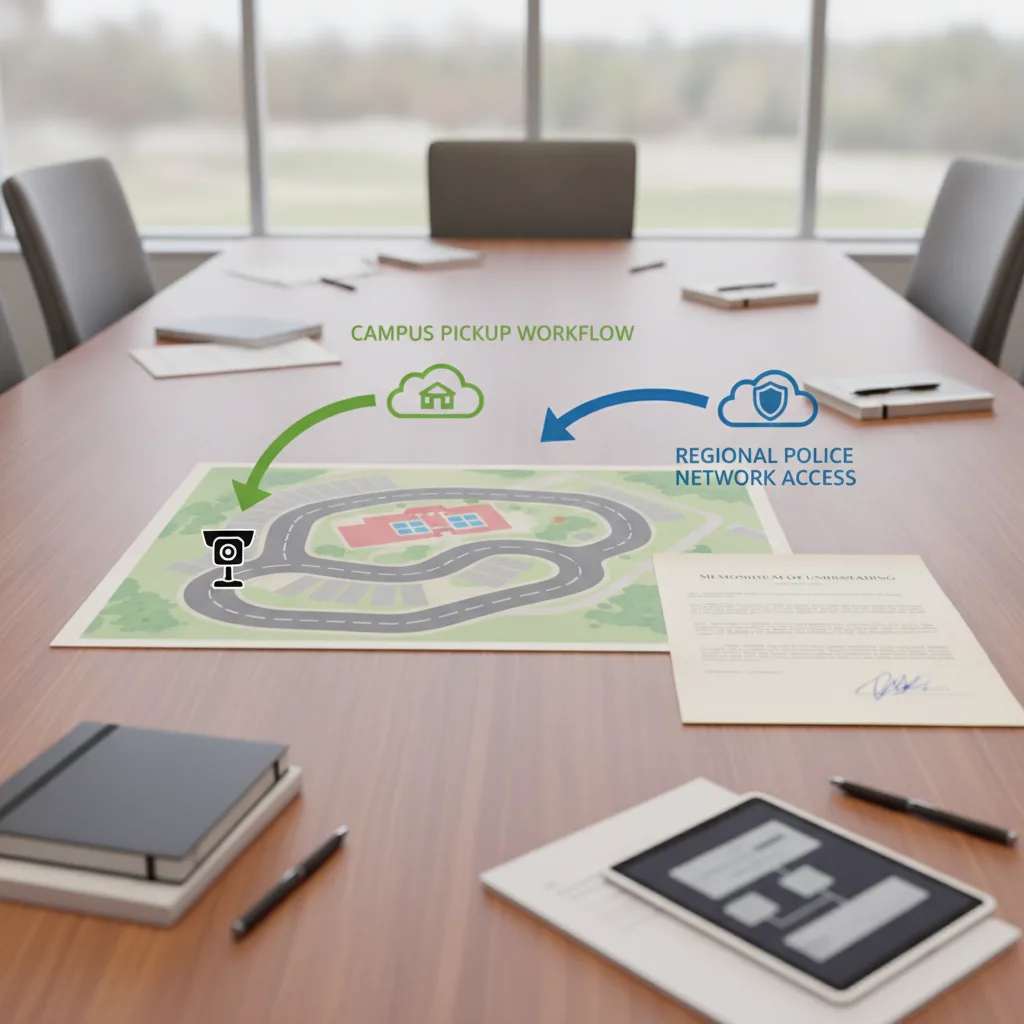
The practical question is whether the school is approving campus identity workflow or regional investigative access. Those two decisions require different facts, different policies and different public explanations.
A campus pickup system asks: is this vehicle on the approved pickup list, which student is associated with it, did staff approve release, and is there a timestamped record if a parent later disputes the handoff? A regional Flock-style network-access MOU asks: which cameras can school police search, which partner agencies or private sites feed the network, which cases qualify, how long searches are logged, who audits misuse, and whether emergency language can become routine practice.
Both can be described as ALPR. They should not be approved as if they are the same tool.
A school ALPR access matrix boards can use
Before approving a school ALPR policy, Flock camera MOU or similar agreement, a board should put each access layer in writing. The value of the CCSD decision is that it exposes how much can be hidden inside the word “access.”
| Decision layer | Question to answer before approval | Why it changes the risk |
|---|---|---|
| Hardware ownership | Does the school own, lease or operate the cameras, or is it only searching cameras controlled by others? | Ownership affects notice, configuration, retention and who can correct a bad deployment. |
| Routine search access | Can school police search a regional plate-reader network for assigned cases, residency checks, discipline, threats or general investigations? | Search authority can expand beyond campus traffic and into historical location tracking. |
| Emergency collaboration | What counts as imminent danger, who approves the request and how is it documented afterward? | Emergency language is useful, but vague language can become a workaround for routine access. |
| Campus pickup workflow | Is the system only matching approved parent or guardian vehicles to student release records? | This is an operational dismissal use case, not the same as broad network search. |
| Audit and board reporting | Who reviews access logs, how often, and what summary reaches the board or public? | Audit logs matter only if someone independent reviews them and acts on exceptions. |
Why campus pickup LPR is a different Placa.ai conversation
School leaders who reject routine regional ALPR access may still need better pickup accountability. That is where the technology discussion should move from police-network search to campus workflow design.
Placa.ai’s school pickup line license plate recognition page describes a narrower operating model: an approved vehicle enters the pickup lane, the plate is matched to the student’s authorized pickup list, staff review the arrival and approve dismissal, and the system keeps a timestamped audit trail. Placa’s automated student dismissal workflow materials also focus on queueing and release operations rather than regional investigative search.
That difference is commercially important, but it should be stated carefully. Public Placa pages support claims about pickup matching, staff review and release records. Placa’s legal terms and privacy policy still need to be reviewed before a buyer makes absolute claims about retention, government access, subpoenas, training use or data sharing. The credible Placa advantage here is not a slogan about privacy. It is workflow fit: a school can evaluate a campus-scoped pickup system without treating it as a standing MOU for routine police access to a regional plate database.
What did not happen in Clark County
The CCSD decision should not be exaggerated. Based on the available local reporting, the district police chief said the department would not pursue a new Flock access MOU. The reports did not establish that CCSD owned Flock cameras, operated the hardware, removed cameras from campuses, or banned all future vehicle-recognition technology.
That nuance protects the article from the same mistake buyers need to avoid. A district can say no to routine network access and still define how it will work with local law enforcement during an imminent threat. It can also evaluate campus pickup tools on their own merits. The policy should make those boundaries explicit rather than burying them in a vendor agreement or a police procedure.
How school boards should write the decision record
A useful school board record should answer the access question in plain language before the vote. If the district is considering a Flock camera MOU, say whether school police can search all shared cameras, only cameras near schools, only named cases, or no network at all. If emergency collaboration remains available, define the trigger, approving official, documentation and after-action review. If campus pickup LPR is being considered, define where capture happens, what data is extracted, who sees it, how long it is kept, and how parents can update authorized vehicles.
Boards should also separate vendor claims from district policy. A vendor dashboard may offer permissions and logs, but the district still decides who receives accounts, what reasons are allowed, which exceptions trigger review, and whether parents are told the difference between pickup recognition and police search.
For deeper background on this distinction, Placa’s article on public-safety ALPR and private-property LPR is the better internal comparison than another generic vendor list. For buyers evaluating Flock-style systems more broadly, the Flock Safety alternatives hub is relevant, but it should not replace the school-specific access analysis.
The school buyer takeaway
CCSD’s October 2026 decision gives school buyers a cleaner vocabulary. Do not ask only whether the district is using Flock, ALPR or cameras. Ask who owns the hardware, who can search the data, whether searches are routine or emergency-only, what campus workflow the school actually needs, and what the board will report back to parents.
A school that needs faster, more accountable pickup lines should not have to accept routine access to a regional surveillance network as the price of operational improvement. Conversely, a school that wants emergency collaboration with law enforcement should define that collaboration directly, rather than letting it blur into everyday searches.
That is the strategic opening for Placa.ai: help schools solve the campus vehicle-identification problem on school terms. The buyer still has to verify legal language, retention, sharing and parent notice. But the starting point is stronger when pickup accountability, staff approval and audit trails are treated as a campus workflow, not as a standing invitation into a regional ALPR network.