

Parking Enforcement System Cost Guide
Parking enforcement system cost depends on more than software subscription pricing.
For towing companies, the real cost includes cameras, installation, in-truck computers, DVRs, hard drives, support, maintenance, downtime, and lost enforcement revenue when the system fails.
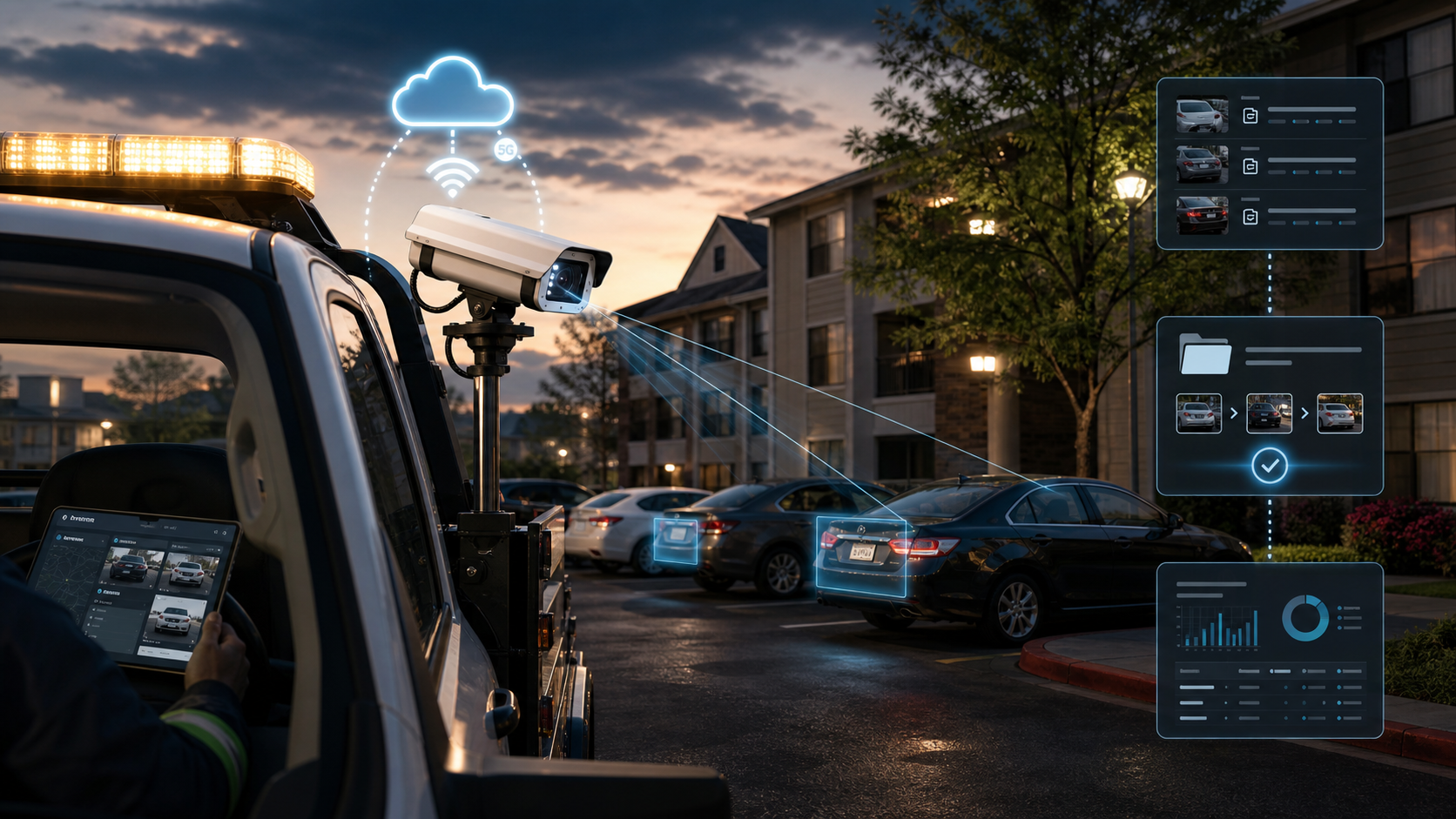
PLACA AI reduces the hardware side of the equation by eliminating in-truck computers, DVRs, hard drives, and local processing hardware.
Cost Categories to Compare
Software Subscription
This is the visible monthly or annual cost.
Cameras
LPR workflows need cameras. PLACA AI uses IP cameras as part of the enforcement capture process.
In-Truck Computers
Some systems require computers inside each enforcement vehicle. This increases installation, support, and replacement cost.
DVRs and Hard Drives
Local storage adds failure risk and maintenance cost.
Installation
More components usually mean more labor.
Downtime
Downtime is the cost buyers underestimate. A system failure can reduce patrol coverage and tow volume.
Hardware-Heavy vs Cloud Cost Model
| Cost factor | Hardware-heavy system | PLACA AI |
|---|---|---|
| Truck computer | Often required | Not required |
| DVR / hard drive | Often required | Not required |
| Cloud processing | Limited or secondary | Core workflow |
| Maintenance | More in-vehicle components | Fewer in-vehicle components |
| Downtime risk | Higher hardware exposure | Lower hardware exposure |
How to Estimate ROI
Estimate:
- Number of trucks.
- Number of patrol shifts per week.
- Average vehicles scanned per shift.
- Average violations found per shift.
- Current downtime hours per month.
- Average tow revenue.
- Account retention value.
Then compare how much revenue is lost when hardware issues slow enforcement.
The PLACA AI Cost Advantage
PLACA AI is not just a software purchase. It is a simpler operating model.
By moving processing to the cloud, PLACA AI helps towing companies avoid the cost of maintaining a full computer and storage stack inside every truck.
FAQ
-
How much does a parking enforcement system cost?
Costs vary based on software, cameras, vehicles, properties, installation, support, and hardware requirements. Always include downtime and maintenance in the calculation.
-
What is the cheapest parking enforcement system?
The cheapest quote is not always the lowest total cost. A system with more hardware can become more expensive through maintenance and downtime.
Ready to stop installing computers in trucks?
See how PLACA AI uses IP cameras, cloud processing, and real-time enforcement decisions to reduce hardware downtime and help towing teams enforce faster.
Related Resources
Understanding Parking Enforcement System Costs
What factors drive the total cost of a parking enforcement system?
The total cost depends primarily on the number of cameras needed, whether the system uses cloud-based or on-premise storage, and whether hardware is purchased outright or leased. A single-camera installation for a small surface lot costs significantly less than a multi-camera system covering a structured parking garage with multiple entry and exit points. Software subscription fees for cloud-based systems typically range from a few hundred to a few thousand dollars per year depending on camera count and feature set.
Are there hidden costs to budget for?
Beyond hardware and software, operators should budget for installation labor (mounting cameras, running conduit, and connecting power), network infrastructure if the installation location lacks internet connectivity, ongoing maintenance agreements, and signage required for legal enforcement compliance. Cellular-connected cameras eliminate the network infrastructure cost but carry a monthly data plan fee. Placa.ai offers transparent per-camera pricing with no hidden setup fees, and the installation checklist provided before purchase helps operators identify any site preparation needed.
How does LPR enforcement compare to hiring a patrol service?
A dedicated parking patrol service for a mid-size lot typically costs $1,500 to $4,000 per month, depending on coverage hours and frequency. An LPR camera system covering the same lot may cost $150 to $400 per month in subscription fees after the initial hardware investment. Over a three-year period, the LPR system generally delivers substantially lower total enforcement cost while providing continuous coverage that a patrol service cannot match without significantly higher staffing costs.
About Placa.ai
Placa.ai is a license plate recognition platform designed for property managers, HOA boards, school administrators, and parking operators who need reliable vehicle identification without enterprise-level complexity. The system pairs high-accuracy LPR cameras with cloud software that delivers real-time alerts, access logs, and direct integration with gate control systems.
Communities and facilities using Placa.ai gain automated vehicle identification that works around the clock. All plate data is encrypted in transit and at rest, stored in compliance with applicable data protection standards, and accessible through the web portal or mobile app.
To learn more or schedule a demo, visit placa.ai.
Industry reference: National Multifamily Housing Council – Parking Management Resources