

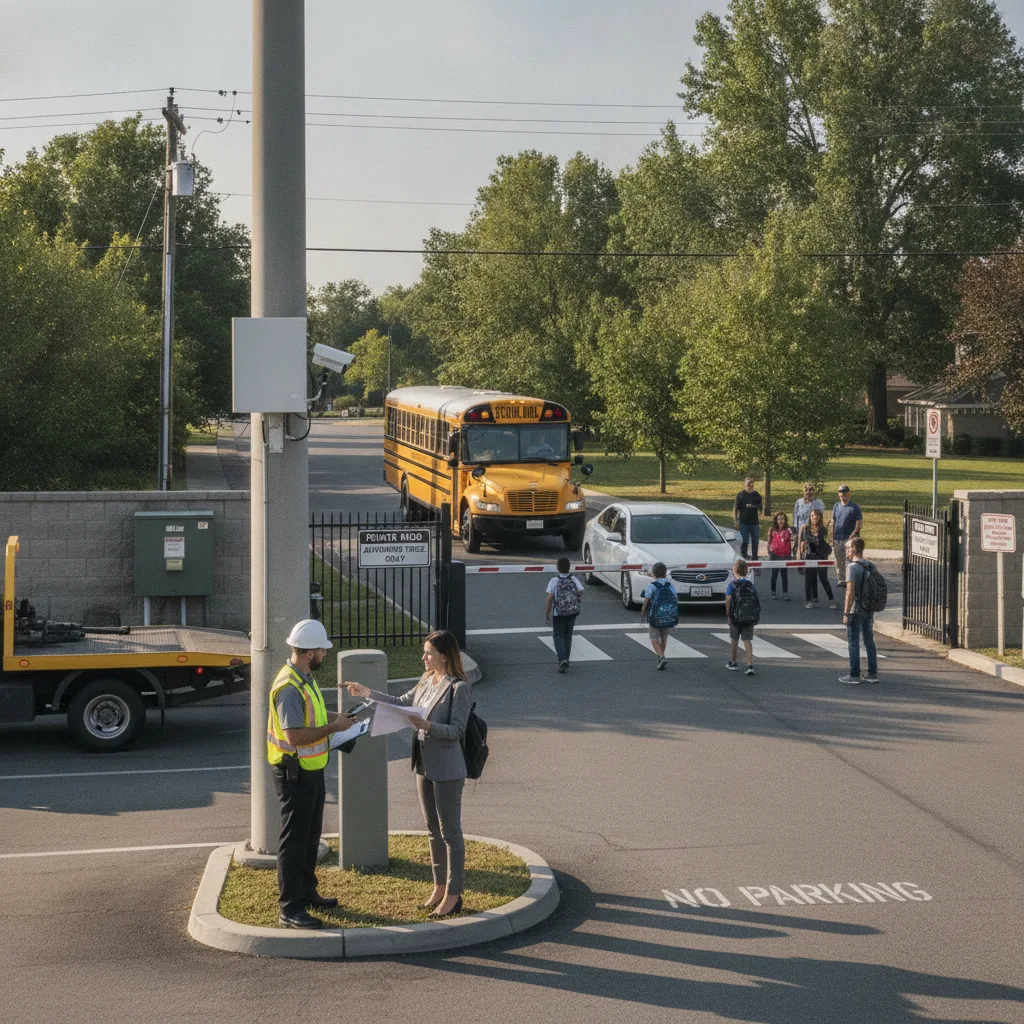
An ALPR camera mounting safety review should happen before any HOA, apartment, or private-road installation. Confirm property control, right-of-way permission, clear-zone exposure, breakaway or shielded hardware, visibility, utilities, maintenance access, and inspection records before approving a pole, trailer, sign-mounted unit, or gate camera.
Key Takeaways
- Boards should review physical installation risk separately from privacy, data retention, police sharing, pricing, and plate-read accuracy.
- A useful site packet names who owns the installation point, who can approve work there, and who signs off after installation.
- Fresh July 30, 2026 reporting raised concerns that some roadside ALPR poles may lack crashworthy hardware or sit too close to travel lanes.
- FHWA guidance on roadside supports is a practical reminder: fixed roadside objects can become hazards when a driver leaves the roadway.
- The safest buyer response is not panic or vendor-bashing. It is a documented location, permit, hardware, visibility, and maintenance checklist.
What This Workflow Involves
This workflow adds a physical-site checkpoint to the camera approval packet. The board or operator starts with a map of every proposed device: entrance gate, exit lane, clubhouse lot, private road, visitor parking area, mobile trailer, speed-feedback sign, or pole near a roadway. Each location gets a separate owner, approval path, and installation standard.
The next step is to classify the location. A camera bolted to a building on association property creates a different risk profile than a standalone pole near a road, a trailer near a curve, or a unit mounted in a public right-of-way. A plate reader can be useful and still be the wrong physical object for a specific shoulder, curve, slope, or lane edge.
The deliverable is a short site packet: camera map, property-control note, required permit or no-permit memo, vendor installation responsibility, utility check, clear-zone or roadside-exposure note, visibility plan, maintenance access plan, post-install photo, and date for reinspection.
Why This Problem Is Showing Up Now
The Guardian reported on July 30, 2026 that roadside safety advocates are scrutinizing some Flock Safety automated license plate reader installations as potential roadside hazards. The report described concerns about stand-alone poles near roads, breakaway hardware, inspection markers, and right-of-way permitting. Flock told the Guardian it follows state and local requirements and planned to review camera pole installations across its network.
Public questions are moving in the same direction. In a recent public Cincinnati discussion about new Flock cameras, commenters asked why roadside ALPR poles would not have to follow state transportation rules and whether local officials or state DOTs should review them. Those comments are not factual authority, but they show the question boards should expect: who checked the bottom of the pole, not just the top of the camera?
Official roadway guidance explains why that question matters. The Federal Highway Administration says a clear zone is an unobstructed, traversable roadside area that gives a driver room to stop or recover after leaving the roadway. FHWA guidance on sign supports also explains that roadside supports within the clear zone should be breakaway, yielding, or shielded by a barrier or crash cushion.
The Core Operational Problem
The core problem is that ALPR buying conversations often skip the physical fixture. A board may ask whether the system reads plates, whether the data is private, whether police can search it, and whether the price fits the budget. Those are necessary questions. They do not answer whether the pole, trailer, or roadside object belongs in the proposed location.
Private communities can also confuse camera-placement terms. One placement conversation is about recognition quality: angle, lighting, speed, plate distance, lane width, and field of view. A separate placement conversation is about physical safety and authority: ownership, right-of-way, clear zone, crashworthy support, curb exposure, reflective visibility, utilities, and maintenance access.
Use PLACA.AI’s Flock Safety alternatives for HOA communities guide for vendor and governance comparison, but make the site packet its own approval artifact. A privacy policy cannot fix a pole that was installed in the wrong place.
Evidence And Source Context
The July 30 Guardian report focused on public-road examples and safety advocates’ concerns. It should not be read as proof that every ALPR camera is unsafe or improperly installed. The operational lesson for private communities is narrower: do not assume a camera vendor, city, HOA, or management company has already completed the same physical review that a roadside sign, light pole, or utility fixture might receive.
FHWA’s guidance on roadside sign supports explains that supports can become hazards when struck and describes breakaway, yielding, or shielded designs for supports in a clear zone. FHWA’s clear-zone guidance frames the design goal as giving errant vehicles a recoverable roadside area and reducing crash severity.
Flock Safety’s License Plate Reader Policy, last updated June 30, 2026, lists LPR data categories such as plate image, vehicle image, vehicle characteristics, plate number, plate state, date, time, and camera location. That policy is useful for data review, but a board should also verify the separate physical work order, permit responsibility, and inspection record for each camera location.
ALPR Camera Mounting Safety Checklist
| Checkpoint | Question to answer | Record to keep |
|---|---|---|
| Property control | Is the proposed fixture on association property, private owner property, a utility easement, municipal right-of-way, or state right-of-way? | Parcel map, easement note, owner approval, or permit memo |
| Approval authority | Who can approve the work: board, manager, municipality, DOT, utility, developer, or private-road owner? | Resolution, written authorization, permit, or counsel note |
| Roadside exposure | Could a vehicle leaving the lane strike the pole, trailer, sign frame, cabinet, solar mast, or foundation? | Site photo, distance measurement, speed context, curve or slope note |
| Crashworthy treatment | If the object sits in an exposed roadside area, is it breakaway, yielding, shielded, relocated, or engineer-reviewed? | Hardware spec, vendor installation sheet, engineer or agency approval |
| Visibility | Can drivers, maintenance crews, and emergency responders see the object at night and during weather? | Reflective treatment, lighting note, photo after dark if needed |
| Utilities and maintenance | Will installation, battery swaps, cleaning, snow removal, landscaping, or repairs create new hazards? | Utility check, maintenance access route, service responsibility |
| Post-install inspection | Does the installed device match the approved location, height, hardware, setback, and orientation? | Completion photos, checklist signoff, next review date |
When A Gate-Mounted Camera May Be Simpler
A camera mounted on an existing gate structure, building, canopy, or private entrance fixture may avoid some roadside-pole questions. It still needs an installation review, but the risk profile can be easier to manage because the object may already be part of the entrance design and within the association’s control.
That does not mean every gate camera is automatically acceptable. The board should still confirm mounting height, angle, lighting, line of sight, pedestrian paths, emergency access, utility routing, and whether the installation interferes with gate operation. For broader private-community planning, use the HOA license plate recognition camera planning guide alongside the physical site packet.
When A Standalone Pole Needs Extra Review
A standalone pole or trailer deserves more scrutiny when it sits near a curve, lane edge, shoulder, sidewalk, drainage ditch, slope, school route, bike path, parking-lot drive aisle, or maintenance path. The closer the device is to vehicle movement, the more important it becomes to document who reviewed location, hardware, and visibility.
Ask the vendor and the approving authority direct questions: who selected the exact spot, what standard was used, whether a permit was required, whether breakaway or shielding was considered, who owns repair after impact, and whether the fixture must move if the road is resurfaced, widened, or re-striped.
If the answers are vague, do not approve the location as-is. Move the device to a controlled fixture, use an existing structure where allowed, request an engineering review, or choose a deployment model that avoids adding a fixed roadside object.
Risks, Limitations, And Exceptions
This article is not engineering or legal advice. A private road, public street, gated entrance, apartment drive aisle, and state right-of-way can each trigger different standards. A board should use counsel, the road owner, the permitting agency, or a qualified engineer when the location sits near vehicle paths or outside association-controlled property.
Do not turn the checklist into fear-based messaging. ALPR cameras can support vehicle access, incident review, and parking workflows when they are governed well. The point is to reduce uncertainty before installation, not to imply that every camera pole is dangerous or every vendor is careless.
Also separate physical safety from data governance. A well-mounted camera can still have weak privacy controls. A privacy-first camera can still be badly located. Boards need both reviews before launch.
Worked Example: Private Road Entrance Near A Curve
A 340-home HOA wants two ALPR cameras at a private-road entrance. The first quote places one camera on the gatehouse wall and one on a new pole near the outbound lane because the plate angle is better. The pole location is close to a curve where delivery trucks sometimes swing wide.
The board pauses the quote and builds a site packet. Management confirms that the gatehouse wall is association property and the wall-mounted camera does not affect the lane edge. The outbound pole is more complicated. The association asks the vendor for the exact hardware spec, setback, foundation detail, maintenance access plan, and whether a breakaway or shielded support is appropriate. Counsel checks whether the road easement allows a new fixture.
After review, the board chooses a revised location on an existing private entrance structure with a slightly different camera angle. The read-rate test still passes, and the board avoids adding a new fixed object near the curve. That decision record is more useful than a generic claim that the system was installed safely.
Frequently Asked Questions
Does an HOA need an engineer for every ALPR camera?
No. A camera mounted on an existing building or gate structure may only need normal vendor and property-owner review. A standalone pole, trailer, sign-mounted unit, or fixture near a travel lane may need permitting, agency, counsel, or engineering input depending on location and local rules.
Is camera placement for plate accuracy the same as roadside safety review?
No. Plate accuracy focuses on angle, lighting, distance, speed, and image quality. Roadside safety review focuses on whether the physical object is allowed, visible, maintainable, and crashworthy or shielded when exposed to vehicle movement.
What should the board ask a vendor before approving a pole?
Ask who selects the exact location, who obtains permits, what hardware is used, whether breakaway or shielding applies, who inspects the installation, who owns repairs, and what happens if the road owner requires the device to move.
Can this checklist apply to apartments and parking operators?
Yes. Apartment communities, private lots, mixed-use properties, and campus parking teams should use the same logic for entrances, drive aisles, mobile trailers, and roadside fixtures. The authority and permitting path may differ, but the physical questions are similar.
How should this affect a Flock replacement comparison?
Use the checklist for any provider, including Flock, PLACA.AI, or another ALPR vendor. A fair comparison should cover data ownership, access, retention, support, camera fit, and the physical installation model for each proposed location.
Related PLACA Resources
- Use Flock Safety alternatives for HOA communities when comparing ownership, sharing, contract, and deployment tradeoffs.
- Review the PLACA.AI vs Flock Safety comparison when the board needs a direct vendor framework.
- Start physical and operational planning with the HOA license plate recognition camera planning guide.
- Use the LPR camera and software comparison guide when camera type, placement, and workflow fit are still open.
Next Step
Before approving an ALPR quote, ask for a one-page site packet for every proposed device. If a location cannot show property authority, permit status, roadside exposure, hardware treatment, visibility, maintenance access, and inspection ownership, hold that location until the missing answer is documented.