

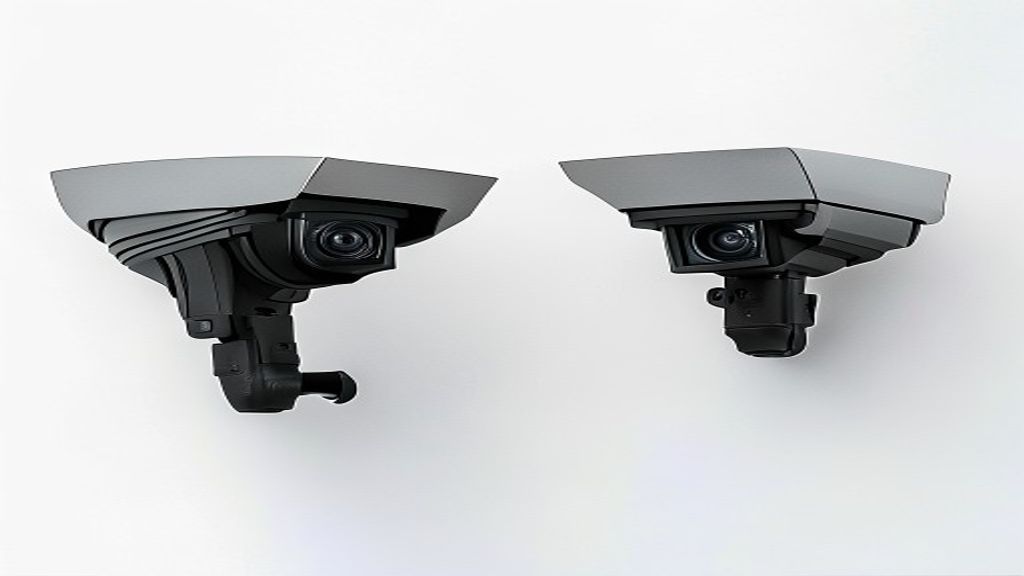
dedicated lpr camera vs software anpr cost
Software-based ANPR (Automatic Number Plate Recognition) running on standard IP cameras delivers 95–99% daytime accuracy for controlled-access scenarios at 5–10x lower total cost than dedicated LPR camera systems. For small properties — HOAs, parking lots, schools, and small businesses — software LPR is the economically rational choice in most deployments.
Key Takeaways
- Dedicated LPR cameras cost $742–$2,500+ per unit; comparable quality IP cameras cost $50–$150
- Software LPR on existing cameras eliminates hardware replacement cost entirely for properties with IP cameras already installed
- For a 2-gate property, software LPR saves $3,000–$10,000 in first-year costs versus dedicated hardware
- 3-year total cost of ownership (TCO): software LPR typically costs 70–85% less than dedicated hardware systems
- Accuracy trade-off: dedicated hardware wins at high speed (highway) and extreme weather; software LPR is equivalent for gate/lot applications under 15 mph
What Are Dedicated LPR Cameras?
Dedicated LPR cameras (also called ANPR cameras or LPR hardware) are purpose-built cameras with integrated processing chipsets, specialized IR illuminators, and firmware optimized for license plate capture. Unlike standard IP cameras that record general-purpose video, dedicated LPR cameras are tuned for one thing: reading plates accurately at speed, in all lighting conditions, at longer distances.
Software LPR (or software ANPR) is an AI application that performs the same plate recognition function by processing video from any standard IP camera supporting RTSP or ONVIF. The recognition runs in software — either in the cloud or on a local server — rather than being embedded in camera hardware.
Hardware Cost Comparison
| Camera Type | Price Range | Examples |
|---|---|---|
| Dedicated LPR / ANPR camera | $742–$2,500+ per unit | Axis P1448-LE LPR, Hanwha XNO-8080R, Genetec AutoVu |
| High-end IP security camera | $150–$400 | Hikvision DS-2CD2T87G2-L, Axis P3245-V, Dahua IPC-HFW5849H |
| Mid-range IP camera (LPR-capable) | $70–$150 | Hikvision DS-2CD2143G2-I, Amcrest IP8M-2493EW, Dahua IPC-HDW2849H |
| Budget IP camera (LPR-capable) | $30–$70 | Reolink RLC-810A, Reolink RLC-823A |
A property with 2 entry gates needs 2 cameras. Dedicated LPR hardware: $1,484–$5,000+ in cameras alone. Mid-range IP cameras: $140–$300 for the same 2 cameras. If the property already has IP cameras installed, the hardware cost for software LPR is $0.
Full Cost Breakdown: 2-Gate Property Over 3 Years
| Cost Item | Dedicated LPR System | Software LPR (placa.ai) |
|---|---|---|
| Camera hardware (2 cameras) | $1,484–$5,000 | $0 (existing) or $100–$300 (new) |
| NVR or on-premise server | $500–$2,000 | $0 (cloud-based) |
| Professional installation | $500–$2,000 | $0 (self-install, 30–60 min) |
| Software license (3 years) | $0–$1,200 (varies by vendor) | ~$900–$1,800 (published monthly rate) |
| Maintenance and support | $200–$600/year | Included in subscription |
| Camera replacement (3-year cycle) | $742–$2,500 per camera | $50–$150 per camera |
| 3-Year Total (2 gates) | $3,500–$14,000+ | $900–$3,000 |
Hidden Costs of Proprietary Dedicated LPR Systems
Vendor Lock-In
Most dedicated LPR camera vendors tie their cameras to proprietary management software. Axis cameras work with Axis Camera Station or AXIS LPR. Genetec AutoVu requires Genetec Security Center. Switching software vendors means replacing cameras — a forced hardware refresh cycle that doesn’t exist with software LPR on standard IP cameras.
Professional Installation Requirements
Dedicated LPR systems often require professional installation due to proprietary firmware, NVR configuration, and integration with gate controllers. Installation fees of $500–$2,000 are common. Software LPR on RTSP cameras can be self-installed by following a RTSP URL setup guide — no technician required.
NVR / Server Requirements
Many dedicated LPR systems require a proprietary NVR or on-premise server for processing. This adds $500–$2,000 in hardware, requires IT management, and creates a single point of failure. Cloud-based software LPR requires no on-premise server — the cloud handles processing.
Maintenance and Firmware Updates
Proprietary LPR systems charge for firmware updates, extended support contracts, and replacement parts that are only available through the original vendor. Standard IP cameras used with software LPR are commodity hardware — maintenance is cheaper, and replacement cameras cost $50–$150 rather than $742–$2,500.
When Dedicated LPR Hardware Is the Right Choice
Software LPR is not always the better option. Dedicated hardware is justified when:
- High-speed capture: Vehicles passing at 30+ mph (highway ramp meters, toll systems, law enforcement) require dedicated LPR hardware with fast shutter speeds and specialized optics
- Extreme weather conditions: Dedicated cameras with external housing ratings (IP66/IP67/IK10) and heated enclosures are more durable in extreme environments than standard IP cameras
- Long-distance reads: Plate capture at 50+ feet requires dedicated optics and illuminators that standard IP cameras don’t provide
- Regulatory requirements: Some law enforcement and government applications require certified LPR hardware for admissibility of evidence
For the HOA, school, parking lot, or small business use case — vehicles at gate speed (5–10 mph), gate distances of 10–30 feet, standard weather — software LPR on IP cameras is functionally equivalent and dramatically cheaper.
Accuracy Comparison in Controlled-Access Scenarios
| Condition | Dedicated LPR Camera | Software LPR on IP Camera | Winner |
|---|---|---|---|
| Daytime, gate speed (5–10 mph) | 99%+ | 95–99% | Tie (both excellent) |
| Nighttime, IR illuminated | 97%+ | 85–95% | Dedicated (marginal advantage) |
| Moving vehicles, 30+ mph | 95%+ | 50–70% | Dedicated (significant advantage) |
| Partial plates or damaged plates | 80%+ | 70–80% | Dedicated (slight advantage) |
| 4K resolution, optimal setup | 99%+ | 97%+ (at gate speed) | Tie |
For a gated HOA community, school driveway, or parking lot entrance where vehicles slow to gate speed, the accuracy difference between dedicated hardware and software LPR on a quality IP camera is negligible. The 2–5% gap in challenging nighttime conditions rarely matters in practice — a 95% read rate means 1 in 20 vehicles may need to use a backup entry method (intercom, key code), which is acceptable for most properties.
Break-Even Calculator: How Many Gates Justify Dedicated Hardware?
For most small properties, software LPR breaks even on cost in month 1. But the crossover point where dedicated hardware becomes cost-competitive depends on scale:
- 1–4 gates: Software LPR is almost always cheaper over 3 years
- 5–10 gates: Software LPR remains cheaper; dedicated hardware TCO approaches parity around 8–10 gates with volume pricing
- 10+ gates, high-speed application: Dedicated hardware may be justified by accuracy requirements, not cost
For a 4-gate HOA: software LPR over 3 years ≈ $1,800–$3,600. Equivalent dedicated hardware system: $6,000–$20,000+. The savings fund years of subscription fees even at the premium end of software pricing.
Frequently Asked Questions
Can software LPR replace a dedicated LPR camera entirely for HOA access control?
For the typical HOA gate scenario — vehicles entering at 5–10 mph, gate distance of 10–25 feet, a combination of daytime and nighttime reads — yes. Software LPR on a quality 1080p or 4MP IP camera with proper IR illumination achieves accuracy rates that are operationally indistinguishable from dedicated hardware for most HOA boards. The remaining accuracy gap (2–5%) affects edge cases that can be handled with a backup entry method.
What happens if the software LPR vendor shuts down? Am I stuck with hardware I can’t use?
Unlike dedicated LPR systems where cameras are tied to a specific vendor’s software, IP cameras used with software LPR remain standard RTSP devices. If you switch from placa.ai to another software provider, your cameras work with any RTSP-compatible LPR software. You are never locked into a single vendor relationship.
Are there dedicated LPR cameras that work with third-party software?
Some do. Cameras from brands like Axis, Hanwha, and Pelco can connect to third-party LPR software via RTSP. However, these cameras still cost $742–$2,500+ each — you’re paying the hardware premium without necessarily getting the interoperability benefit. The economic case for dedicated LPR hardware in small-property applications is weak unless the use case genuinely requires it.
Does software LPR work in parking garages with low light?
Yes, with the right camera. Parking garages typically have ambient artificial lighting. In well-lit garages, even a basic IP camera without IR will produce adequate image quality for LPR. In dimly lit garages, an IR-capable camera is recommended. The key is consistent, even illumination of the license plate area — which garages typically provide via overhead lighting.
Stop paying for hardware you don’t need
placa.ai works with IP cameras you already own. No dedicated LPR hardware required. Start for free and see the accuracy with your existing cameras before committing to any plan.
Data reference: EFF: Automated License Plate Readers