

help your school improve the pickup
Help Your School Improve the Pickup Line
A practical guide for parents who want faster, safer school dismissal — with an email template you can send to your principal or PTA today.
Staff stays in control — no surveillance
QR code option available for privacy-sensitive families
Sound Familiar? You’re Not Alone.
School pickup shouldn’t feel like a daily stress event. But for millions of families, it does. Here’s what we hear from parents most often:
⏰ 30-45 Minute Waits
Every afternoon, parents sit in a line that barely moves. Staff are overwhelmed. Cars block traffic. It’s unpredictable and exhausting.
📄 Paper Tag Chaos
Tags get lost, forgotten, soaked in the rain, or used by the wrong person. There’s no way to know if the person holding a paper tag is actually authorized.
🌦️ Rainy Day Nightmares
When it rains, pickup takes twice as long. Tags are wet. Windows won’t roll down. Staff can’t read names. Everyone is frustrated.
👩👧 Grandparent & Relative Confusion
When grandma or a neighbor needs to pick up, parents have to call the school, explain the situation, and hope the message got through. Every time.
📵 No Pickup Record
When a parent asks “who picked up my child today?” there’s often no clear answer. No log. No timestamp. No confirmation.
😬 Anxious Moments
Parents worry every day: Is dismissal running late? Did my child get in the right car? Is there a system if something goes wrong?
A Safer Pickup Line Is Within Reach — And You Can Help Start the Conversation
You don’t have to be on the school board or the PTA to make a difference. A single well-written note to the principal can open the door to a pilot program that changes dismissal for your whole school.
Here’s what you can ask your school to consider:
- A digital pickup authorization system where parents control who is allowed to pick up their child
- A QR code pickup option for families who prefer not to register a license plate
- Staff-controlled dismissal approval — no student is released without a staff member confirming authorization
- Temporary pickup permissions for grandparents, neighbors, and carpool partners that expire automatically
- A dismissal log so parents can see who picked up their child and when
- A pilot program starting with one lane, one grade, or one dismissal period
Copy This Email and Send It to Your Principal Today
Personalize the bracketed fields and hit send. You can CC the PTA president if you’d like school leadership to hear it at the same time.
Hello [Principal Name],
I hope you're doing well. I wanted to share a possible solution for improving our school pickup line.
Many parents have noticed that dismissal can become slow, stressful, and confusing—especially when different family members or authorized pickup people are involved. We've had situations where grandparents or neighbors needed to pick up our child, and the process felt unclear and uncertain for everyone involved.
I recently came across Placa.ai, a school pickup platform that helps schools manage pickup using vehicle recognition, QR code options, parent authorization, and staff-controlled dismissal approval. Parents can authorize specific pickup people, set day-of-week restrictions, and revoke access instantly. Staff still approves every dismissal—no automation replaces the human decision.
The company offers a pilot program where schools can start with a single lane, one grade level, or just the afternoon dismissal period. There's no long-term commitment required to evaluate it.
Would you be open to reviewing whether a small pilot could help our school improve safety and reduce pickup delays? I'm happy to share more information or connect you with the Placa.ai team.
Thank you for everything you do for our school community.
Warm regards,
[Parent Name]
[Student Name], [Grade]
Ready to Bring This to Your Next PTA Meeting?
Use these talking points to start a productive conversation at the next PTA/PTO meeting. See the full PTA school pickup safety guide for a complete agenda and survey template.
Staff stays in control
Placa does not automatically release students. Every dismissal requires a staff member to review and approve the release. The app gives staff better information, not less authority.
QR code option for privacy-sensitive families
Parents who prefer not to register a license plate can use a QR code shown on their phone. Same authorization check. Full privacy choice.
Pilot before full adoption
Schools don’t have to commit to a campus-wide rollout. A one-lane or one-grade pilot program lets everyone evaluate the system with minimal disruption.
Grandparents and carpools included
Parents manage temporary pickup permissions for grandparents, relatives, and carpool partners. Time-limited authorizations expire automatically. No more front-office calls.
Privacy-first design
Placa reads vehicle plates — not student faces or biometric data. See our school pickup privacy page for full details on data handling.
Less staff stress
Teachers and aides spend dismissal managing students — not deciphering paper tags in the rain or answering radio calls about unfamiliar vehicles.
Tell Us About Your School’s Pickup Line
Nominate your school for a free pickup line review. Placa’s team will reach out to assess your current setup and explain what a pilot would look like for your specific campus.
To nominate your school, send an email with:
• Your school name and city/state
• Your biggest pickup line pain point
• Approximate average wait time
• Optional: principal name and email
📧 Nominate My School via Email
Or request a school pickup safety review at: placa.ai/demo-form
Everything Parents Need to Know About School Pickup Safety
Student Pickup Line App — How Placa Works for Schools
School Pickup Pilot Program — One Lane or One Grade
PTA Guide to School Pickup Safety
School Pickup App FAQ — Common Parent Questions
School Pickup App Privacy and Parent Choice
FERPA, Privacy & LPR for School Pickup
Ready to Nominate Your School?
It takes 2 minutes. No commitment. Just start the conversation.
Request a School Pickup Safety Review
Data reference: National Center for Education Statistics
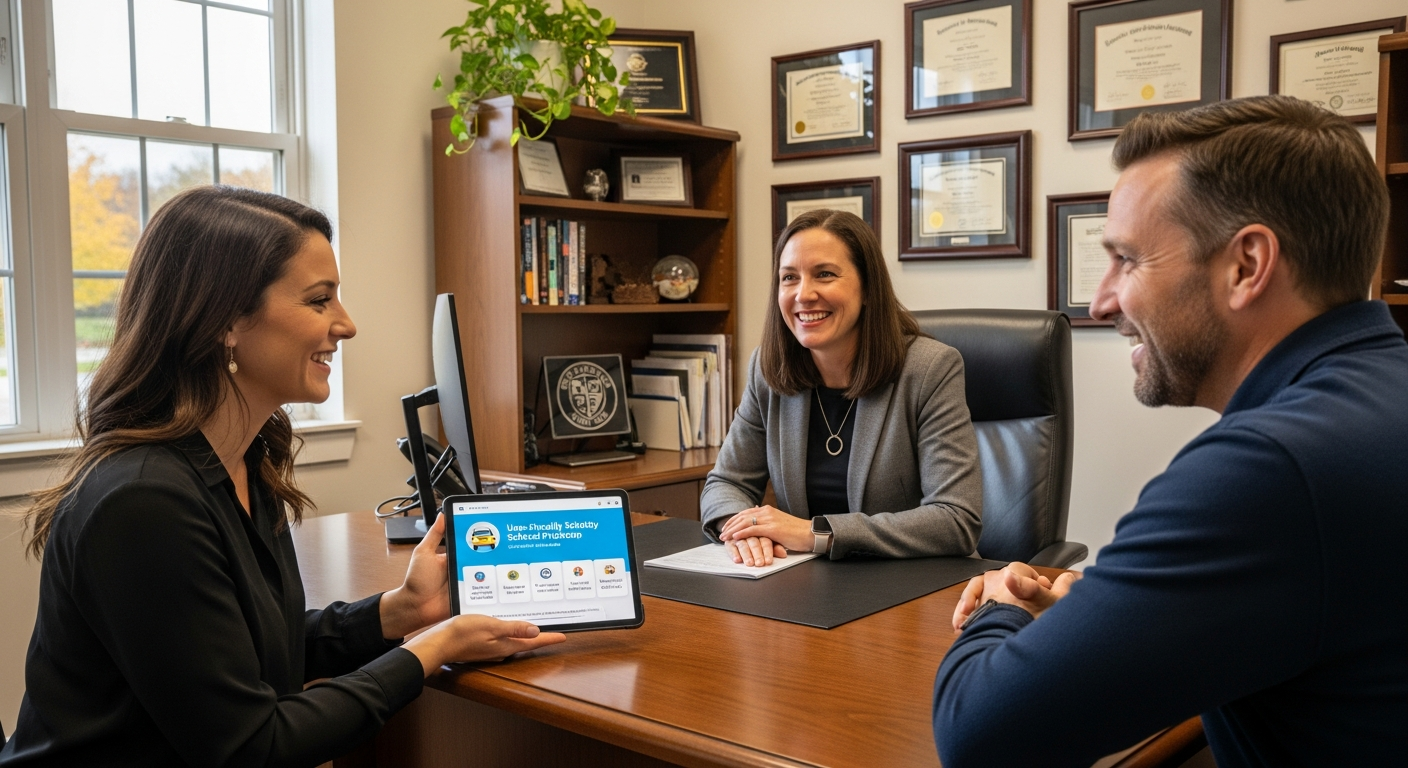
How Parents Can Help Their School Improve the Pickup Line
Parent advocacy is one of the most effective drivers of school dismissal improvement. When parents collectively identify pickup line problems and present technology-based solutions to administrators, schools are more receptive to piloting new systems. Understanding how to frame the request increases the likelihood of a positive response from principals and school boards.
How should parents document pickup line problems?
Parents can document pickup line inefficiency by recording average wait times over two weeks, noting specific incidents where students were staged incorrectly, and tracking days when the line extended onto public roads. Concrete data-average wait time of 18 minutes, line extending 400 feet past school property-is more persuasive to administrators than general complaints about delays.
What organizations support school transportation improvement?
National organizations including the National School Transportation Association and the National Center for Safe Routes to School provide research and guidelines on dismissal safety. Referencing these organizations’ data in parent presentations adds credibility to improvement proposals. School administrators respond well to requests backed by national safety standards and peer-reviewed transportation research.
What is the best format for a parent pickup line improvement proposal?
A one-page executive summary with three supporting pages of data performs well with school administration. The summary should state the current problem, propose a specific solution (such as LPR-based dismissal), include projected time savings based on comparable school implementations, and outline a pilot program structure. Attaching a vendor comparison or product overview as an appendix gives administrators a starting point for further research without burdening the main proposal.
How long does school administration typically take to evaluate pickup proposals?
Evaluation timelines vary by district. Independent schools often make decisions within four to six weeks. Public schools with board approval requirements may take one to two semesters. Submitting proposals at the beginning of a school year or immediately after budget season opens positions the request for funding consideration in the next fiscal cycle. Following up at PTA meetings keeps the proposal visible without creating administrative pressure.
What pilot program structure works best for school pickup improvements?
A single-grade pilot-typically kindergarten or the largest grade-allows schools to test a dismissal system with a controlled group before full implementation. Pilots run for four to six weeks, long enough to capture routine dismissal conditions and resolve setup issues. Data collected during the pilot (average wait times, read accuracy, parent satisfaction) provides the evidence needed for school-wide rollout approval.
Can parent groups fundraise for school pickup technology?
Yes. PTA and PTO organizations can fundraise for school safety technology in states where this is permissible under school board policy. Some schools have funded LPR camera installations through parent organization drives, reducing the district’s technology budget burden. Grant opportunities from state transportation safety departments and private foundations focused on K-12 operations are also available for qualifying schools.
What should parents expect during the first month of a new pickup system?
The first month involves a learning curve for parents and staff. Parent enrollment in the registration portal typically reaches 70 to 80 percent by week two. Weeks one and two see elevated missed reads as families register plates and adjust approach habits. By week three, most schools report smooth operation with missed-read rates under five percent. Full-year performance data shows consistent improvement as the parent enrollment reaches 90 percent or above.
Parents who understand the steps to help their school improve the pickup line are better positioned to advocate effectively, reduce dismissal delays, and contribute to a safer departure process for all students at their campus.
What technology features matter most for school dismissal safety?
School dismissal safety technology should prioritize accurate student-to-guardian matching, real-time departure logging, and exception handling for unauthorized pickup attempts. Systems that combine vehicle identification (LPR or QR scanning) with a digital guardian authorization database eliminate the documentation gaps that exist in paper car tag systems. Mobile notifications for parents confirm when their child has been released, closing the loop between school and home at the end of every school day. Schools that implement multi-factor dismissal safety-vehicle ID plus registered guardian confirmation-reduce unauthorized release incidents to near zero compared to tag-only systems.
How do schools communicate pickup system changes to families?
Schools typically use email, school app notifications, and printed flyers sent home to communicate dismissal system changes. A two-week notice period before go-live allows families to register plates and ask questions before the system is active. Schools that host a brief informational session-in person or via video-report faster parent adoption rates. Clear communication about privacy practices (what data is collected, how it is stored, and who can access it) reduces parent concerns and increases registration completion rates before the first live dismissal day.
Dismissal system improvements that reduce average pickup time from 18 minutes to under 6 minutes represent a measurable quality-of-life improvement for parents, reduced neighborhood traffic complaints for the surrounding community, and lower afternoon supervision costs for schools. The best pickup systems pay for themselves through operational savings within the first two school years of deployment. Schools that successfully improve their pickup lines often become models for neighboring campuses, with district administrators citing them as proof-of-concept implementations that justify broader technology investment across the district.