

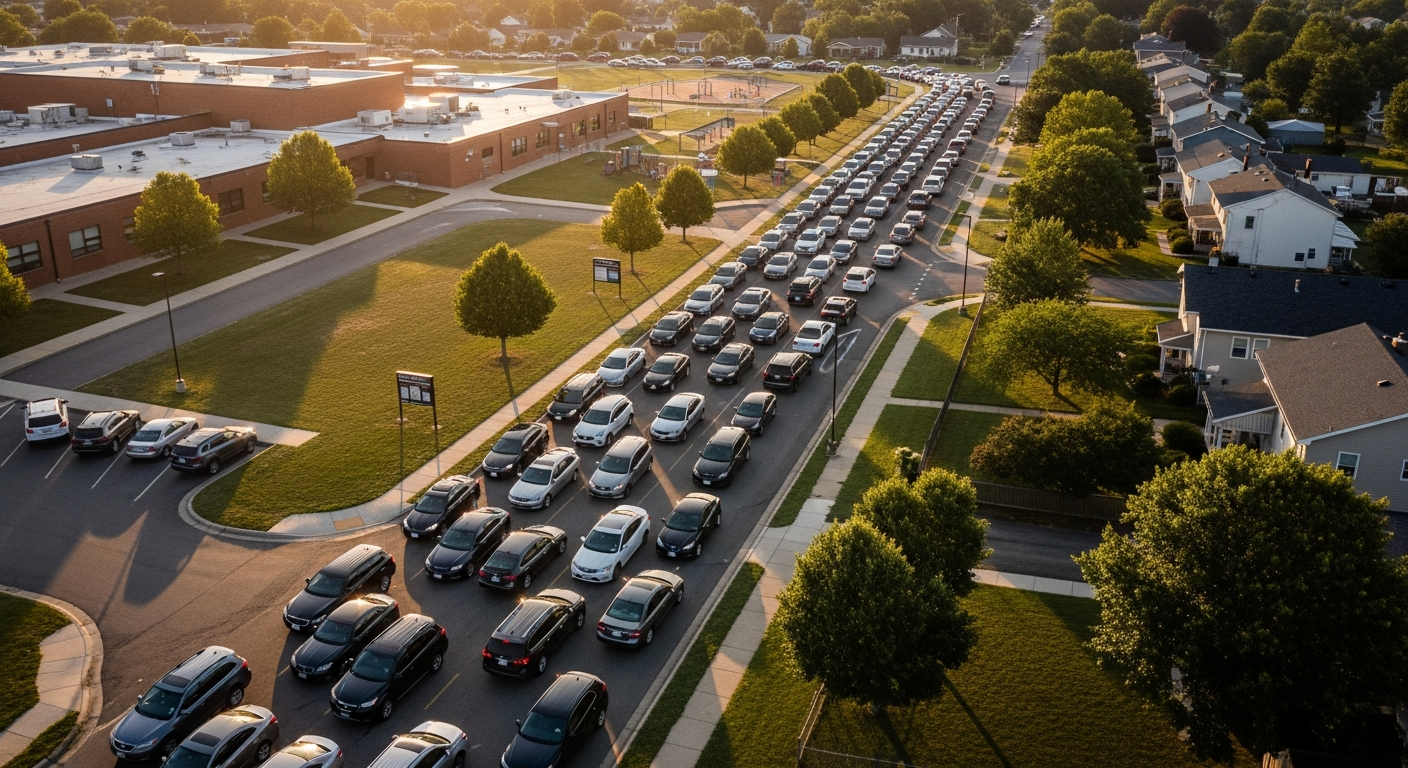
why school pickup lines are slow
The school pickup line is one of the most common frustrations in K-12 education. Parents wait 30-45 minutes for a process that should take under 10. Here is why it takes so long – and what schools can do about it.
The Fundamental Problem: Too Many Cars, Too Little Coordination
Most school pickup lines were designed when elementary schools had 200 students and every child was picked up by one parent in one car. Today, schools have 400-800+ students, multiple authorized pickup people per child, carpools, after-school program releases, bus dismissals, and sibling groups – all moving through the same physical space with no real coordination system.
Paper car tags were never designed to handle this complexity. They were a quick solution to a simple problem. The problem has grown; the solution has not.
5 Specific Reasons School Pickup Lines Are So Slow
1. Staff Can’t Read Tags Until Cars Reach the Front
The biggest bottleneck in most car lines is that staff cannot identify which student to call until the car reaches the front of the line. Every car that arrives is unknown until it is within arm’s reach of a staff member. This creates a stop-and-wait pattern throughout the entire queue.
A student pickup line app with vehicle recognition solves this: staff knows who is arriving before the car reaches the front, so the student can be called and staged for pickup while the car is still in line.
2. Radio Communication During Dismissal Is Slow and Unreliable
In a typical school pickup, one staff member at the curb radios or calls another staff member to find and send the student. This relay system introduces a 1-3 minute delay per vehicle. Multiply that by 200 cars and you have hours of cumulative delay every week.
3. Temporary and Unfamiliar Pickups Take Longer
When an unfamiliar car arrives – grandparent, neighbor, carpool partner – staff must stop, verify authorization, call the front office, wait for confirmation, and then proceed. Each of these events can add 5-10 minutes to the line while other cars wait behind.
See how parent-controlled authorization handles grandparents and temporary pickups automatically.
4. Rain, Wind, and Weather Make Everything Worse
Paper tags become illegible. Windows fog up. Parents avoid rolling down windows. Staff can’t see the tag. Students crowd under the overhang instead of lining up in order. A bad weather day can double dismissal time at many schools.
5. No Proactive Staging of Students
Without advance notice that a specific parent is arriving, staff cannot prepare students ahead of time. Students are assembled at the exit only after the car reaches the front – adding another waiting cycle for every pickup.
Is your school pickup line ready for a safer system?
Schedule a free 15-minute school pickup safety review. No commitment required.
What a Faster School Pickup Line Looks Like
Schools using a digital school car rider dismissal system report 40-60% reduction in average dismissal time. The core difference is pre-notification: staff knows who is coming before the car arrives.
Want to see what this looks like on your campus? The one-lane pilot program lets schools test the improvement with minimal disruption before any campus-wide decision.
Frequently Asked Questions
Data reference: National Center for Education Statistics – Public School Enrollment Data
How Schools Can Reduce Pickup Line Wait Times
Schools that deploy license plate recognition technology can significantly reduce average wait times during afternoon dismissal. Rather than staff members checking clipboards or walkie-talkying student names to classrooms, the LPR system identifies arriving vehicles automatically and queues the correct student in the dismissal management software. Staff receive the notification before the car reaches the front of the line, allowing the handoff to happen in seconds rather than minutes.
Parent communication also affects line efficiency. Schools that send daily pickup time reminders, stagger dismissal by grade level, and provide a real-time queue status update through a parent app see measurable reductions in the peak traffic surge that creates the worst bottlenecks. Combining operational scheduling improvements with LPR-based identification typically delivers the fastest results.
About Placa.ai
Placa.ai is a license plate recognition platform designed for property managers, HOA boards, school administrators, and parking operators who need reliable vehicle identification without enterprise-level complexity. The system pairs high-accuracy LPR cameras with cloud software that delivers real-time alerts, access logs, and direct integration with gate control systems.
Communities and facilities using Placa.ai gain automated vehicle identification that works around the clock. Setup typically takes one to two hours per camera, and the management dashboard is ready immediately after camera enrollment. All plate data is encrypted in transit and at rest, stored in compliance with applicable data protection standards, and accessible through the web portal or mobile app.
Placa.ai serves residential communities, commercial parking facilities, self-storage operators, K-12 schools, and private road associations across the United States. The platform scales from single-camera residential installations to multi-site enterprise deployments with centralized management.
To learn more or schedule a demo, visit placa.ai.
How to Improve Elementary Pickup Lines
For younger students, the next step is usually a tighter routine. See the best practices for elementary school pickup lines.
Related planning resource: one-lane pilot before changing the whole pickup line.