

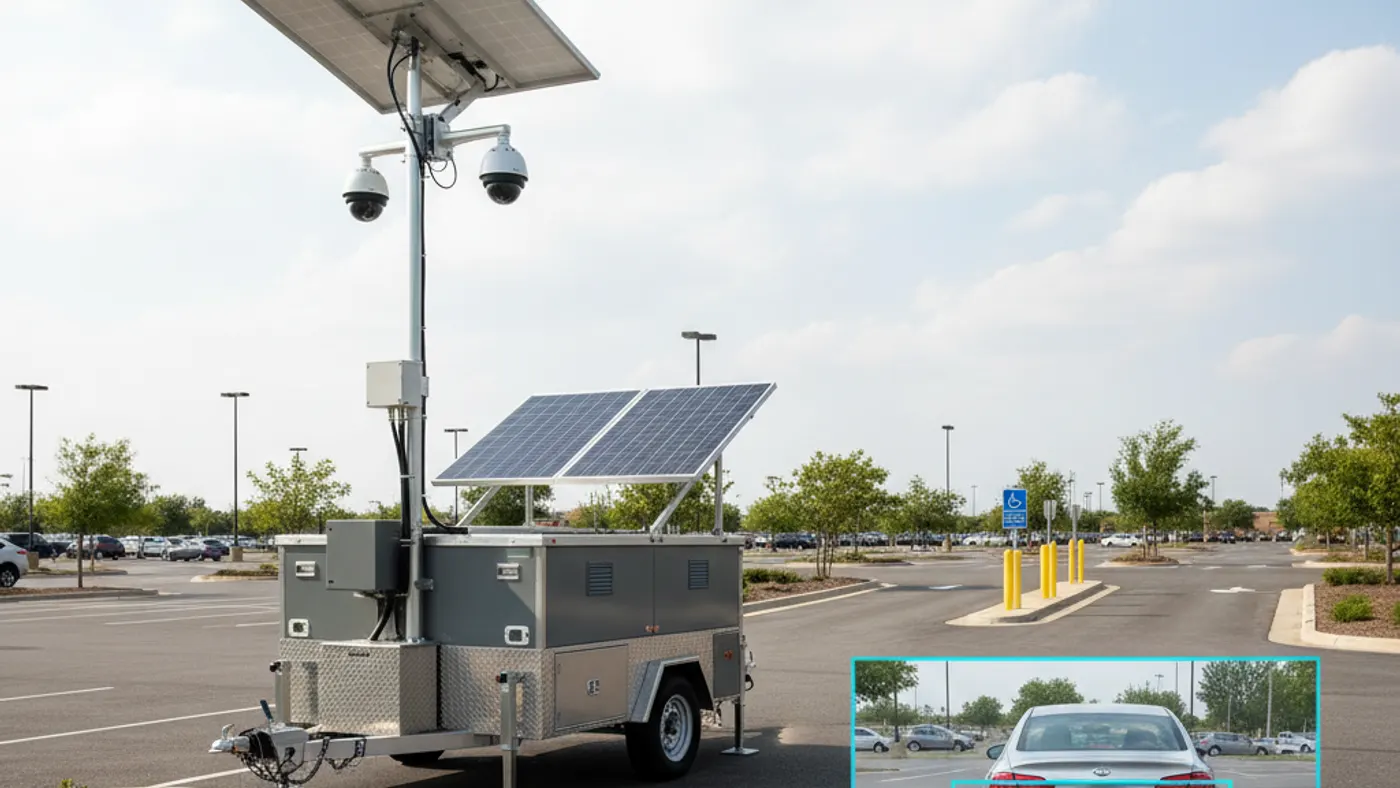
Direct answer: Treat any statement that a solar trailer configuration was tested as evidence for that documented configuration—not universal compatibility. Record camera, lens, firmware, mounting, distance, illumination, power, network, site, and acceptance results before reusing the conclusion.
This guide is for solar trailer providers, security integrators, property owners, network teams, and LPR operators and addresses validating solar trailer camera systems for mobile LPR. Separate what the system detects from what an authorized person may decide.
Set a narrow outcome
A successful demo can be overgeneralized after the camera, trailer position, carrier, scene, speed, or firmware changes.
Example: A configuration that reads slow vehicles at a controlled gate may not meet the same target on a wide parking-lot approach. Both deployments need their own evidence.
Tested-configuration evidence sheet
| Decision point | Evidence or control | Required response |
|---|---|---|
| Hardware identity | camera, lens, firmware, trailer components | record exact configuration |
| Scene and mounting | distance, angle, height, lanes, speed | capture deployment geometry |
| Infrastructure | power, network, stream, environmental conditions | test continuity and recovery |
| Acceptance result | sample size, day/night cases, failure modes | limit claim to evidence |
Turn the rule into action
- Step 1. Review hardware identity: camera, lens, firmware, trailer components; then record exact configuration.
- Step 2. Review scene and mounting: distance, angle, height, lanes, speed; then capture deployment geometry.
- Step 3. Review infrastructure: power, network, stream, environmental conditions; then test continuity and recovery.
- Step 4. Review acceptance result: sample size, day/night cases, failure modes; then limit claim to evidence.
Test the least convenient scenario, not only the happy path.
Stop conditions
Retest after material changes and avoid a blanket supported-hardware claim when the available evidence covers only a bounded configuration.
Correct the record, approve a bounded exception, deny under the documented rule, or escalate to the named authority; do not leave the case open-ended.
Baseline and pilot
A rollout should stop when required evidence is missing.
- configurations with complete records
- day and night plate samples reviewed
- events recovered after connectivity loss
- material changes triggering retest
- claims traceable to acceptance evidence
Define who counts each measure, the observation period, and the result that prevents expansion.
Proof before rollout
- State the purpose and non-goals for validating solar trailer camera systems for mobile LPR.
- Assign owners for the normal path, correction, exception, and final approval.
- Test live conditions with the people who administer and experience the workflow.
- Confirm contracts, pricing, integrations, support, data handling, and governing requirements independently.
- Retain the evidence needed to reproduce an approval, denial, correction, or escalation.
Related PLACA.AI planning resources
Operational FAQs
What should be approved first for validating solar trailer camera systems for mobile LPR?
Approve the purpose, responsible owner, decision rule, required evidence, and exception path before selecting a broad rollout.
What should the pilot prove?
The pilot should reproduce the normal path and the exception described above, while collecting configurations with complete records and the other named measures.
When should implementation stop?
Stop when the required evidence is unavailable, ownership is unclear, a serious exception has no safe route, or the actual result conflicts with the approved rule.
Plan a limited workflow review
Bring the current rule, process, exceptions, and success criteria for validating solar trailer camera systems for mobile LPR. PLACA.AI can help evaluate a bounded pilot without assuming another property’s workflow is the right answer.
Editorial refresh: July 22, 2026. Independently confirm current product capabilities, third-party features, pricing, contracts, governing requirements, and local rules before acting.
Internal Resources
- How Repo and Tow Operators Can Prioritize High-Risk Lots With Mobile LPR Workflows
- How HOA Patrol Operators Can Identify Repeat Violators With Mobile LPR Workflows
- How Private Property Towing Companies Can Compare Patrol Software With Mobile LPR Workflows
Data source: Electronic Frontier Foundation: License Plate Readers