

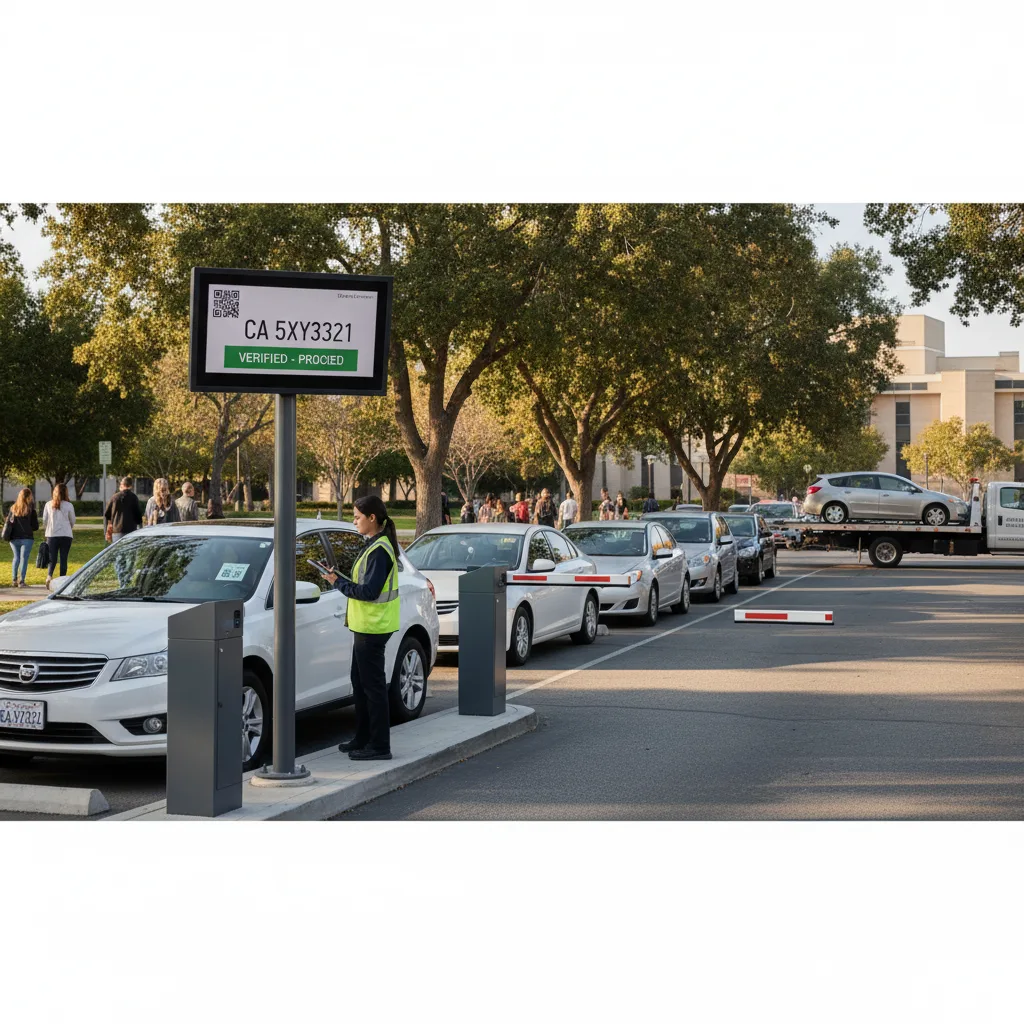
Direct answer: Normalize and join the QR checkout’s property, zone, entered plate, state, rate, duration, payment status, effective window, receipt, and enforcement feed. Treat a plate read as a matching signal, not proof of payment or violation. For connecting QR parking sessions to license plates for operators, record the responsible owner, the accepted outcome, the reason for each correction, and the measured result for paid sessions joined correctly before expanding the process.
This guide is for parking operators, drivers, finance teams, support staff, enforcement teams, and integrators and addresses connecting QR parking sessions to license plates for operators. Use real site conditions, current records, and named responsibilities.
Make the rule testable
Formatting, a mistyped character, delayed synchronization, or multiple vehicles can leave a valid payment unmatched.
Example: A driver who enters O instead of 0 needs an auditable correction path before enforcement treats the session as absent.
Operator QR-to-plate join
| Decision point | Evidence or control | Required response |
|---|---|---|
| Checkout | property, zone, entered plate, duration, rate | confirm transaction |
| Normalization | plate format, state, confidence, aliases | prepare match |
| Entitlement | payment, effective window, feed status | publish to patrol |
| Reconciliation | mismatch, correction, refund, disposition | close records |
Run the controlled process
- Step 1. For checkout, verify property, zone, entered plate, duration, rate and then confirm transaction.
- Step 2. For normalization, verify plate format, state, confidence, aliases and then prepare match.
- Step 3. For entitlement, verify payment, effective window, feed status and then publish to patrol.
- Step 4. For reconciliation, verify mismatch, correction, refund, disposition and then close records.
Every open exception needs an owner and expiry.
Handle edge cases
Unreadable plates, shared vehicles, delayed feeds, device barriers, and failed payments require human recovery.
Correct the record, approve a bounded exception, deny under the written rule, or escalate to the named authority; do not leave the case unresolved.
Test before scaling
Run a limited test long enough to observe the recurring pattern and at least one correction or fallback.
- paid sessions joined correctly
- plate-entry corrections
- entitlements visible on time
- unmatched payments
- enforcement mismatches resolved
Define who counts each measure, the observation window, and the result that blocks expansion.
Evidence to retain
- State the purpose and non-goals for connecting QR parking sessions to license plates for operators.
- Assign owners for the normal path, correction, exception, and final approval.
- Test live conditions with the people who administer and experience the workflow.
- Confirm contracts, pricing, support, integrations, data handling, and governing requirements independently.
- Retain enough evidence to reproduce each approval, denial, correction, or escalation.
Related PLACA.AI planning resources
Implementation questions
What must be approved first for connecting QR parking sessions to license plates for operators?
Approve the purpose, owner, evidence standard, decision rule, and exception path before scaling.
What should the pilot reproduce?
Test the normal process and the named exception while collecting paid sessions joined correctly and the other listed measures.
When should rollout stop?
Stop when ownership is unclear, required evidence is missing, a serious exception lacks a safe route, or the result conflicts with the approved rule.
Plan a limited workflow review
Bring the current rule, process, exceptions, and success criteria for connecting QR parking sessions to license plates for operators. PLACA.AI can help evaluate a bounded pilot without assuming another property’s workflow is the right answer.
Editorial refresh: July 22, 2026. Independently confirm current product capabilities, third-party features, pricing, contracts, governing requirements, and local rules before acting.
Data source: U.S. Department of Transportation