

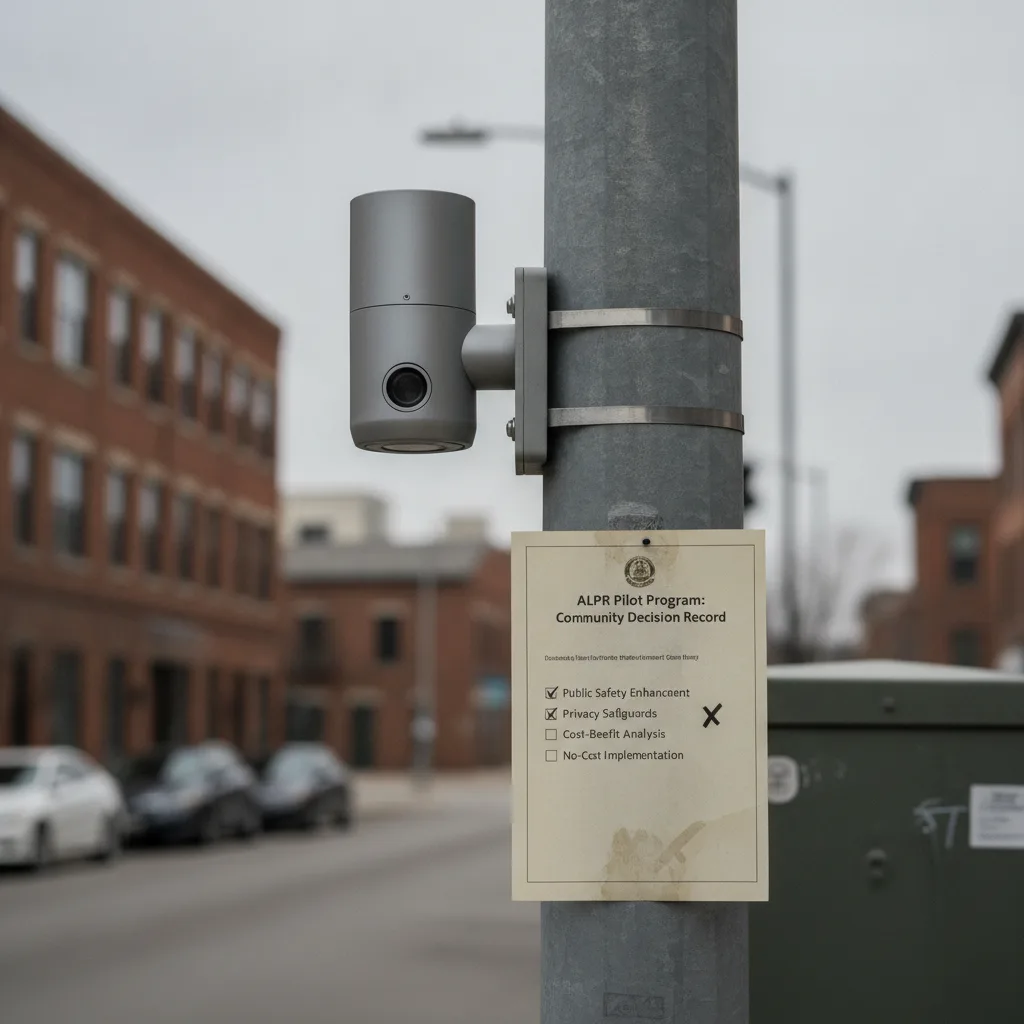
Los Angeles did not vote to build a permanent citywide plate-reader program on October 27. The City Council’s 9–6 vote on the Axon Lightpost item fell short of the ten votes needed to veto the Police Commission-approved memorandum, allowing the reported no-cost, three-month pilot to proceed. That is a narrow public decision. It is also a useful reminder for any buyer considering a no-cost ALPR pilot: a zero-dollar offer can still create a very real operating commitment.
The hard part of a trial is not mounting a camera. It is deciding, before the first alert or plate read, what the trial is allowed to prove—and what happens if it proves less than promised. LAist’s reporting and the Council File establish the current event; neither turns one municipal pilot into a template for every city, HOA, school, garage or gate.
A no-cost ALPR pilot is still an operating commitment
Direct answer: treat a no-cost ALPR pilot as a bounded procurement and operations decision, not as a free preview. Before activation, the buyer should put the purpose, data, access, evaluation and end-state in writing. That is Placa analysis, not a universal legal rule; local law, procurement policy and the actual agreement can add requirements.
Why be this formal about a short pilot? Because the price is only one term. A camera can generate images, plate reads, timestamps, vehicle attributes or other derived outputs depending on its configuration. Those are not interchangeable things. Nor does the fact that a camera captures an image establish who can search records, how long material is retained, whether it is shared, or whether an audit trail exists. The pilot record is where a buyer makes those distinctions visible enough to evaluate.
What Los Angeles decided—and what it did not
The official Council vote record lists the October 27 result as 9–6, and notes that vote results are provisional until entered in the Council Journal. LAist reported that the result left the Council short of the veto threshold and allowed a no-cost, three-month Axon Lightpost automated license-plate-reader pilot to proceed.
It did not, by itself, show that every camera is already operating, establish a permanent program, or settle what a private-property owner should buy. It also does not let an outside reader infer the pilot’s retention, sharing, access or configuration details from the word “pilot.” Those details must come from the governing documents and the implemented system—not from a headline.
The five lines a pilot decision record should contain
A useful record can fit on a page, but it should force five specific answers before installation. The goal is not paperwork for its own sake. It is to make the decision at the end of the trial easier, more accountable and less vulnerable to momentum. A no-cost ALPR pilot needs a decision record before it needs a launch date.
| Decision to write down | What the buyer should be able to point to | Why it belongs before activation |
|---|---|---|
| Purpose and boundary | The exact problem, locations, hours and exclusions; for example, gate access or parking entry rather than an open-ended surveillance purpose. | A trial cannot be evaluated if its job keeps expanding. |
| Output and retention | Which outputs are expected—images, plate reads, metadata or derived events—and the applicable retention and deletion terms. | Capture, extraction and retention are different decisions with different consequences. |
| Access and sharing | Named roles, permitted searches, account lifecycle controls, audit evidence and any sharing pathway that the agreement actually authorizes. | Access is not implied by installation, and sharing is not implied by capture. |
| Evaluation evidence | The baseline, measures, false-positive or exception review, operational owner and review date. | A dashboard without a decision rule is just activity, not an evaluation. |
| Off-ramp and next decision | The end date and the choices available then: continue, purchase, re-scope, remove equipment, preserve required records or delete under the governing terms. | A temporary installation otherwise has a habit of becoming the default. |
For public buyers, procurement rules, public-records duties, labor agreements and local policy may add to this list. For private property, the questions still matter, but the responsible parties and notices may be different. The point is not to pretend the two settings are the same; it is to stop calling a trial “simple” when the decision it creates is not.
Build the exit test while nobody wants to end the project
The camera cannot choose the success metric
“We got useful reads” is not enough. A no-cost ALPR pilot should state what operational outcome would justify the next step. At a garage, that could be a measurable reduction in entry exceptions paired with a documented manual fallback. At a gate, it could be faster verified access without turning a plate read into the only credential. In a public setting, the relevant standard may be defined by the authorizing body rather than by a vendor presentation.
An evaluation metric needs a decision rule
Before the pilot starts, assign someone to review the evidence and name the possible outcomes. If the pilot misses the agreed measure, who can end it? If it succeeds, does success authorize a purchase, a new procurement, a narrower second test or only a recommendation? The answers prevent a favorable anecdote from silently becoming a renewal decision.
Removal needs a record too
The off-ramp is more than taking hardware down. It should identify who confirms the asset state, what happens to accounts and access, which records must be retained under the agreement or law, and how the buyer verifies the chosen disposition. That is not an allegation about Los Angeles’s arrangement. It is the practical control that turns a pilot into a reversible test.
Private-property LPR should start with the workflow, not the streetlight
A city streetlight pilot may be relevant news, but it is a poor default design for a private lot, HOA entrance, campus gate or parking operation. For a no-cost ALPR pilot on private property, a buyer should begin with the narrow job: authorize entry, reconcile a permit, manage an exit exception or document an event. The distinctions in public-safety ALPR networks and private-property LPR systems matter here because a municipal program can have purposes, oversight and access paths that a property workflow neither needs nor should assume.
That is where Placa has a more concrete role than a generic closing paragraph. Placa’s published parking entry, exit and permit workflows give a buyer a way to frame a pilot around an actual operating problem. Its Terms say the software works with security cameras that support ONVIF or RTSP, subject to the Terms’ limits. For a buyer, that means camera compatibility can be evaluated as part of a scoped test rather than assuming a packaged streetlight network is the only path.
The same Terms distinguish Data, Operational Data and De-Identified Data and contain data-use provisions. That is a reason to ask for the relevant agreement language—not a reason to make a broad marketing promise about ownership, retention, third-party access or sharing. The signed documents and implemented configuration must answer those questions for the particular pilot.
The practical standard: write the end state before the start
Los Angeles’s vote is consequential because it allowed a specific, time-limited pilot to move forward. The buyer lesson is not “free cameras are safe” or “all pilots are suspect.” It is simpler: before a camera goes live, write down what it is there to do, what it may create, who can use the output, how performance will be judged and how the test ends. That is what makes a no-cost ALPR pilot a test rather than an undefined deployment.
Buyers evaluating private-property alternatives to a broad LPR network should make that record part of the comparison. A pilot is valuable when it makes the next decision clearer. It is risky when it postpones the decision until the system is already difficult to unwind.