

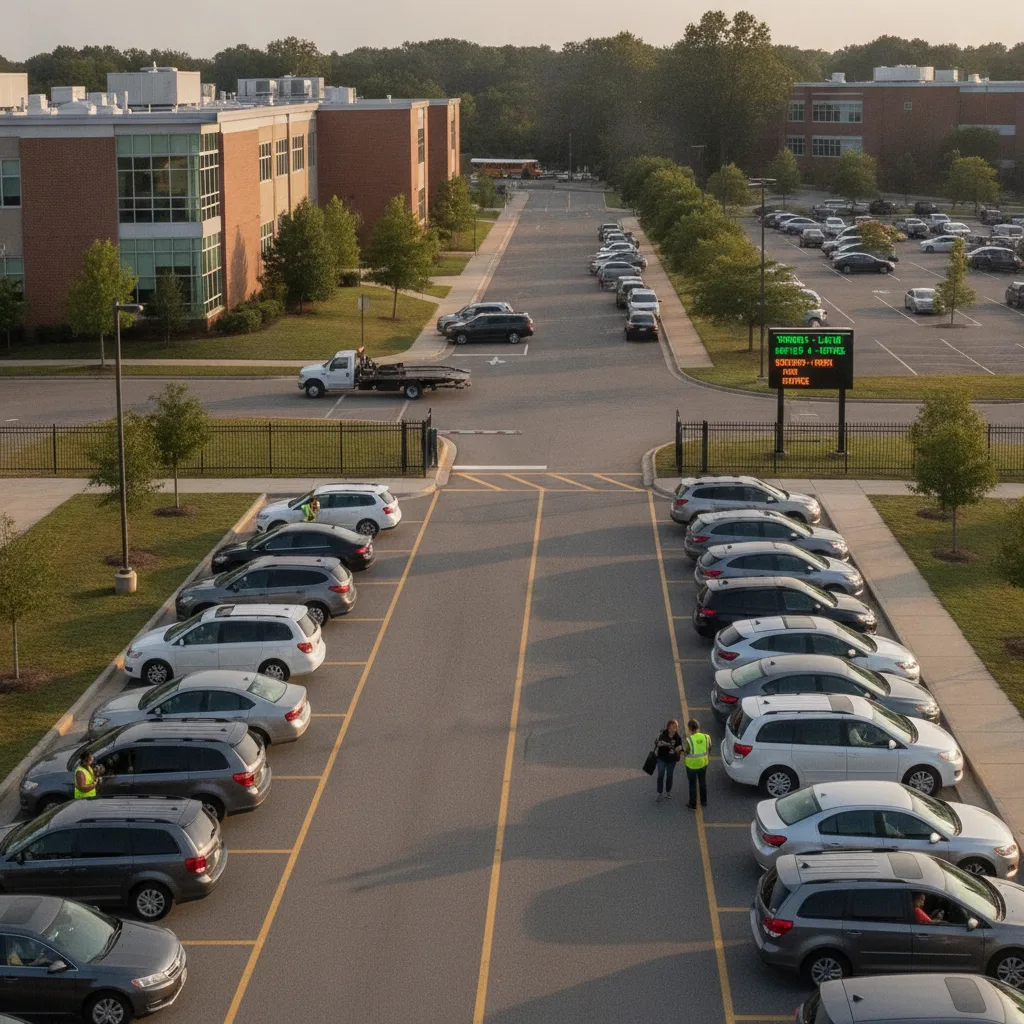
Direct answer: Standardizing dismissal across a K-12 system means agreeing on one thing only: what “released” means and who is accountable for it, at every grade band, on every campus. Everything else — which door, which lane, whether it’s a car line or a walk-up gate, how sibling groups are handled — can and should stay local, because an elementary carline and a high school parking lot are not the same problem wearing different signage.
This overview is for superintendents, cabinet-level administrators, school boards, and any K-12 team trying to decide how much dismissal should look the same across an elementary school, a middle school, and a high school in the same district. It’s meant as a starting point before drilling into the specifics that differ by role — an elementary principal’s dismissal problem and a district operations team’s dismissal problem overlap, but they are not identical, and a policy written for one often doesn’t fit the other without translation.
Why “Same Platform” Doesn’t Mean “Same Process”
A district can put every campus on the same dismissal software and still end up with six different definitions of what counts as a completed release. An elementary school with 400 six-year-olds who cannot self-report anything treats “released” as the moment a staff member physically hands a child to a verified adult. A high school with 1,800 students who drive themselves, walk to a bus stop unsupervised, or get picked up in a parking lot the size of a shopping center treats “released” as the moment the bell rings, full stop. Both are reasonable given the age group. The problem isn’t that they’re different — it’s that nobody wrote down that they’re supposed to be different, so when a parent complaint or an incident report moves from campus to district office, everyone is arguing from a different mental model of what happened.
What Actually Needs to Be Shared District-Wide
| Element | Should be standardized district-wide? | Why |
|---|---|---|
| Definition of “released” / “handoff complete” | Yes | Needed for incident review, audits, and cross-campus reporting to mean the same thing |
| Who owns an unresolved dismissal case | Yes | A missing-child or custody question can’t wait on a campus figuring out its own chain of command in the moment |
| Physical layout — doors, lanes, staging areas | No | An elementary carline and a high school lot have different geometry, traffic patterns, and staffing |
| Grade-appropriate verification method | No | A kindergartner needs a staff-confirmed adult handoff; a senior needs a parking permit and a bell |
| Sibling and multi-child household handling | Partially | Elementary needs coordinated sibling release; secondary rarely does, but cross-campus siblings (elementary + middle) need a shared record |
The Elementary-to-Secondary Gap Most Policies Miss
The single biggest standardization failure in K-12 dismissal isn’t between two elementary schools — it’s between elementary and secondary campuses in the same feeder pattern. A parent with a kindergartner and a seventh grader is dealing with two completely different dismissal experiences on the same afternoon, and if the district’s custody or authorized-pickup record isn’t shared across both campuses, a restriction entered at the elementary school after a custody change may never reach the middle school where the older sibling attends. That’s not a hypothetical edge case; it’s one of the more common gaps districts find once they actually audit whether campus records agree with each other.
A Practical Starting Sequence
- Pick one shared definition of “released” and write it in one sentence campuses can’t reinterpret.
- Inventory how each campus currently verifies a pickup — staff memory, a laminated card, a phone app, a vehicle check — without changing anything yet.
- Identify where custody restrictions and authorized-pickup lists are stored, and confirm whether a change at one campus actually reaches a sibling’s campus.
- Pilot the shared definition at two dissimilar campuses — one elementary, one secondary — before writing district-wide policy.
- Set a single escalation path for unresolved cases (missing student, disputed pickup, unclear authorization) that works the same way regardless of grade band.
Signals That Standardization Is Actually Working
- A custody restriction entered at one campus shows up automatically for a sibling at another campus in the same district
- An incident report from an elementary carline and one from a high school lot use the same terms for “released,” “handoff,” and “unresolved”
- New principals can explain the district’s dismissal escalation path without calling the district office to check
- Front office staff at different campuses give the same answer when asked what happens when an unrecognized adult arrives for pickup
Where the Details Live
This overview intentionally stays at the policy level. The practical mechanics differ enough by audience that a single document can’t cover them well: an elementary principal needs to think about sibling groups and supervised handoffs the way a campus verifying authorized pickup vehicles does, while a district operations team needs to think about data governance and vendor consistency across dozens of campuses, and front office staff need a desk-level procedure for the parent standing in front of them right now. Vehicle-based verification — matching a car at the curb against an authorized-pickup record — is one tool that helps enforce a shared definition of “released” without forcing every campus to use identical physical layouts, but the tool only works once the underlying policy question is settled.
Related PLACA.AI planning resources
Common Questions
Does standardizing dismissal mean every campus needs the same carline layout?
No. Standardize the definition of a completed release and the escalation path for problems. Leave lane count, staging areas, and staffing to each campus’s actual geometry and enrollment.
Where do most districts find their biggest gap?
Between grade bands within the same feeder pattern — specifically whether a custody or authorization change at one campus reaches a sibling’s campus automatically.
Who should own this project?
It works best as a joint effort between district operations and campus leadership, piloted at contrasting campuses (one elementary, one secondary) before it becomes district-wide policy.
See how vehicle-based verification fits your standardization plan
Placa.ai’s license plate recognition can enforce a shared “released” definition at the curb across every campus in a district, without requiring identical physical layouts. If you’re mapping out what to standardize first, we can walk through it with you.
Editorial refresh: July 22, 2026. Independently confirm current product capabilities, third-party features, pricing, contracts, governing requirements, and local rules before acting.
Data source: National Center for Education Statistics