

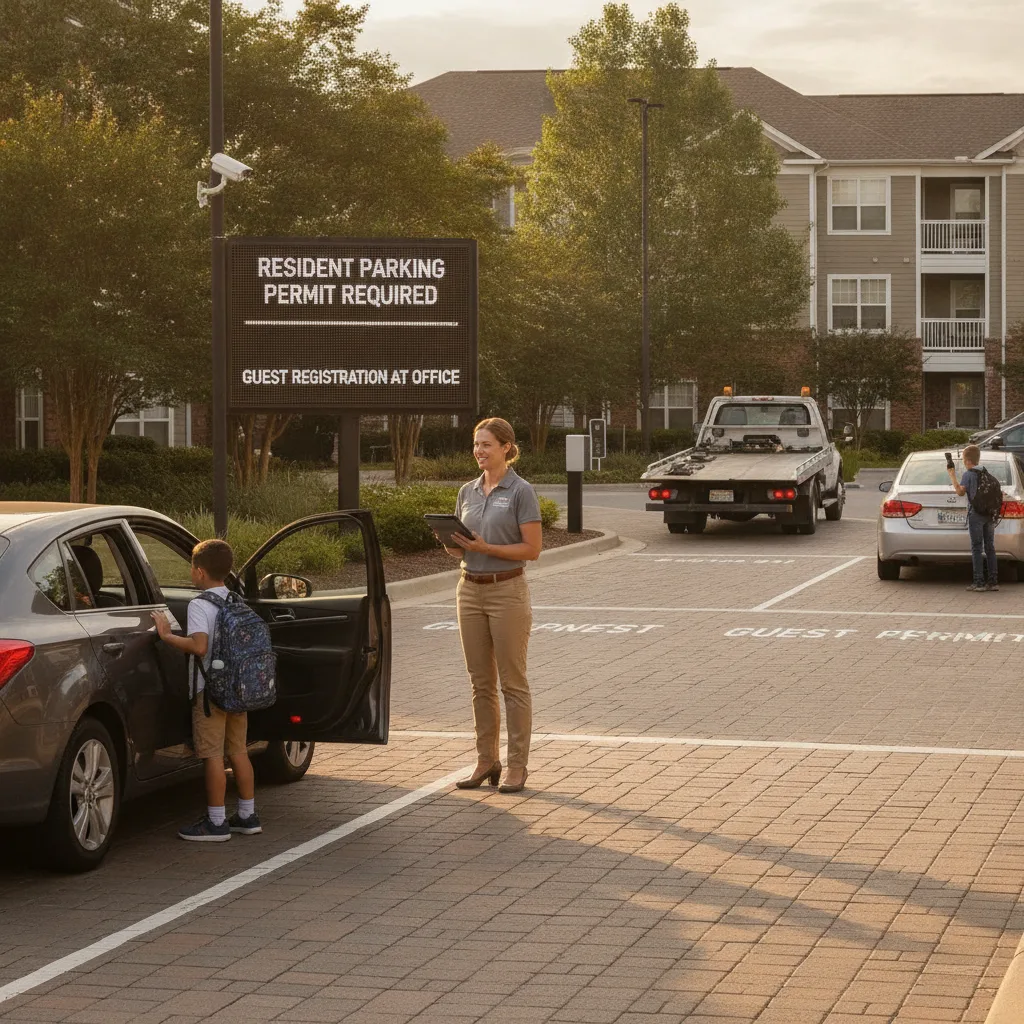
Direct answer: The fastest way to stop guest permit sharing without turning it into a resident-by-resident fight is to run one detection-and-response rule across every account in your portfolio, instead of building a custom process for each HOA client. Flag repeated use of a single guest credential across different plates, confirm the context with the sponsoring resident, and close the case with a consistent, logged outcome — the same four steps whether the property uses paper hangtags, a QR-based app, or plate recognition at the gate.
This guide is written for community management companies — the portfolio managers, regional supervisors, and on-site or after-hours staff who administer guest parking across a stack of HOA and condo accounts, not a single self-managed board running one property. The problem looks different at that scale: you’re not deciding what’s fair for one community, you’re deciding what’s repeatable across dozens of them, run partly by staff who weren’t at the property when the rule was written.
Permit sharing looks different at every property; your process shouldn’t
Every account on your books probably has a slightly different guest system. One HOA still uses paper hangtags residents photocopy for visiting family. Another runs a resident-facing app where a guest code gets texted out and, inevitably, forwarded to whoever needs it that weekend. A third has moved to plate-based guest registration tied to a gate camera. If you build a separate sharing-detection process for each of those systems, your team can’t move between properties without relearning the rules, and any HOA board that asks “how do you catch this?” gets a different answer depending on which manager they talk to.
The fix is to standardize on what you’re actually looking for, not on the system that surfaces it: the same guest credential — a code, a hangtag number, or a permit ID — showing up against multiple unrelated plates within a short window, at more than one property if your portfolio management software rolls up case data across accounts. That single pattern is detectable no matter what hardware a given HOA has, which means your process can be taught once and applied everywhere, including by a newer staffer covering an account they don’t know well.
Set the sharing threshold before you flag anything
A guest credential reused on a second plate is not automatically abuse. Households swap rental cars, a caregiver arrives in a different vehicle each visit, and front-desk staff mistype a plate on entry. If your threshold for “possible sharing” is too loose, you generate cases your team can’t clear fast enough across a large book of business, and residents at every property start hearing about parking disputes. If it’s too tight, sharing goes unaddressed until a board member complains that the same visitor pass has been used by five different cars all month.
| Trigger | What the manager checks | Standard portfolio response |
|---|---|---|
| Same credential, new plate within 24–72 hours | prior visit history, any correction entered at the gate or front desk | log as pending, no contact yet if this is the first repeat |
| Same credential, 3+ distinct plates in a rolling window | whether the sponsoring resident has an active exception on file (caregiver, rideshare-heavy household, rental) | contact sponsor, request current explanation before any action |
| Sponsor unresponsive or explanation doesn’t match the pattern | total distinct plates, dates, whether use continued after first outreach | expire the credential, issue a written notice under the community’s existing guest policy |
| Repeat after notice | case history from the first cycle | escalate to the property’s designated board contact, not a portfolio-wide override |
A four-step response your night or weekend staff can run without calling you
- Detect. The system or gate log surfaces a credential tied to more than one plate. No assumption of intent is made at this stage — this is a queue item, not an accusation.
- Verify with the sponsor. A short, neutral message to the resident who owns the permit: “We show this guest pass used on more than one vehicle recently — can you confirm who’s currently using it?” Most legitimate cases resolve here.
- Classify. Corrected entry error, approved household exception, or unexplained repeat use. Each gets a different, predefined next step so staff aren’t improvising a judgment call at 9 p.m. on a Saturday.
- Close and log. Every case ends with a recorded disposition — corrected, exception granted, credential expired, or escalated — tied to the account and date, so the next manager who touches that property can see exactly what happened without a phone call.
Keep HOA board politics out of the enforcement decision
The riskiest moment in this process isn’t catching the sharing — it’s when the flagged resident turns out to be a board member, a board member’s relative, or someone who complains loudly enough that a client HOA starts asking your company to make exceptions on the fly. A documented, portfolio-wide rule protects your staff here: the answer to “why was my guest pass flagged” is never “because a manager decided,” it’s “because this is the same threshold applied at every account we manage.” That consistency is also what you point to if a board later accuses you of enforcing rules selectively against certain residents — the case log shows the same rule fired the same way regardless of who was involved. For accounts where visitor-parking pressure goes beyond permit sharing into general overflow and guest abuse, it’s worth pairing this process with a broader visitor-parking policy the board has already approved, so your team isn’t inventing a response mid-shift.
Tracking it across a portfolio without a spreadsheet per property
Manual logs don’t scale once you’re past a handful of accounts — nobody on a rotating on-call schedule is going to maintain thirty separate tracking sheets accurately. The cases worth automating first are the ones with the clearest signal: repeated plates on one credential, and repeated violations after a documented notice. A shared resident parking report workflow that every property feeds into the same way makes it possible for one regional manager to spot a pattern across three communities that no single on-site team would ever notice on its own. Where a guest case escalates into an enforcement or towing decision rather than a simple permit correction, it also helps to have a shared exception-queue review step so nothing gets towed before a human confirms it isn’t a documented exception.
Rolling this out to a new client account in under a week
- Confirm what guest system the incoming HOA already uses — don’t require them to switch hardware just to adopt your sharing-detection rule.
- Set the same repeat-use threshold you use at every other account, unless the community’s governing documents require something different.
- Name a single escalation contact at the HOA board level before the first case comes up, not after.
- Give on-site or after-hours staff the same four-step script used everywhere else in the portfolio.
- Review the first 30 days of cases with the board so they see the pattern and the resolution rate before assuming the policy is working.
Related PLACA.AI planning resources
Questions to settle
What must be approved first for stopping guest permit sharing through community-management operations?
Approve the purpose, owner, evidence standard, decision rule, and exception path before scaling.
What should the pilot reproduce?
Test the normal process and the named exception while collecting alerts resolved through sponsor confirmation and the other listed measures.
When should rollout stop?
Stop when ownership is unclear, required evidence is missing, a serious exception lacks a safe route, or the result conflicts with the approved rule.
Plan a limited workflow review
Bring the current rule, process, exceptions, and success criteria for stopping guest permit sharing through community-management operations. PLACA.AI can help evaluate a bounded pilot without assuming another property’s workflow is the right answer.
Editorial refresh: July 22, 2026. Independently confirm current product capabilities, third-party features, pricing, contracts, governing requirements, and local rules before acting.
Data source: Community Associations Institute