

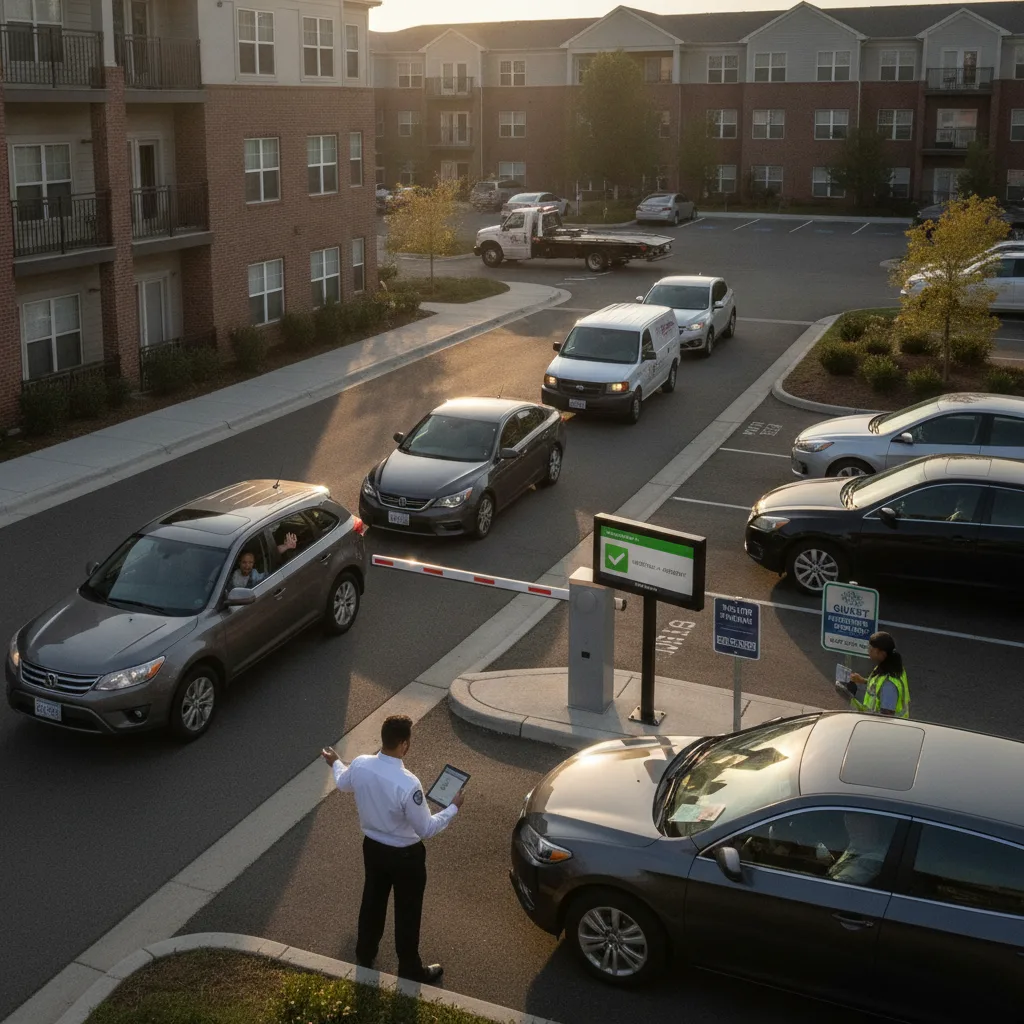
Direct answer: Reduce visitor parking abuse by separating legitimate guests, resident overflow, recurring service vehicles, and unauthorized storage. Give each category an eligibility rule, time limit, evidence standard, correction path, and escalation owner.
This guide is for HOA boards, managers, parking committees, residents, and enforcement vendors and addresses reducing visitor parking abuse through an HOA policy. Make the rule visible to the people who administer it and those affected by it.
The risk to remove
A single visitor label hides materially different uses and leads to selective enforcement when staff decide exceptions case by case.
Example: A weekend guest with a mistyped plate needs correction, while a resident vehicle repeatedly occupying visitor inventory needs the resident-overflow rule. The record should show why the outcomes differ.
Visitor-use classification table
| Decision point | Evidence or control | Required response |
|---|---|---|
| Short guest stay | resident sponsor and visit window | allow under guest rule |
| Recurring caregiver or service | purpose, schedule, expiry | use temporary exception |
| Resident overflow | ownership or household relationship | apply resident vehicle rule |
| Repeated unauthorized storage | dates, notices, evidence | follow approved escalation |
Sequence the daily work
- Step 1. Review short guest stay: resident sponsor and visit window; then allow under guest rule.
- Step 2. Review recurring caregiver or service: purpose, schedule, expiry; then use temporary exception.
- Step 3. Review resident overflow: ownership or household relationship; then apply resident vehicle rule.
- Step 4. Review repeated unauthorized storage: dates, notices, evidence; then follow approved escalation.
Close every case with an approved outcome or escalation.
Fallback and correction
Emergency, accessibility, caregiver, and contractor situations need documented handling. Governing documents, notices, towing, and local rules require qualified review.
Correct the record, approve a bounded exception, deny under the documented rule, or escalate to the named authority; do not leave the case open-ended.
Test the hardest cases
Compare the pilot with a written baseline.
- guest registrations matched to visits
- resident overflow identified correctly
- entry errors corrected before penalty
- repeat misuse after notice
- appeals resolved within policy time
Define who counts each measure, the observation period, and the result that prevents expansion.
What the owner verifies
- State the purpose and non-goals for reducing visitor parking abuse through an HOA policy.
- Assign owners for the normal path, correction, exception, and final approval.
- Test live conditions with the people who administer and experience the workflow.
- Confirm contracts, pricing, integrations, support, data handling, and governing requirements independently.
- Retain the evidence needed to reproduce an approval, denial, correction, or escalation.
Related PLACA.AI planning resources
Implementation questions
What should be approved first for reducing visitor parking abuse through an HOA policy?
Approve the purpose, responsible owner, decision rule, required evidence, and exception path before selecting a broad rollout.
What should the pilot prove?
The pilot should reproduce the normal path and the exception described above, while collecting guest registrations matched to visits and the other named measures.
When should implementation stop?
Stop when the required evidence is unavailable, ownership is unclear, a serious exception has no safe route, or the actual result conflicts with the approved rule.
Plan a limited workflow review
Bring the current rule, process, exceptions, and success criteria for reducing visitor parking abuse through an HOA policy. PLACA.AI can help evaluate a bounded pilot without assuming another property’s workflow is the right answer.
Editorial refresh: July 22, 2026. Independently confirm current product capabilities, third-party features, pricing, contracts, governing requirements, and local rules before acting.
Internal Resources
- How Event Valet Companies Can Track Repeat VIP Vehicles Using Ticketless Vehicle Recognition
- How Florida Associations Can Reduce Board Enforcement Disputes Without Creating Resident Friction
- How Florida Associations Can Manage Seasonal Resident Parking Changes Without Creating Resident Friction
- How Gated Communities Can Manage Seasonal Resident Parking Changes Without Creating Resident Friction
- How Gated Communities Can Protect Limited Guest Spaces Without Creating Resident Friction
Data source: Community Associations Institute