

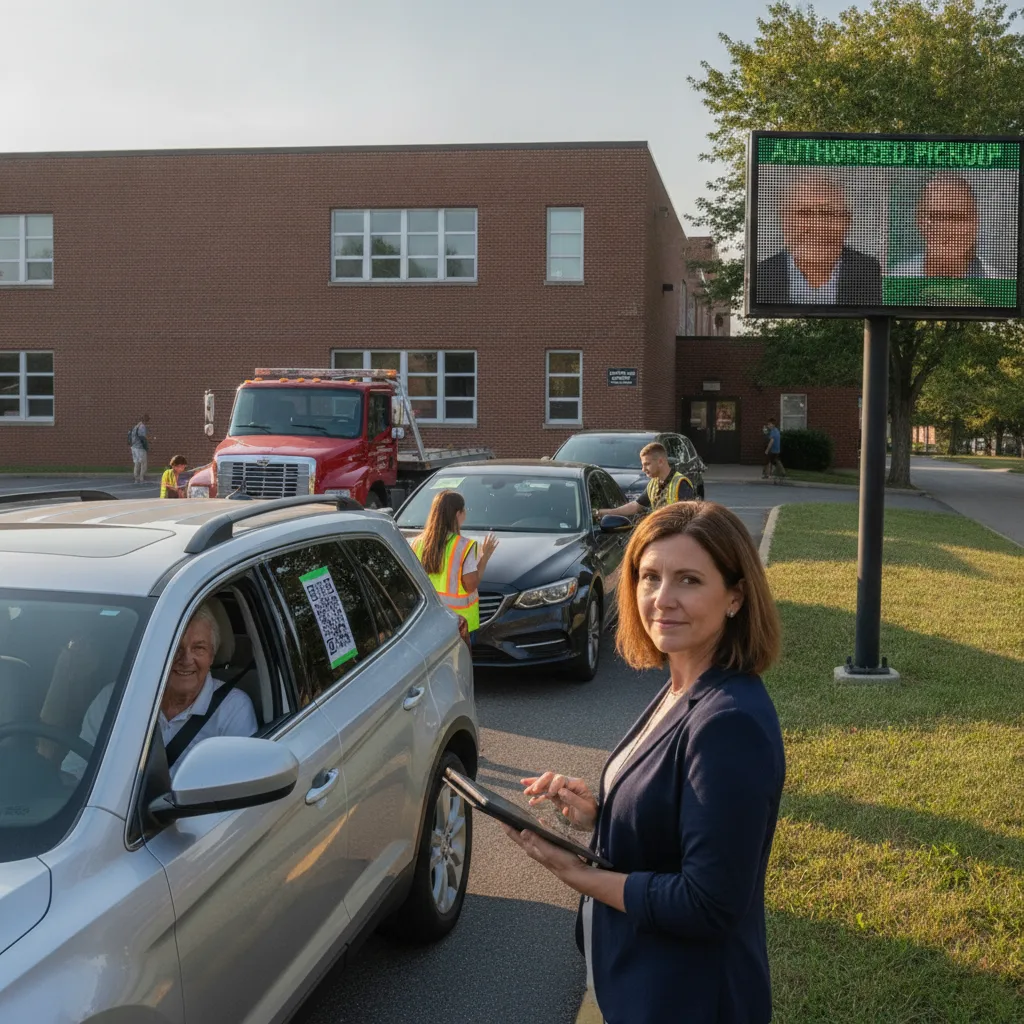
Direct answer: Treat every grandparent pickup as a temporary permission event, not a standing authorization, unless a parent or guardian has explicitly told the school otherwise in writing. A grandparent who picks up occasionally — for a doctor’s appointment, because a parent is traveling, or as a regular Friday arrangement — needs the same identity check and the same expiration date every time, because a five- or seven-year-old cannot be expected to confirm whether “Grandma is picking me up today” is actually true, let alone whether it’s the grandparent the school has on file.
This is for elementary principals, assistant principals, and dismissal teams managing the specific, recurring situation of a grandparent — not a parent, not a listed emergency contact by default, a grandparent specifically — picking up a young child on an occasional or semi-regular basis. It’s a narrower problem than everyday authorized-vehicle matching: most grandparent pickups aren’t the daily routine the carline system is built around, they’re the exception that shows up a few times a month, often communicated informally, and they carry a different kind of risk because young children trust a grandparent’s word without question.
Why This Is Different From Everyday Pickup Verification
A campus that has already built a solid authorized pickup vehicle verification process for daily dismissal often assumes grandparent pickups are just another entry on the same list. They’re not, structurally. A parent’s car is on the list every day, indefinitely, until someone changes it. A grandparent’s car might be authorized for one Tuesday and never again, or it might be a standing Friday arrangement that started in October and nobody remembers to end in June. The everyday system is built for permanence; grandparent permission is usually built for exceptions, and treating it like a permanent entry is exactly how it turns into an indefinite, unreviewed authorization that nobody meant to create.
Where the Informal Request Usually Comes From
Grandparent pickup permission rarely arrives through a formal channel. It shows up as a note in a backpack, a phone call to the front office at 8 a.m., a text to a teacher’s personal number, or a parent mentioning it at drop-off in passing. Each of those is a real request, but none of them is automatically a verified one, and a child who’s excited to see a grandparent isn’t a reliable source of confirmation either. “Grandma is coming today” from a six-year-old is not the same thing as a parent-confirmed authorization, and elementary staff who have worked dismissal for any length of time know the difference matters — the eagerness in a child’s voice doesn’t distinguish between a planned visit and a misunderstanding.
The Verification Sequence
| Step | What to confirm | Common mistake |
|---|---|---|
| Request received | Comes from the parent or guardian of record, not the grandparent themselves or the child | Accepting a grandparent’s own phone call as sufficient without parent confirmation |
| Identity and scope set | Which grandparent (if there’s more than one on either side), which date(s), one-time or standing | Leaving the scope open-ended by default instead of asking “just today, or ongoing?” |
| Front office and classroom notified | The teacher, not just the front office, knows before dismissal begins | The office logs it but the classroom teacher never hears, so the child is still prepped for the usual pickup |
| Arrival and handoff | Staff confirm the adult at the curb or door matches who was authorized, by ID if unfamiliar | Waving through because the child recognizes and greets the grandparent happily |
| Expiration | One-time permissions expire that day; standing ones get a review date, not an indefinite entry | A “just for this month” arrangement that’s still active a year later because nobody set a reminder |
Handling It Without Making Families Feel Distrusted
The hardest part of this for elementary leaders isn’t the paperwork — it’s that asking a grandparent for ID at pickup can feel, to the family, like the school doesn’t trust them. That reaction is real and worth planning for, not dismissing. The way to avoid it is consistency: if every family, including staff members’ own children, goes through the same identity check for a first-time or infrequent pickup adult, it reads as a standard safety step rather than a judgment about a specific family. Explaining the “why” once, in a family handbook or an enrollment conversation, does more to prevent hurt feelings than trying to explain it in the moment at a busy carline.
Sequencing the Process at Your Campus
- Require every grandparent pickup request to come through the parent or guardian of record, not the grandparent or the child directly.
- Ask explicitly whether the request is one-time or standing, and set an automatic review date for standing arrangements.
- Confirm the classroom teacher has the update before dismissal, not just the front office roster.
- Check identity at arrival for any grandparent staff doesn’t recognize by sight, using the same standard applied to every other unfamiliar adult.
- Review standing grandparent authorizations at least once a semester so arrangements that ended informally actually get closed out.
Metrics Worth Tracking
- Grandparent pickup requests confirmed by a parent or guardian versus accepted directly from the grandparent or child
- Standing authorizations still active past their review date
- Cases where the classroom teacher wasn’t informed before dismissal began
- Identity checks completed for unfamiliar grandparents versus waved through on child recognition alone
Related PLACA.AI planning resources
Common Questions
Should a grandparent be added to the everyday authorized-vehicle list?
Only for genuinely standing arrangements with a set review date. One-time or occasional pickups should stay as time-limited exceptions, not permanent entries that outlive the arrangement.
What if the child insists a grandparent is picking them up but the office has no record?
Treat the child’s statement as a reason to call the parent, not as confirmation. A young child’s excitement isn’t verification.
How do you avoid the process feeling like an accusation toward the family?
Apply the same identity check to every unfamiliar adult, every time, and explain the standard once in writing rather than justifying it case by case at the curb.
Give every grandparent pickup an expiration date
Placa.ai’s license plate recognition can flag a grandparent’s vehicle as authorized for a specific date range instead of indefinitely, so temporary arrangements don’t quietly become permanent ones. If you’re rethinking how occasional pickups get verified, we can walk through it with you.
Editorial refresh: July 22, 2026. Independently confirm current product capabilities, third-party features, pricing, contracts, governing requirements, and local rules before acting.
Data source: National Center for Education Statistics