

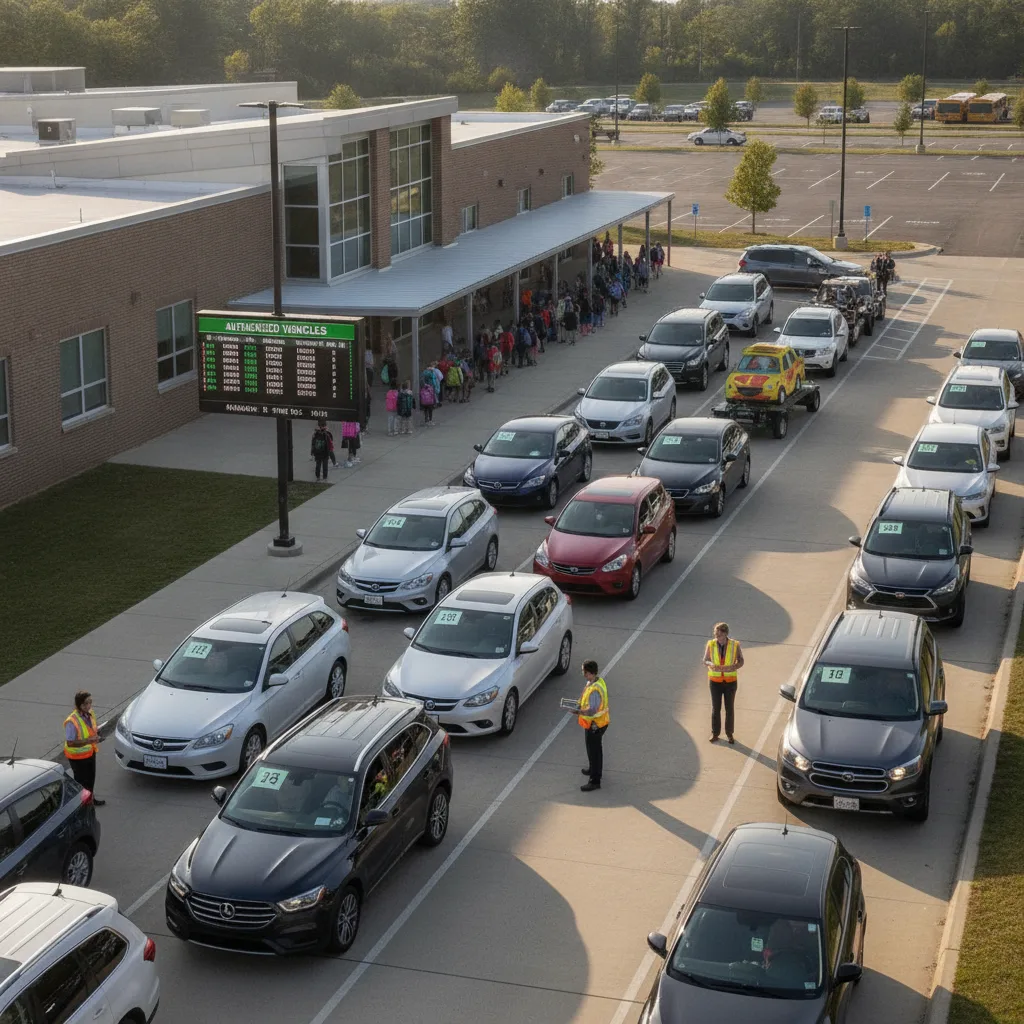
Direct answer: Standardizing dismissal across a group of elementary campuses means every campus uses the same rule for what counts as a completed handoff to a verified adult, even though the physical layout, staffing, and grade configuration at each school can differ. A kindergartner and a fourth grader both need an adult to physically confirm the release; a fourth grader can carry a laminated pickup card between siblings’ classrooms, a kindergartner cannot. Write the rule around the adult confirmation, not the building.
This is for elementary principals, assistant principals, and network-level leaders overseeing more than one elementary campus — a small district’s elementary schools, a network of charter elementary campuses, or a feeder cluster within a larger district. The audience matters because elementary dismissal has constraints that don’t apply once students are old enough to self-report: young children can’t confirm their own pickup, can’t be expected to remember a change in plans, and sibling groups routinely split across two or three classrooms that each need to agree before anyone leaves the building.
The Problem With Copying One School’s Playbook Onto Another
Elementary leaders who manage multiple campuses often start by taking the dismissal process that works at their flagship school and rolling it out everywhere. It usually breaks somewhere in the first month, and not because the process was wrong — because the building it was designed for had a covered carline with four lanes and two administrators on duty, and the second campus has a shared lot with the middle school next door and one aide covering dismissal along with recess duty. The process needs the same rule, not the same floor plan.
What Has to Match, School to School
| Element | Standardize across campuses? | Elementary-specific reason |
|---|---|---|
| Teacher-confirmed adult handoff before a child leaves | Yes | A six-year-old cannot verify their own pickup; an adult must, every time, everywhere |
| Sibling group release rule | Yes | Splitting siblings between an early release and a late release creates the exact confusion families complain about most |
| Physical carline, gate, or walk-up layout | No | Building geometry, staffing headcount, and enrollment size vary too much to force one layout |
| Who staffs dismissal (teacher, aide, volunteer) | No, but roles should be | Staffing level differs by school size, but every role needs the same authority and training regardless of title |
| Escalation for an unrecognized adult | Yes | Front office needs the same response everywhere, or families get inconsistent — and alarming — experiences |
Staffing Reality: This Isn’t Run by Trained Officers
It’s worth saying plainly because most policy templates assume otherwise: elementary dismissal is staffed by classroom teachers, instructional aides, and parent volunteers, not security personnel. That’s true whether it’s one campus or six. A standardization plan that assumes every campus has a dedicated safety officer at the curb will fail the moment it meets a 300-student elementary school with one part-time aide. The rule has to be simple enough for a volunteer with fifteen minutes of training to apply consistently, at every campus, not just the one with the most staff.
Sequencing the Rollout
- Write the handoff rule in one sentence an aide or volunteer could recite from memory.
- Visit each campus’s actual dismissal point — carline, gate, bus loop — and note where the rule is hardest to apply given the physical layout and staffing.
- Build a sibling-release checklist that works even when siblings are in different grade wings or different dismissal times.
- Train front office staff at every campus on the same unrecognized-adult script, so a parent gets the same answer at any of the schools.
- Pilot at the two most different campuses in the group — usually the largest and the smallest — before calling the rule “standardized.”
Metrics That Matter to a Multi-Campus Elementary Leader
- Sibling groups released together versus split across separate handoffs
- Teacher or aide acknowledgment recorded for every release, at every campus, not just the ones with more staff
- Unrecognized-adult events, and whether the front office response matched across campuses
- Time between a parent-reported change (early pickup, different adult) reaching the classroom that actually needs it
Building Trust Alongside the Process
Parents notice inconsistency faster than staff do, especially families with children at more than one of your campuses. A parent who has a kindergartner at one elementary school and a fourth grader at another in the same network will compare notes, and if one school insists on seeing ID for a new pickup adult while the other waves cars through on a first-name basis, that difference becomes the story parents tell each other — not the safety improvement leadership intended. Vehicle-based verification at the curb, checked against the same authorized-pickup record regardless of campus, is one way to make that experience consistent without requiring every school to hire additional staff. It’s worth reading how a single-campus rollout handles the mechanics of verifying authorized pickup vehicles day to day before deciding how to apply the same logic across a group of schools.
Related PLACA.AI planning resources
Common Questions
Should every elementary campus use the same carline layout?
No. Standardize the handoff rule and the sibling-release logic; let each campus’s physical layout and staffing determine the lanes, gates, or walk-up process.
How should sibling groups across different campuses be handled?
If siblings attend different elementary schools in the network, a pickup change at one campus should be visible to the other, at minimum for shared custody or authorization changes — not just within a single building’s roster.
What’s the fastest way to find where the rule breaks?
Walk the smallest, most understaffed campus in the group through the proposed rule before finalizing it. If it works there with a volunteer and fifteen minutes of training, it will work at the flagship campus too.
Standardize verification without standardizing your buildings
Placa.ai’s license plate recognition can apply the same authorized-pickup check at every elementary campus in your network, regardless of carline layout or staffing level. If you’re comparing how dismissal actually runs school to school, we can help map it out.
Editorial refresh: July 22, 2026. Independently confirm current product capabilities, third-party features, pricing, contracts, governing requirements, and local rules before acting.
Data source: National Center for Education Statistics