

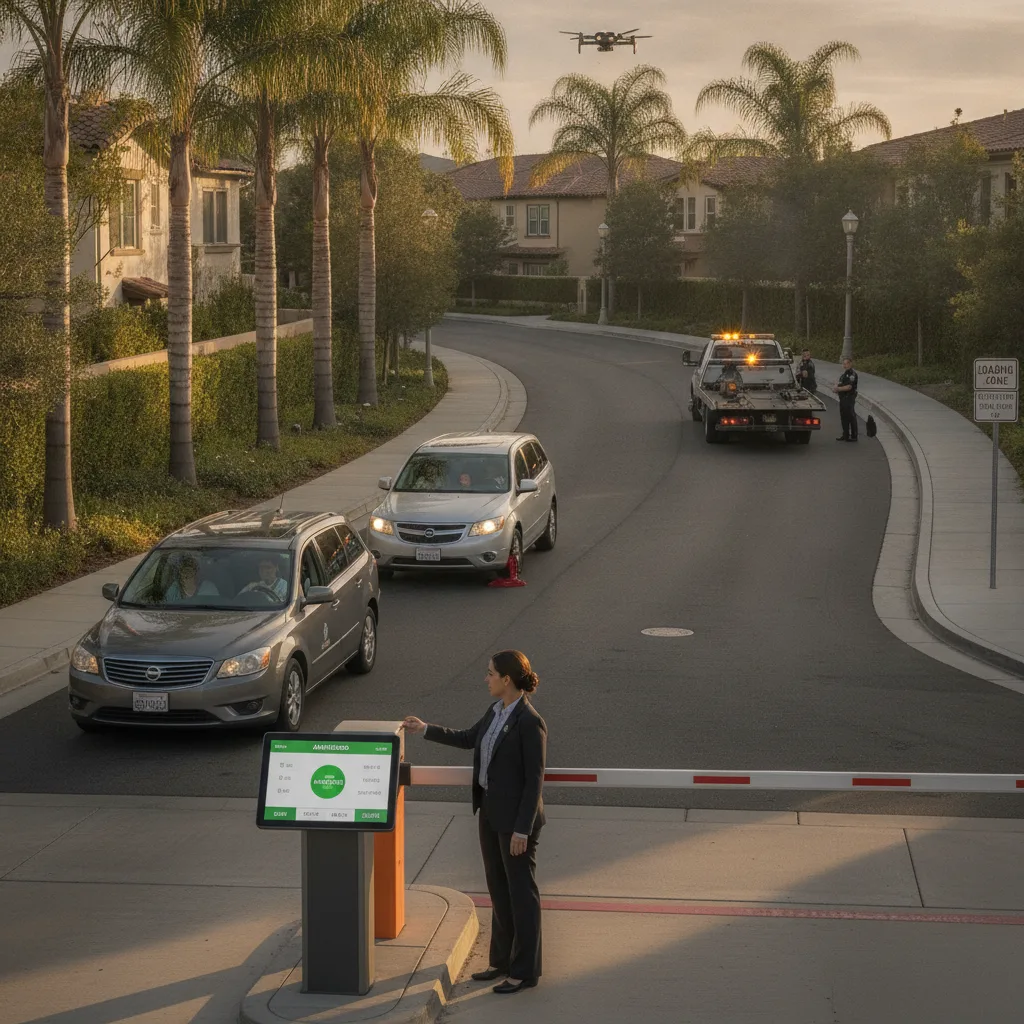
Direct answer: Gated communities have a specific misconception to work against on fire-lane complaints: residents and even some board members sometimes assume that because the streets are private and access is controlled by a gate, fire-lane rules are somehow more flexible or the community’s own call to make. They aren’t. A gate credential controls who can drive in — it has no bearing on whether a parked vehicle is blocking the path a fire truck needs to reach a building, and gated communities need to be especially clear internally that “private road” does not mean “private fire-code standard.”
This is written for gated-community boards, on-site managers, gate attendants, courtesy patrol, and residents — with particular attention to the gate-access confusion that doesn’t come up the same way in ungated properties.
The gate-specific problem
Two things are true at once in a gated community: the gate controls who enters, and gated communities generally still have to meet local fire-department access requirements, often including a way for emergency vehicles to get through even when the gate itself is closed (a Knox box, a radio-controlled override, or a similar arrangement coordinated with the local fire department). A blocked fire lane inside a gated community is not a lower-priority problem because the street is private — if anything, the controlled access makes it more important that the internal lanes and turning radii stay clear, since a fire truck can’t simply route around a blockage the way it might on an open public street grid.
The complaint pattern that shows up most at gated properties: a resident parks “just for a minute” near a fire hydrant or narrow internal turn, reasoning that because it’s inside the gate, only neighbors will notice. Gate staff and courtesy patrol are often the ones who actually catch this — not because they’re fire-code experts, but because they’re the people physically present on the property routinely, which makes them the right first line for identifying an active obstruction, even though the response and any enforcement decision should still follow the same process as any documented rule.
Gated fire-lane triage
| Situation | What gate/patrol staff should check | Response |
|---|---|---|
| Vehicle currently blocking an internal fire lane | Is the obstruction active right now, and does it affect a marked lane or hydrant clearance? | Treat as urgent regardless of gate status — contact the vehicle owner if identifiable, and involve emergency services directly for a genuinely blocked access route, not the standard complaint process |
| Resident argues the road is private so the rule doesn’t apply | Confirm the community’s documented fire-access agreement with the local fire department | Point to the existing agreement rather than debating the point on the spot; escalate repeat pushback to the board |
| Gate-controlled emergency access point | Is the override or Knox-box arrangement current and tested? | Verify periodically with the local fire department — this isn’t a one-time setup, it needs occasional confirmation that codes and hardware still work |
| Past-incident photo report from a resident | Does the photo clearly show the vehicle’s position relative to marked boundaries? | Route to standard evidence review if the vehicle is no longer there |
Building the response around gate operations
- Make sure gate staff and patrol know the “private road doesn’t change fire code” point explicitly — this is worth stating directly in training, since it’s the misconception that causes both under-enforcement and resident pushback.
- Keep the community’s fire-department access agreement current and visible to management, not filed away from whenever it was originally set up. Confirm the override mechanism still works periodically.
- Treat an active obstruction as urgent regardless of who’s watching the gate — this shouldn’t wait for a shift change or a board meeting.
- Log resident pushback about “private road” rules separately, since a pattern of this response may mean the community needs to communicate the rule more clearly, not just enforce it harder case by case.
Where this goes beyond gate staff
Any active emergency goes to emergency services immediately — a gate attendant or patrol officer should never treat a genuinely blocked access route as an internal matter to resolve on their own. Beyond active hazards, fire-code interpretation, the specifics of the community’s access agreement with the fire department, and towing authority on private roads all need qualified review — a gate desk shouldn’t be improvising an answer to “can we tow this” without a documented rule behind it. For board-level enforcement authority more broadly, see how other gated communities handle enforcement disputes.
Testing the process
Run the triage table above for a defined period and see how many complaints gate staff correctly flagged as urgent versus routine, and how many “private road” pushback incidents came up. Communities using license plate recognition at gates and along internal roads get a timestamped, location-tagged record that helps resolve past-incident reports without relying on a resident’s photo alone — and if gate-data retention is a board concern, it’s worth reviewing against your community’s LPR data-handling and opt-out policy before rollout.
Operational FAQs
What must be approved first for responding to fire-lane complaints in gated communities?
Confirm the community’s documented fire-department access agreement is current, and make sure gate and patrol staff understand that private-road status doesn’t change fire-lane obligations.
What should the pilot reproduce?
An active-obstruction case, a “private road” pushback scenario, and a past-incident photo report, so staff have handled all three before the process goes community-wide.
When should rollout stop?
Stop when the fire-department access agreement can’t be located or confirmed current, or when gate staff can’t clearly identify the fire lane’s marked boundaries.
Related PLACA.AI planning resources
Plan a limited workflow review
Bring the current rule, process, exceptions, and success criteria for responding to fire-lane complaints in gated communities. PLACA.AI can help evaluate a bounded pilot without assuming another property’s workflow is the right answer.
Editorial refresh: July 22, 2026. Independently confirm current product capabilities, third-party features, pricing, contracts, governing requirements, and local rules before acting.
Data source: Community Associations Institute