

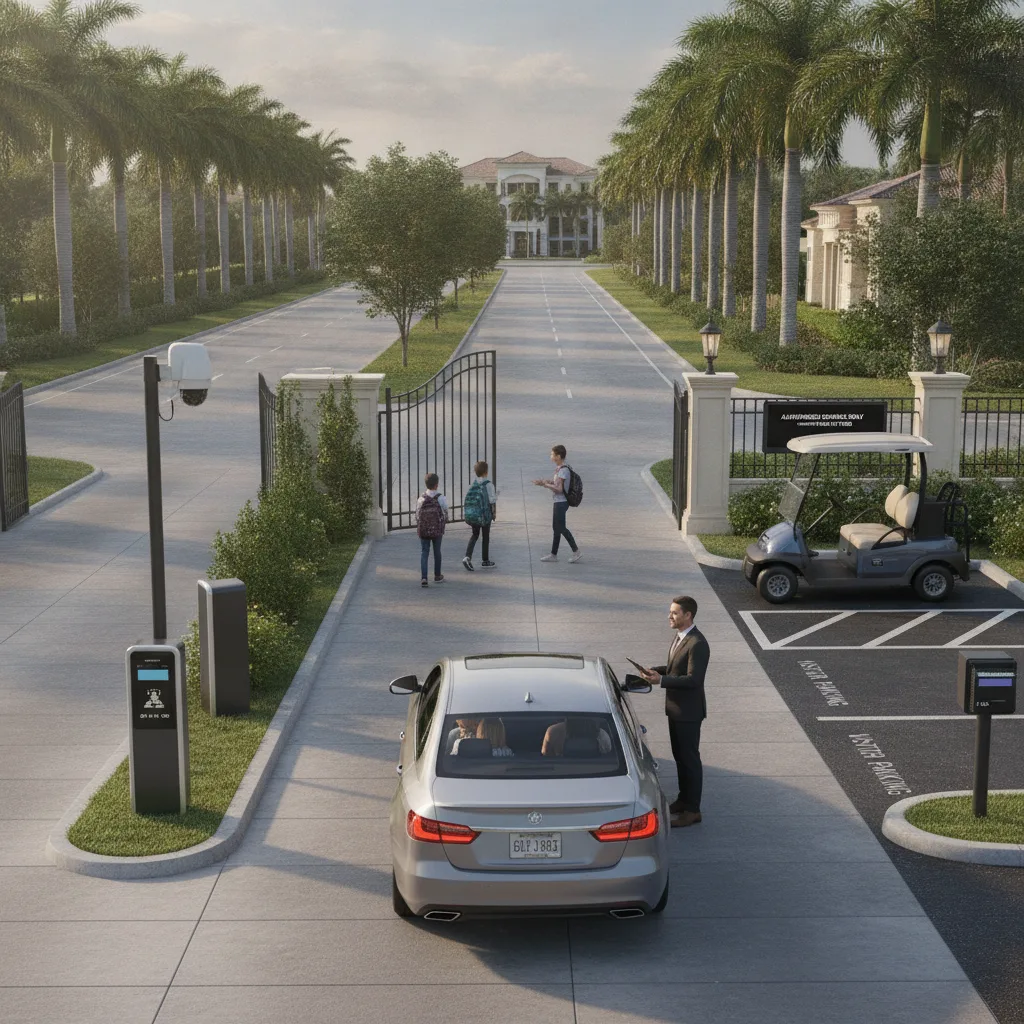
Direct answer: In a gated community, enforcement disputes usually aren’t about whether a car was parked wrong — they’re about whether it should have been on the property at all. The fastest way to cut down on disputes is to treat the gate log as the primary evidence source for any parking case, not a separate system nobody cross-checks, and to give the guard staff (whether in-house or contracted) a written standard for what they log and when they escalate to the board instead of making a judgment call at the gate.
This is written for boards and managers running communities with a manned or camera-controlled gate — the kind where every vehicle that enters is supposed to already be accounted for, which is exactly why residents get angrier than usual when enforcement looks arbitrary. If a car got past the gate, the assumption is someone let it in; disputes tend to focus on who, and whether that makes the resident’s fine unfair.
Why gated communities argue about parking differently
In an open community, the dispute is usually “prove I was actually violating the rule.” In a gated community, it’s often “prove I shouldn’t have been allowed to park here in the first place” — because the gate is supposed to be the control point. A resident whose overnight guest gets towed will ask why the gate let the car in if it wasn’t authorized. A vendor who gets a violation notice will point out the guard waved them through. Every parking dispute becomes partly a dispute about the access-control system, which means the access-control log — not a director’s memory — is usually the record that actually resolves it.
Where gate operations and enforcement fall out of sync
| Situation | What causes the dispute | What resolves it |
|---|---|---|
| Overnight guest parked past curfew | Resident says the gate authorized the guest; enforcement says the guest overstayed the visitor window | Gate entry timestamp cross-checked against the visitor policy window, not against who was on shift |
| Vendor or contractor vehicle | Guard waved the vehicle in without logging it as a work vehicle; enforcement later flags it as unregistered | A standing rule: vendor vehicles get logged with a company name and expected duration at the gate, every time |
| Shift change disputes | The guard who logged the entry isn’t the one who issued the violation, and details don’t match | A single shared log format so the incoming shift can read the outgoing shift’s entries without a phone call |
| Tailgating entries | A car follows a resident through the gate without being logged at all | Treat unlogged vehicles as a known gap, not evidence of authorization, and route those cases to manual review instead of an automatic fine |
Building a record the board can actually stand behind
- Standardize what the gate logs, not just that it logs. Plate, time, and stated purpose (resident, guest, vendor, delivery) for every entry — guard staff need a one-line standard, not discretion.
- Give shift handoffs a shared source. If the morning guard issued a violation based on an overnight entry, the record needs to be readable without calling last night’s guard at home.
- Separate “the gate let them in” from “the resident is authorized.” A car entering doesn’t mean the board approved it staying past the visitor window — write that distinction into the policy so residents understand it before there’s a dispute, not during one.
- Route tailgating and gate-malfunction cases differently. If the log shows a gap or a vehicle that wasn’t actually processed, that’s not the same case as a logged, authorized entry that overstayed — treat it as an exception, not a violation.
Guest and visitor volume is usually the biggest source of disputes at a gated property, so it’s worth reading alongside our guide on stopping guest permit sharing, which covers the same log-first approach for visitor passes specifically. If your gate hardware itself is part of the conversation, our overview of the plate-recognition cameras used at gated entries covers what actually gets captured automatically versus what still depends on a guard’s judgment call.
What this looks like operationally, not just on paper
Most gated communities contract their guard staff through a third-party security company, which means the people creating your enforcement evidence don’t report to your board and may turn over every few months. That’s a real constraint — it means your evidence standard has to be simple enough that a new guard can follow it on day one, and durable enough that it doesn’t depend on any single guard remembering context. A one-page logging standard posted at the gate booth, reviewed with the security company at each contract renewal, does more for consistency than a detailed policy the guard company never actually reads.
Questions to answer before your next board meeting
- If a resident disputes a violation tied to a gate entry, can you pull that entry’s timestamp and stated purpose without calling the guard who was on shift?
- Does your guard staff have a one-line standard for logging vendor and delivery vehicles, and do they actually follow it?
- Are tailgating or unlogged entries treated as a system gap, or are they being fined the same as authorized entries?
- Does your security contract include a logging standard the board actually reviews, or does it just cover staffing hours?
Related PLACA.AI planning resources
Plan a limited workflow review
Bring your current gate logging format, one recent guest or vendor dispute, and your security contract’s reporting terms. PLACA.AI can help evaluate whether automated plate capture at the gate would reduce reliance on manual guard logs without assuming your setup matches another property’s.
Editorial refresh: September 18, 2026. Independently confirm current product capabilities, third-party features, pricing, contracts, governing requirements, and local rules before acting.
Data source: Community Associations Institute