

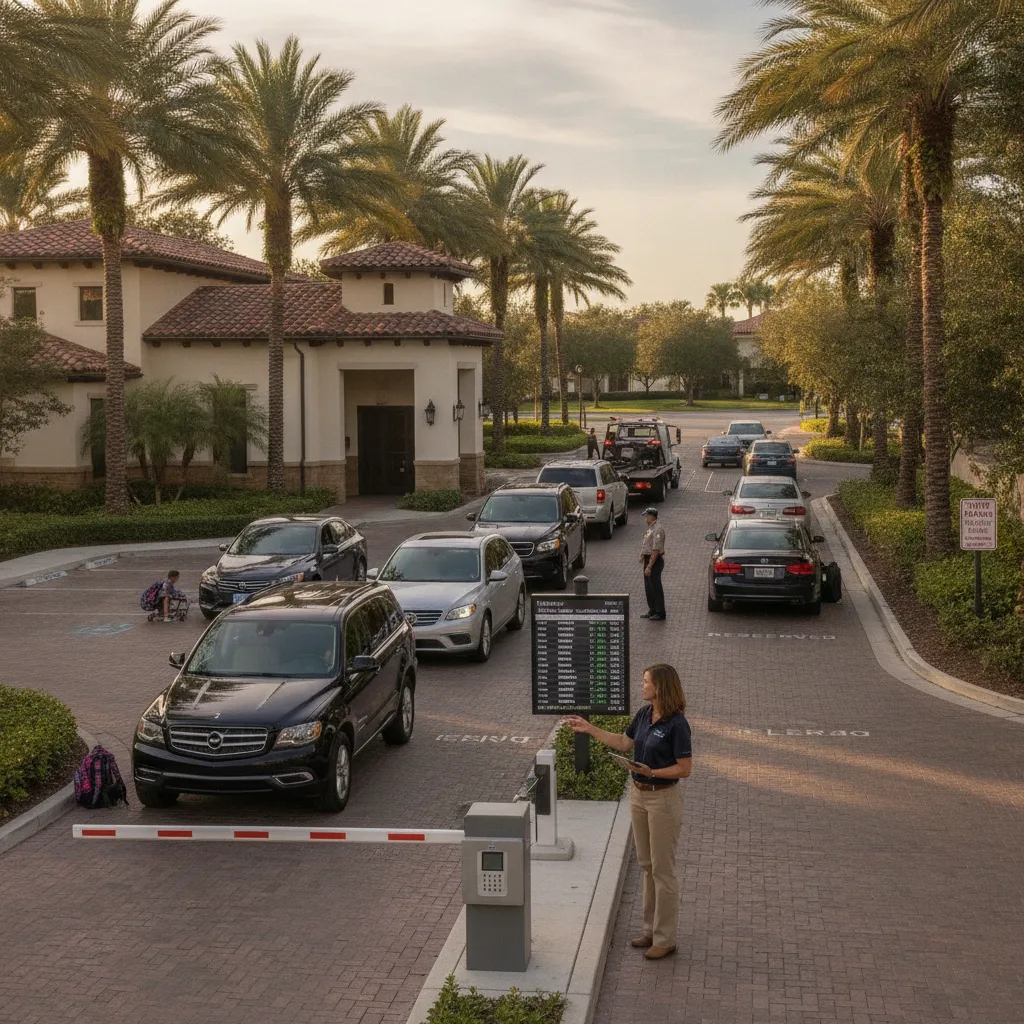
Direct answer: In a gated community, the parking roster and the gate access roster are two different systems, and seasonal turnover is where they drift apart. A resident who leaves for the summer gets removed from the parking list but often stays live in the gate credential system, or the reverse: gate access is revoked but a stored boat trailer or a caretaker’s vehicle is still parked on a decal that never expired. The fix isn’t a better spreadsheet — it’s a single seasonal changeover event that updates gate credentials, the parking permit list, and guest sponsorship rights at the same time, with one person accountable for closing the loop.
This is written for gated-community boards, on-site managers, gate attendants, and the patrol or courtesy-officer staff who actually walk the lots. If your community staffs a gatehouse — even part-time — the seasonal parking conversation has to include the people who control the barrier arm, not just the people who write the rule.
Why gate access and parking rights need separate tracking
Most gated communities treat “has a gate credential” and “is allowed to park here” as the same fact. They aren’t. A seasonal owner who transponders through the gate twice a year to check on the house is still a valid resident, but their vehicle may have been sold, replaced, or left in storage since the credential was issued. A departing snowbird’s adult child might keep gate access to check the property while the parking decal on the parent’s car sits unused in a garage. Guards can verify who is allowed through the gate; they usually have no visibility into whether the vehicle behind that credential is still the one on file for the reserved or assigned space.
The practical failure mode is a gate log that looks clean while the parking roster underneath it is stale. Boards that only audit gate access reports at renewal time miss this every year, because the gate system will happily keep validating a credential attached to a car that left the community months ago.
A seasonal changeover built around gate operations
| Season event | What the gate log shows | What must also update in parking |
|---|---|---|
| Owner departs for the off-season | Credential still active for gate entry | Remove active-parking status; log any vehicle left on site as “stored,” not “resident active” |
| Property manager or caretaker takes over | New or shared credential issued | Register the caretaker’s vehicle separately, with an end date tied to the management agreement |
| Owner returns for the season | Credential reactivated at the gate | Re-verify the vehicle on file — many owners arrive in a different car (rental, replacement, family vehicle) than the one on the prior season’s decal |
| Rental tenant occupies during the off-season | Temporary or guest-tier credential | Time-bound parking rights to the lease dates, not the calendar season |
Running the changeover without gate-desk backlog
- Set the changeover window. Pick a defined start and end date for the seasonal turnover rather than processing it owner-by-owner as people happen to call in. This lets the gate desk batch the work instead of fielding one-off requests during peak arrival weeks.
- Reconcile gate and parking rosters together, not separately. Before the window opens, pull both lists and flag every credential without a matching active vehicle, and every parking record without a matching gate credential.
- Confirm the vehicle, not just the person. A returning owner’s identity doesn’t tell you what they’re driving this year. Ask for current plate information as part of reactivation, not as an afterthought.
- Close out departures the same day, not at month-end. A credential or decal that stays live for weeks after someone leaves is the single most common source of “who parked here” disputes later in the season.
Cases that need a person, not a rule
A few situations come up every season and deserve a written answer before they turn into a gatehouse argument: an adult child or property manager who needs ongoing access while the owner is away; a vehicle left in a driveway during a storm evacuation that technically has an expired decal; and a returning owner who arrives before their gate credential has been reactivated in the system. None of these should default to “call the board” — assign one person (usually the community manager) who can approve a short, dated exception on the spot, log why it was granted, and set an expiration so it doesn’t quietly become permanent.
Test the process on one gate before the full turnover
Run the reconciliation on a single gate or a small block of units first, ideally with a real returning-resident case and a real departure case in the batch. Track how many records needed correction, how long the gate desk spent per changeover, and how many exceptions got approved without a documented reason. If exceptions are piling up undocumented, the written policy needs to be clearer before you roll it out community-wide.
Communities that pair this reconciliation with license plate recognition at the gate and in the lots get an independent check on both lists — the camera confirms which vehicles are actually on site regardless of what the credential system says, which catches the gap between “gate says active” and “car hasn’t been seen in three months.” It’s worth reviewing your overall approach against other HOA parking enforcement methods before deciding how much of this to automate versus keep manual at the gatehouse.
Implementation questions
Who should own the seasonal changeover?
One named person — typically the community manager or gate operations lead — should own reconciling gate and parking records together. Splitting the task between the gatehouse vendor and the board almost always produces the drift described above.
What should the pilot batch include?
At least one straightforward departure, one straightforward return, and one exception case (caretaker, rental, or storm-related), so you can see how the process handles both the routine and the messy version before scaling it to the whole gate roster.
When should the changeover stop and escalate?
Stop when a vehicle can’t be matched to any owner record, when a credential holder disputes their departure date, or when a stored vehicle has no documented end date — these need board or management review rather than a gate-desk judgment call. For disputes that touch board enforcement authority more broadly, see how other gated communities structure their enforcement escalation path.
Plan a limited workflow review
Bring the current rule, process, exceptions, and success criteria for managing seasonal parking changes in gated communities. PLACA.AI can help evaluate a bounded pilot without assuming another property’s workflow is the right answer.
Editorial refresh: July 22, 2026. Independently confirm current product capabilities, third-party features, pricing, contracts, governing requirements, and local rules before acting.
Data source: Community Associations Institute