

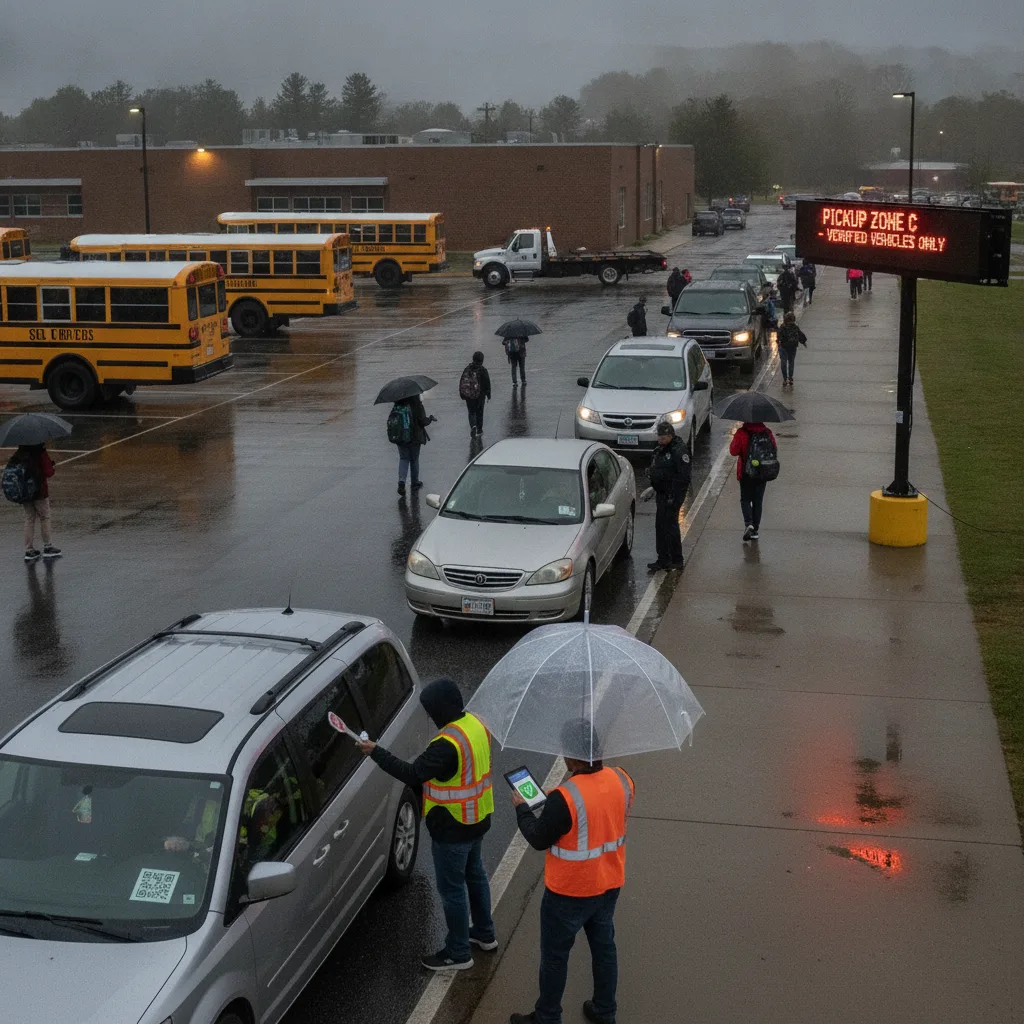
Direct answer: A district-wide rain event exposes the same gap as any other district-wide policy question: campuses default to whatever the site administrator personally decides, and those decisions rarely match. One school delays dismissal fifteen minutes, another releases on schedule into a downpour, and a third tries to reroute buses without telling the transportation office. Fix it by setting one district-wide activation trigger (a shared weather threshold, not each principal’s judgment call), a minimum set of safety controls every campus must apply once triggered, and a single reporting channel so your office knows, in real time, which campuses have activated and which haven’t – without calling each one individually.
This guide is for district operations directors, transportation coordinators, and the risk and safety staff who have to answer for what happened across every campus during a weather event, not just the one that generated a complaint.
Inconsistent weather response is a liability question, not a comfort question
When two campuses handle the identical forecast two different ways, the district loses the ability to say “we followed our policy” – because there wasn’t one policy, there were as many as there are principals willing to make an independent call. That gap becomes visible fast if a weather-related incident occurs at the campus that didn’t activate its rain plan while a nearly identical campus down the road did. The district-level question isn’t whether every campus handles rain identically down to the layout – site geography genuinely differs – it’s whether every campus activated based on the same trigger and applied the same minimum safety floor once they did.
Example: A fast-moving storm crosses the district during dismissal. One elementary school’s principal, watching the sky, delays release by twenty minutes and keeps students under cover. A middle school two miles away, without a shared trigger to follow, releases on the normal schedule because the principal there was in a meeting and didn’t personally notice the weather. A parent whose child was standing in the open at the second campus reasonably asks why the district didn’t have one standard everyone followed.
What the district sets once versus what each campus adapts
| Decision | Set once, district-wide | Adapted per campus |
|---|---|---|
| When the rain plan activates | Shared weather threshold and decision channel | – |
| Minimum safety floor once activated | Covered staging required, release-group size limits, communication requirements | – |
| How the plan is executed physically | – | Lane layout, covered capacity, staffing, local traffic pattern |
| Resource escalation | Who campuses call for extra staff, buses, or facilities support | What each campus actually needs, based on its own layout |
Give campuses one trigger they don’t have to interpret
The single highest-leverage fix is removing judgment from the activation moment. A principal watching the sky and deciding “this doesn’t look bad enough yet” is exactly the inconsistency that creates risk exposure, and it’s not a fair burden to put on any one administrator in the moment. A shared threshold – tied to a weather service alert, a defined rainfall rate, or another objective trigger – means every campus activates at the same point, and any campus that’s slow to respond is visibly behind the trigger rather than making an independent judgment call the district would have to defend after the fact. This is the same discipline that underlies broader efforts to standardize dismissal across every campus – weather response is simply the version of that standard that gets tested hardest, because it happens under real time pressure with real visibility problems.
Know who activated and who didn’t, without a phone tree
A district running a dozen or more campuses cannot manage a weather event by calling each principal to ask whether they’ve activated their local plan – that’s slower than the storm itself. Build a reporting mechanism that shows activation status in one place, so operations can see which campuses need a check-in and which are already handling it, and so the after-action review has an actual timestamped record instead of everyone’s memory of who called whom. This same real-time visibility matters year-round, not just for weather – see the broader case for carline automation software that gives district operations a live view into every campus’s dismissal status rather than a patchwork of local systems.
What to measure before expanding the process
- campuses activating within the shared trigger window
- campuses reporting status without a manual phone check-in
- minimum safety floor applied consistently once activated
- resource requests fulfilled during a weather event
- weather-related incidents, campus by campus, correlated to activation timing
Owner sign-off
- State the purpose and non-goals for the district-wide rain-plan standard.
- Name who owns the shared trigger and who can grant a campus-specific exception.
- Test the trigger and reporting mechanism across campuses of different sizes and layouts, not just one pilot site.
- Confirm contracts, pricing, integrations, data handling, and governing requirements independently.
- Retain a district-wide activation record your risk office can review after any weather event.
Related PLACA.AI planning resources
Questions to settle
What must be approved first for a district-wide rain plan standard?
The shared activation trigger, the minimum safety floor every campus must meet once triggered, and how activation status gets reported without a manual phone tree.
What should the pilot reproduce?
A real or simulated weather event across two or three campuses of different sizes, with activation timing and safety-floor compliance measured against the shared standard.
When should rollout stop?
If campuses cannot meet the minimum safety floor with current staffing, if activation status can’t be confirmed without individual phone calls, or if the shared trigger conflicts with a documented local safety need.
Plan a limited workflow review
Bring the current rule, process, exceptions, and success criteria for coordinating rainy-day carline operations across your district. PLACA.AI can help evaluate a bounded pilot without assuming one campus’s workflow is the right answer for every campus.
Editorial refresh: September 18, 2026. Independently confirm current product capabilities, third-party features, pricing, contracts, governing requirements, and local rules before acting.
Data source: National Center for Education Statistics