

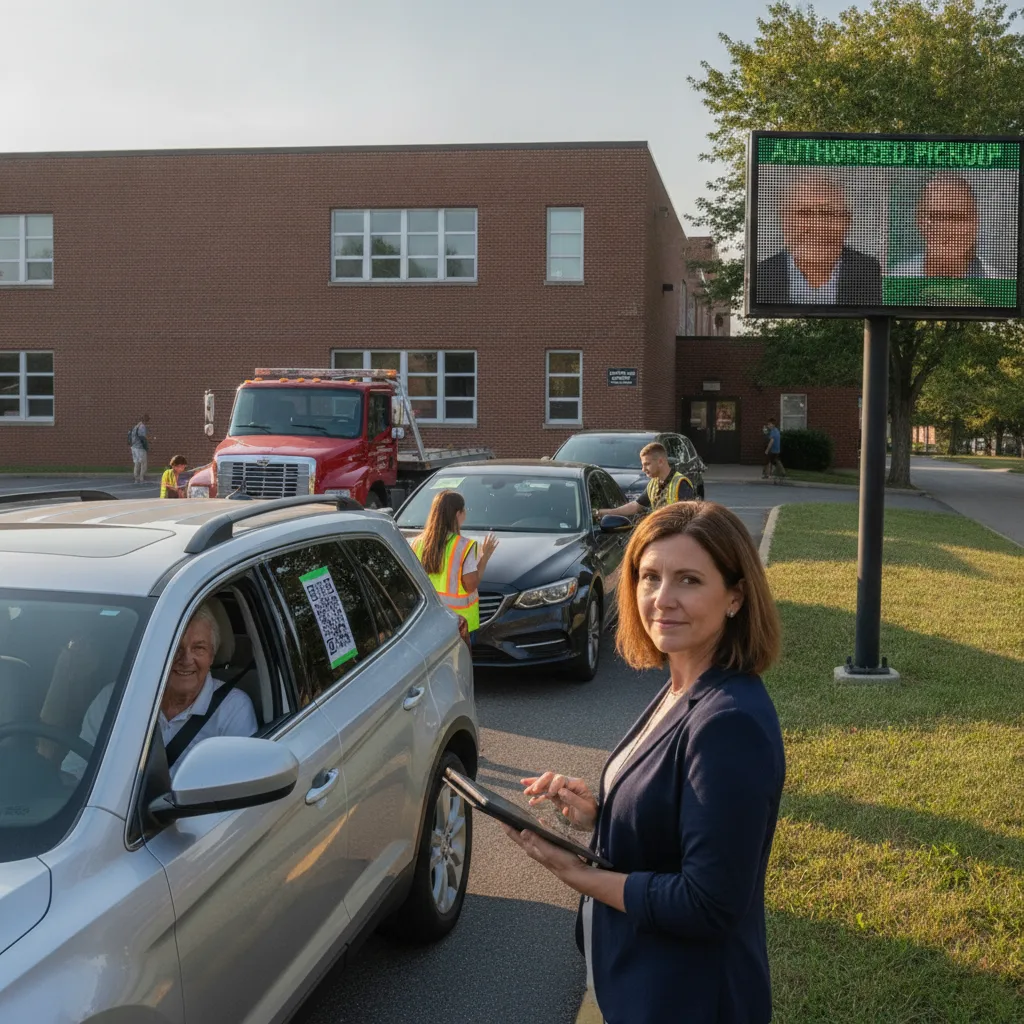
Every school year, thousands of school administrators face the same moment: a parent or family member arrives at the pickup line who is not supposed to take a child. Maybe there is a custody order on file. Maybe the court document says one parent is restricted. Maybe the school was notified, but the staff member on carline duty today is a substitute who was not briefed.
In that moment, the school is one mistake away from a serious safety incident, a legal liability, and a parent’s worst nightmare.
Why Manual Custody Enforcement Fails at Scale
Most schools try to handle custody restrictions with a paper file in the front office, a note in the student information system, or a laminated card given to carline staff. These systems fail for predictable reasons:
- Substitute staff are not briefed on individual student restrictions
- Carline moves too fast for staff to manually cross-reference records
- Restrictions expire, change, or have conditional terms that require judgment to apply
- There is no audit trail proving the school acted correctly if challenged later
PLACA.AI’s patent-pending student release system solves this with an eight-level authorization rule hierarchy that evaluates every pickup request automatically — before any staff member has to make a judgment call.
How the Eight-Level Rule Hierarchy Works
When a vehicle arrives at pickup and is identified, the system constructs an Authorization Request Object and evaluates it against each student’s rules in strict precedence order:
- Active revocation — any explicit revocation blocks all other rules immediately
- Custody restriction — court-ordered or administrator-entered restrictions evaluated next
- Watchlist alert — known flagged individuals checked before any approval proceeds
- Emergency override — administrator-issued overrides for emergency situations
- One-time permission — single-use authorizations for specific pickup events
- Temporal constraint — day-of-week and time-window restrictions applied here
- Authorized person list — standard recurring pickup persons evaluated next
- Unknown party — anyone not matching above rules triggers a HOLD for staff review
The result — APPROVE, HOLD, or DENY — appears on the staff dismissal card before the vehicle reaches the pickup point. The staff member does not need to remember a custody order. The system has already evaluated it.
Custody Restrictions Are Per-Student, Not Per-Vehicle
A critical feature of the patent-pending system is that authorization is evaluated independently for each student associated with a pickup vehicle. A custody restriction on one child does not affect siblings. A one-time permission for one child does not carry over to another. Each student’s release decision stands alone.
Every Decision Is Logged
Every rule evaluation, every HOLD, every DENY, and every staff override is recorded in a tamper-evident audit log with the staff member’s identity, a timestamp, and the rule that triggered the outcome. If a custody situation is challenged legally, the school has a complete, verifiable record of exactly what happened, when, and who made the decision.
Schedule a walkthrough to see how custody restrictions, watchlist alerts, and one-time permissions work in the live carline environment.
Frequently Asked Questions
How do schools enforce custody orders at pickup?
Schools with automated dismissal systems like PLACA.AI enter custody restrictions directly into the student’s authorization profile. When a restricted vehicle or person arrives, the system evaluates the restriction automatically and surfaces a DENY or HOLD result to the staff dismissal card — before the vehicle reaches the carline attendant. No staff member needs to remember individual custody details.
What happens if a parent with a custody restriction tries to pick up a child?
In PLACA.AI’s system, a custody restriction triggers a DENY outcome during rule evaluation. The staff dismissal card shows the restriction flag, and no approval action is available for that student. The vehicle is directed away from the pickup zone, and the event is recorded in the audit log with a timestamp and the triggering rule.
Can schools add custody restrictions without a court order?
Yes. School administrators can enter custody restrictions and pickup revocations directly into a student’s profile at any time — based on a court order, a parent request, or a school safety determination. Administrator-entered restrictions carry the same enforcement weight as any other rule in the system.
What is an authorized pickup list for schools?
An authorized pickup list is a per-student record of vehicles and persons permitted to pick up that child during dismissal. In PLACA.AI’s system, the list is evaluated at Layer 7 of the eight-level rule hierarchy — meaning custody restrictions, watchlist alerts, and revocations are all checked first before the authorized list is consulted.
Does LPR automatically identify restricted individuals at school pickup?
License plate recognition identifies vehicles, not individuals. If a restricted person arrives in an authorized vehicle, the vehicle may be recognized — but the person driving it is a separate evaluation. PLACA.AI’s system captures a vehicle entry image shown on the staff dismissal card, allowing staff to visually confirm the driver before approving any release.
What should a school do if an unauthorized person attempts to pick up a student?
The immediate step is to deny the release, keep the student safely inside, and contact the custodial parent or guardian. The school should document the event — in PLACA.AI’s system this is automatic — and notify administration. If the situation escalates, contact local law enforcement. Having a timestamped audit record of the denial is important for any subsequent legal or administrative review.
How do one-time pickup permissions work at school dismissal?
A one-time permission authorizes a specific person or vehicle for a single pickup event. In PLACA.AI’s system, the permission is consumed when used — it cannot be used again without a new authorization. The one-time permission is evaluated at Level 5 of the rule hierarchy, after revocations, custody restrictions, and watchlist checks.
Data source: National Center for Education Statistics