

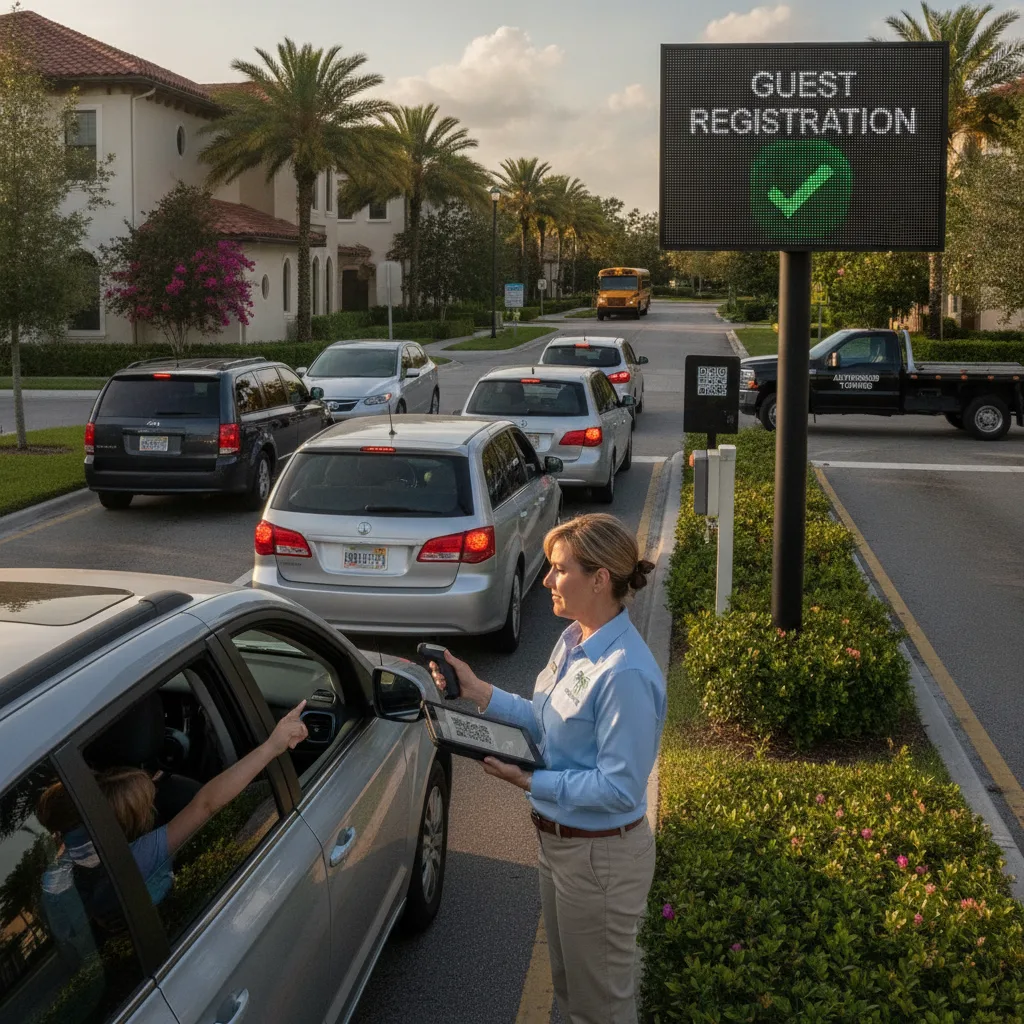
Direct answer: Florida associations should stop guest permit sharing with a written, board-approved rule that treats every household the same way — the same detection threshold, the same verification step, and the same consequence — because the real risk in most Florida communities isn’t the sharing itself, it’s a board being accused of enforcing the rule against some residents and not others. Document the rule, apply it identically regardless of who the sponsoring resident is, and keep a record that shows it.
This guide is written for Florida community association boards, association managers, and the residents who serve on architectural or parking committees. Florida has an unusually dense mix of HOAs and condominium associations, many of them gated, many with a meaningful share of seasonal or part-time owners — and board members are almost always volunteer homeowners who live next door to the people they’re enforcing rules against. That combination makes consistency, not detection technology, the hardest part of this problem.
Why guest permit sharing is a fairness problem before it’s a compliance problem
In most Florida communities, the association isn’t dealing with a stranger gaming the system — it’s dealing with a neighbor whose adult child visits every weekend, a snowbird owner whose property manager hands the same guest pass to whoever is checking on the unit while they’re up north for the season, or a family sharing one visitor code among several regular guests because requesting a new one each time feels like unnecessary friction. None of that is malicious, but if the board only notices and acts on it when a particular resident annoys someone on the committee, the association is exposed to exactly the complaint that causes the most damage to volunteer boards: selective enforcement. A resident who gets a notice while a neighbor’s obviously shared pass goes unaddressed has a legitimate grievance, and it’s the kind of dispute that ends up at an association meeting, not just in an inbox.
The board’s job here is narrower than it sounds: decide, in writing, what counts as sharing, apply the same check to every reported or flagged pass, and be able to show — to any resident who asks — that the process ran the same way for them as it did for everyone else.
A rule the board can defend to any resident
| Situation | What gets checked | Consistent response |
|---|---|---|
| One guest pass, multiple plates | whether the sponsoring owner has a documented exception (property manager access, seasonal caretaker, rideshare-heavy household) | contact the sponsoring owner before any notice goes out — same message, same timeline, every time |
| Owner is off-property for the season | who currently holds the pass on their behalf and whether that’s on record with the association | require a named on-file delegate rather than an informal hand-off |
| No response or explanation doesn’t fit the pattern | full history of use — dates, plates, gate or front-desk notes | expire the pass and issue the same written notice used for every prior case |
| Repeat use after notice | whether the first cycle was documented and closed properly | escalate to the board as a body, not to a single board member’s judgment call |
The process, step by step
- Flag, don’t accuse. A guest credential tied to more than one plate goes into a review queue. Nothing is communicated to neighbors or posted publicly at this stage.
- Contact the sponsor. A short, uniform message asking the owner to confirm current use. Seasonal owners and their property managers should get the same message as full-time residents — no informal exceptions because someone is “usually here” or well known to the board.
- Classify the outcome. Legitimate correction, documented exception (delegate on file, caretaker, rental situation), or unresolved sharing. Each has a predetermined next step so no board member has to invent one under pressure.
- Close with a record. Every case — resolved or escalated — gets logged with date, outcome, and who handled it. That log is what protects the board if a resident later claims they were treated unfairly.
Where the board should stop and route the case elsewhere
Not every case belongs in the standard workflow. Disputes involving accessibility accommodations, a resident’s safety concern, or a disagreement about what the governing documents actually require should go to the board’s legal counsel rather than being resolved informally by whoever is on the parking committee that week. Boards should also be cautious about acting on a single resident’s complaint about a neighbor without independently verifying the pattern first — a complaint is a reason to open a review, not a reason to issue a notice.
Piloting the rule before it applies association-wide
Run the process for a defined period — long enough to see a handful of real cases, including at least one seasonal-owner scenario and one dispute that required escalation — before treating it as settled policy. Track how many flagged passes resolved through a simple sponsor confirmation, how many needed a documented exception, and how many repeat cases occurred after a first notice. If the numbers show the rule falling apart on seasonal-owner cases specifically, fix that before rolling it out further rather than making one-off exceptions that undermine the consistency the whole approach depends on. Boards managing broader visitor-parking pressure beyond just shared passes may also want to review how Florida associations handle general visitor parking abuse alongside this narrower permit-sharing rule, since the two often get raised at the same board meeting.
What to bring to the board before adopting this
- A written definition of what counts as sharing, approved by the full board, not a single officer.
- A named process owner — manager or committee chair — responsible for every case, with a backup for when they’re unavailable.
- A record-keeping approach the board can show a resident on request, consistent with the association’s existing resident parking reporting process.
- Confirmation from association counsel that the notice-and-escalation steps align with the community’s governing documents before enforcement begins.
- A defined point at which a repeat case moves from a parking notice to the association’s standard violation and, if applicable, towing process — reviewed against the community’s existing rule-change-before-towing workflow so residents aren’t towed under a policy that was never formally adopted.
Related PLACA.AI planning resources
Implementation questions
What is the first decision for stopping guest-permit sharing for Florida associations?
Adopt a single written definition of sharing and a single response process, approved by the board, before any individual case is acted on.
What belongs in the pilot?
A normal case, a seasonal-owner or delegate case, and at least one dispute that required escalation to the board or counsel.
What blocks expansion association-wide?
Any sign the process was applied inconsistently, unclear authority to issue notices, or a case that should have gone to counsel but didn’t.
Plan a limited workflow review
Bring the current rule, process, exceptions, and success criteria for stopping guest-permit sharing for florida associations. PLACA.AI can help evaluate a bounded pilot without assuming another property’s workflow is the right answer.
Editorial refresh: July 22, 2026. Independently confirm current product capabilities, third-party features, pricing, contracts, governing requirements, and local rules before acting.
Data source: Community Associations Institute