

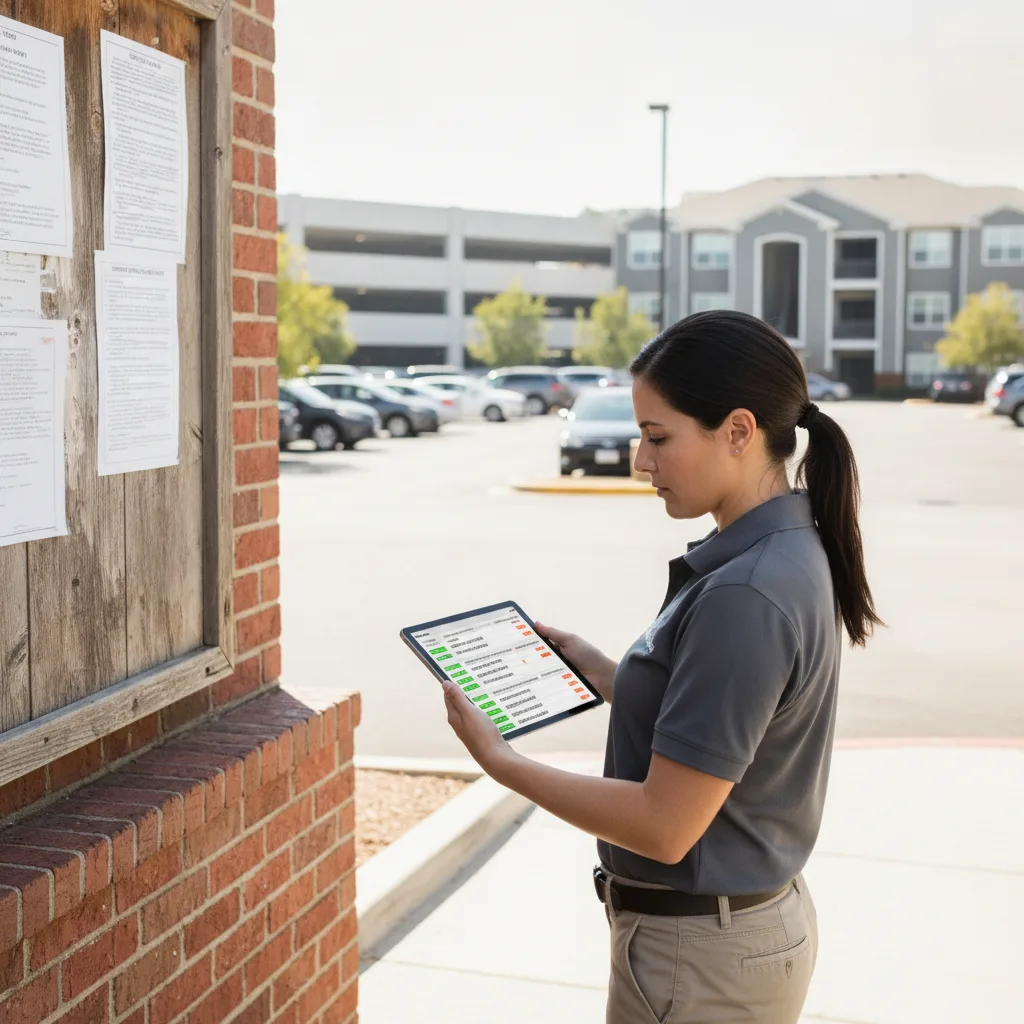
An apartment parking rule change workflow should document the new rule, resident notice, permit roster, service and accessibility exceptions, LPR review criteria, towing-vendor instructions, and support hold before the first vehicle is warned, cited, booted, or towed.
Key Takeaways
- A parking rule change is an operations rollout, not just a posted letter or new sign.
- Before enforcement starts, the property should be able to prove who was notified, which vehicles are authorized, and which exceptions need manual review.
- Fresh public discussion shows residents worry about no-guest rules, disabled visitors, delivery access, and immediate towing after a policy change.
- LPR and towing vendors should receive site-specific hold rules for unclear permits, service vehicles, medical access, deliveries, and first-week mistakes.
- The best enforcement record shows notice, evidence, review, outcome, and resident support in one place.
What This Workflow Involves
This workflow starts before enforcement begins. The manager writes down the rule being changed, the reason for the change, the affected spaces, the effective date, the permit process, the exceptions, and the escalation path. That record becomes the source of truth for residents, patrol teams, towing vendors, leasing staff, and support.
The property then compares the rule against the resident roster and parking inventory. Assigned spaces, paid reserved spaces, ADA spaces, fire lanes, loading zones, visitor areas, delivery routes, contractor access, temporary caregiver access, and medical transport need different treatment. A single message saying unauthorized vehicles will be towed immediately is rarely enough for a clean rollout.
The last step is enforcement control. LPR alerts, patrol notes, warning stickers, tow authorizations, and resident calls should all point back to the same rule version. If a case does not match the rule cleanly, it should go to a hold queue instead of moving straight to tow.
Why This Problem Is Showing Up Now
A fresh public Reddit question from early August 2026 described a Washington apartment community that announced no more guest parking and immediate towing for vehicles without permits after July 31. The useful editorial signal is not the legal conclusion; it is the resident language: visitors, disabled access, delivery drivers, assigned spaces, posted letters, and uncertainty over whether the lease or manager controls the new rule.
Parking rule changes are also showing up in current local news. On August 5, 2026, the Beaumont Enterprise reported that Port Arthur officials were explaining changes to a parking ordinance after residents raised concerns. That municipal example is not an apartment enforcement rule, but it reinforces the operating lesson: when parking rules change, people need clear language, a phase-in plan, and education before penalties become the story.
For apartment and HOA teams, the timing matters because vehicle access systems are becoming more automated. LPR, mobile patrol apps, digital permit rosters, and towing integrations can enforce rules quickly. That speed is useful only when the rule, notice, exception, and review process are already settled.
The Core Operational Problem
The core problem is mismatch. Residents think in terms of daily access: guests, caregivers, grocery delivery, a roommate’s car, a temporary injury, or a vacant assigned space. Property teams think in terms of limited supply, resident complaints, fire-lane risk, lease rules, and unauthorized vehicles. Vendors think in terms of permit lists, plates, timestamps, and tow authorization.
When those views are not connected, the first enforcement week produces avoidable disputes. A visitor may park in an unused assigned space with permission from the resident. A delivery vehicle may stop long enough to appear unauthorized. A resident may not have received a permit. A camera may read the plate correctly but apply the wrong rule. The property may still have a legitimate parking problem, but the record looks unfair because the exception path was not documented.
Teams planning LPR-assisted residential parking should begin with the HOA and apartment license plate recognition guide and map the technology to the actual resident access policy before enforcement begins.
Apartment Parking Rule Change Workflow Checklist
| Checkpoint | Question to answer | Record to keep |
|---|---|---|
| Rule version | What exactly changed, and when does it begin? | Policy text, effective date, approving manager or board |
| Resident notice | Who received the notice, through which channels, and in what language? | Email, letter, portal post, sign photo, delivery log |
| Permit roster | Which plates, spaces, permits, and visitor rules are active? | Current vehicle list and change timestamp |
| Exceptions | How are caregivers, medical transport, deliveries, contractors, temporary injuries, and move-ins handled? | Exception categories and approval path |
| Vendor instructions | What should patrol, LPR, and towing teams do during ambiguous cases? | Hold rules, warning rules, tow authorization form |
| Support path | Where should residents send questions before or after enforcement? | Script, response owner, case log |
| Review cadence | What will the property review after week one? | Dispute summary, waived cases, policy corrections |
What To Hold Before Towing Starts
The first hold should cover missing or newly issued permits. If a resident requested a permit but the property has not processed it, the vehicle should not be treated the same as a repeat unauthorized parker. The record should show the request date, manager response, temporary approval, and any expiration.
The second hold should cover service access. Medical transport, home health aides, delivery drivers, movers, emergency maintenance, and contractors may need short access even if the property is eliminating unmanaged guest parking. A hold does not mean unlimited parking; it means the property has a documented way to distinguish legitimate short service access from resident-space abuse.
The third hold should cover unclear LPR matches. If the plate read, state, permit list, or space assignment is uncertain, the event should go to review. The resident vehicle access and parking operations page explains how vehicle-based workflows should reduce friction for the people who live on the property, not simply automate more disputes.
Evidence And Source Context
The public Reddit thread is used only as a question signal. It shows how quickly a new parking rule can become a trust issue when residents hear that guests or vehicles without permits will be towed immediately. It does not prove the property was wrong or that a specific law was violated.
State rules vary. For example, Washington RCW 46.55.070 addresses posting requirements for towing unauthorized vehicles from certain private property and public parking facilities. Colorado guidance from FirstService Residential notes that some HOA and condo towing scenarios involve notice, specific tow authorization, signage, and limits on towing-carrier patrol activity. Those details should be reviewed by counsel before a property applies any similar rule.
Driver-facing resources also show why residents ask these questions. Washington Law Help’s vehicle towing explainer distinguishes private impounds from public impounds and explains that private-property towing can happen quickly in some circumstances. A property manager does not need to turn that into fear; the better takeaway is to make the rule and evidence packet understandable before a tow happens.
Resident Communication That Reduces Disputes
A good notice says what changed, why it changed, when it starts, which vehicles are allowed, how residents register vehicles, how guests are handled, what exceptions exist, who reviews accommodation requests, and what happens during the first enforcement week. It should avoid vague language like “any vehicle may be towed” unless the property has counsel-approved authority and an actual process behind that sentence.
The property should also give front-office staff the same answers. If leasing staff, security, the towing vendor, and the manager explain the rule differently, residents will experience the process as arbitrary even when the underlying parking shortage is real.
For apartment communities using LPR, the AI license plate recognition for apartment communities resource is the right supporting page for matching resident vehicle records, guest approvals, and access-control events without turning every exception into a tow decision.
Risks, Limits, And Fairness
This article is not legal advice. Leases, HOA covenants, state towing statutes, fair housing requirements, disability accommodations, local signage rules, and vendor contracts can change what is allowed. A property should ask counsel to review the rule, notice, exception process, and towing authorization before launch.
The fairness standard is practical: residents should know the rule before penalties begin, staff should know how exceptions work, and vendors should not be asked to guess. If the property cannot show notice, permit status, LPR evidence, exception review, and tow authorization for a case, it should pause that case instead of escalating.
PLACA.AI is not a substitute for a valid parking policy. It helps organize vehicle records, plate events, exception review, and enforcement evidence after the property has made the policy decision correctly.
Worked Example: No-Guest Rule Rollout
An apartment community has limited parking and repeated complaints that residents cannot use their assigned spaces. Management decides that unmanaged guest parking will end on August 15 and that visitors must use preapproved temporary access or nearby public parking.
A weak rollout posts one letter and tells the towing company to remove any vehicle without a permit. In the first week, a caregiver, a grocery delivery vehicle, and a resident’s temporary rental car are all flagged. Support now has to reconstruct the facts under pressure.
A stronger rollout creates a dated notice, updates the permit roster, opens a temporary exception form, gives residents a support path, tells the towing vendor which categories require manager approval, and routes uncertain LPR hits into review for the first two weeks. The property can still enforce the rule, but it has a cleaner record and fewer avoidable escalations.
Frequently Asked Questions
Can an apartment remove guest parking and start towing right away?
It depends on the lease, property rules, state law, local rules, signage, and notice process. Property managers should not assume a posted letter is enough; counsel should review the rule before towing starts.
Should LPR enforce a new permit rule automatically?
No. During a rollout, LPR should identify possible mismatches and send uncertain cases to review. Automatic towing is risky when permits, plates, exceptions, or resident communications are still being corrected.
What exceptions should be planned before launch?
Plan for medical transport, caregivers, deliveries, contractors, move-ins, temporary rental cars, replacement vehicles, visitors with disability-related needs, and residents waiting on a permit update.
What should a towing vendor receive?
The vendor should receive the current rule version, site map, authorized spaces, signage requirements, hold categories, manager authorization process, evidence requirements, and escalation contacts. Avoid blanket instructions that skip case review.
How should the property handle first-week mistakes?
Keep a support log, review disputed cases quickly, waive or correct cases when the property record is weak, and update the rule or notice if repeated confusion shows the policy was not clear.
Related PLACA Resources
- Start with the HOA and apartment license plate recognition guide when connecting parking rules to LPR operations.
- Use resident vehicle access and parking operations to frame the workflow around the people who live on the property.
- Review AI license plate recognition for apartment communities before using plate events as permit-enforcement evidence.
Next Step
Before the next parking rule starts, pull the notice, permit roster, exception list, vendor instructions, and tow authorization form into one launch packet. If any case category is unclear, hold enforcement for that category until the property has a written answer.
Internal Resources
- Flock Camera Pause Checklist for HOA Boards
- Parking App Phishing Response Workflow for Operators
- How Tow Dispatch Managers Can Train Drivers On Mobile LPR With Mobile LPR Workflows
- How Apartment Enforcement Teams Can Reduce Disputed Tows With Mobile LPR Workflows
- How Parking Operators Can Connect QR Sessions To License Plates Without Adding More Hardware