

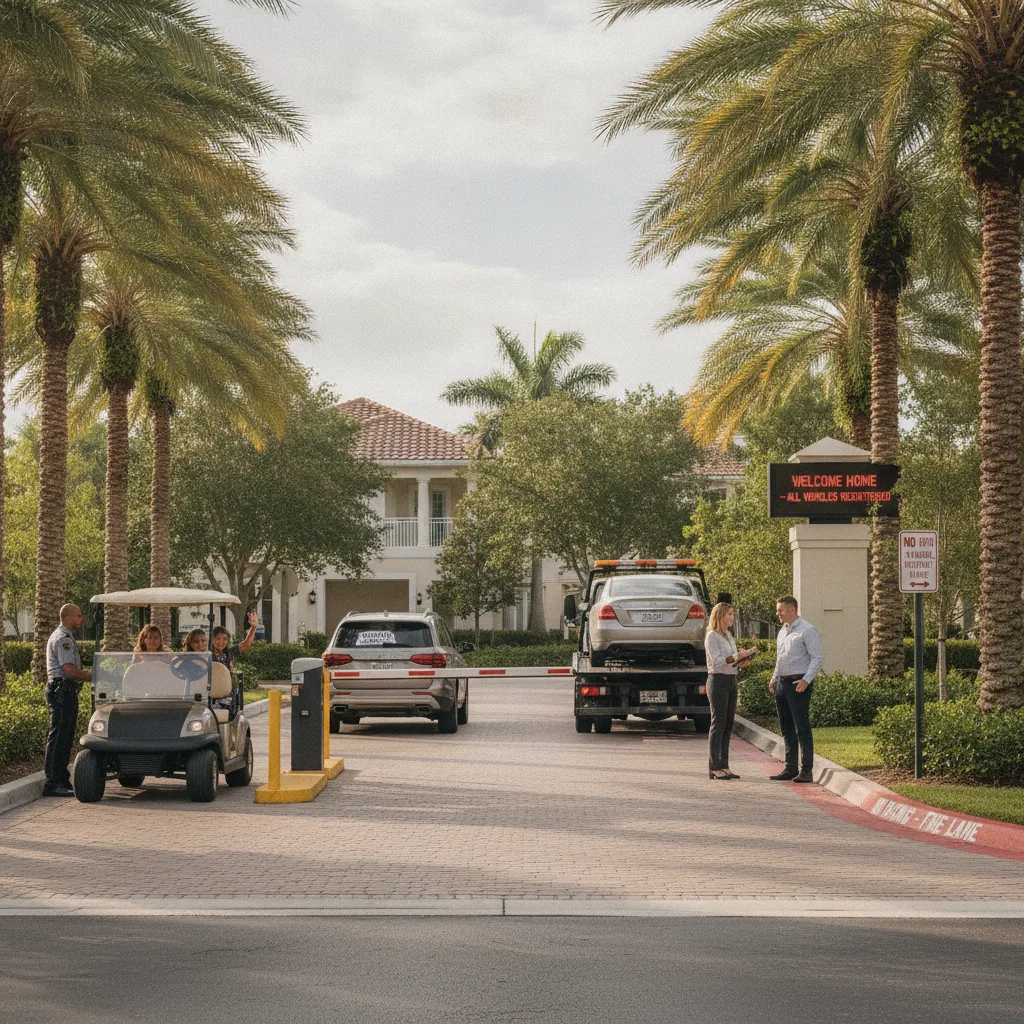
Direct answer: Florida associations should treat a fire-lane complaint as a safety report first and a covenant issue second: confirm whether the lane is actively blocked right now, document the striping or signage that makes it a fire lane under the locally adopted Florida Fire Prevention Code, and only then apply the association’s notice-and-hearing process under Chapter 720 before fining or authorizing a tow.
This guide is written for Florida HOA and condo association boards, community association managers (CAMs), and the residents who file or receive fire-lane complaints. Florida’s mix of high-density townhome and condo sites, narrow internal roadways, and a state fining statute with specific due-process steps makes this one of the few parking complaints where getting the sequence wrong creates real liability.
Why fire lanes are a different category of complaint in Florida
Most Florida municipalities and counties adopt the Florida Fire Prevention Code (based on NFPA 1) largely as written, which means the local fire marshal, not the association, has final authority over what counts as a fire lane, how it must be marked, and who can order a vehicle removed for blocking one. An association’s own governing documents can restrict parking, but they cannot override a fire marshal’s authority to order immediate removal of a vehicle blocking emergency apparatus access. That split matters operationally: a board that tows a car for “fire lane parking” using only its own covenant authority, without confirming the lane is properly marked under the adopted code, is on much weaker ground than one that can point to a striped and signed lane consistent with local fire code.
Florida’s building stock adds to the risk. Townhome and garden-condo communities built with 24-foot internal roadways, tuck-under garages, and shared driveways were often designed before current fire apparatus access standards, so the fire lane may run directly along a curb residents have parked on for years without incident. A complaint that shows up after a new fire marshal inspection or a change in signage is a different case than a complaint about a car parked where residents have always parked. Boards should know which situation they’re in before responding.
Sorting the complaint: hazard first, paperwork second
| Situation | What Florida boards need to confirm | Who acts |
|---|---|---|
| Vehicle is blocking access right now | Nothing else matters yet — call 911 or the non-emergency fire line | Fire department or law enforcement, not the board |
| Vehicle blocked a lane in the past, no current hazard | Lane markings, signage date, photo with a visible curb/sign, timestamp | CAM logs it; board reviews at next scheduled action |
| Lane is not clearly marked or signed | Whether the association’s own rule (vs. fire code) is the actual basis for enforcement | Board should confirm with the local fire marshal’s office before fining |
| Repeat offender after written notice | Chapter 720 notice-and-opportunity-to-be-heard record, prior fine history | Fining committee or board per governing documents |
The sequence that holds up if a resident appeals
- Confirm there’s no active hazard. If a vehicle is currently blocking apparatus access, this is not an association enforcement matter — it’s a call to the fire department or local law enforcement, full stop.
- Capture the lane itself, not just the car. A photo of the vehicle alone proves little. The record needs the curb marking or sign, the vehicle’s position relative to it, and a timestamp, ideally from a system that logs the plate and time automatically rather than relying on a resident’s phone photo weeks later.
- Check the notice-and-hearing requirement before fining. Florida Statute §720.305 requires associations to give the owner a reasonable opportunity to be heard before most fines can be imposed, and the amounts and cure periods are specified in the statute rather than left to board discretion. A fine issued without that step is vulnerable on appeal regardless of how clear the violation was.
- Match the response to the pattern. A first-time, non-hazardous incident usually warrants a written warning under the association’s adopted rule. A vehicle repeatedly obstructing a marked lane after notice is where towing authority (governed separately by Florida’s towing statute, §715.07, which has its own signage and notice requirements) becomes relevant.
Where the board’s authority stops
Associations are not fire code enforcement agencies, and boards should resist the temptation to treat every “fire lane” complaint as automatically actionable under covenant authority. If a resident disputes that a lane is properly marked, or if the dispute turns into a due-process fight over notice, that’s a question for the association’s attorney, not a workflow decision. The same is true for towing disputes: Florida’s towing statute sets specific requirements for signage and post-tow notification, and getting those wrong exposes the association, not just the towing vendor, to liability. For a broader look at how towing authority varies once you’re outside Florida-specific statute, see Can My HOA Tow My Car? Rules by State.
Running this as a bounded pilot before it becomes policy
Before rolling a fire-lane response process out association-wide, test it against a small set of real cases from the last few months: one clear violation with good photo evidence, one ambiguous case where the lane markings are faded or missing, and one repeat-offender case that would trigger the fining committee. Walk each through the same four steps above with whoever actually handles complaints day to day — often the CAM, not the board directly — and see where the process stalls. If the CAM can’t get a clean plate-and-timestamp record without physically visiting the lane, that’s a documentation gap worth solving before scaling enforcement, not after a resident challenges a fine. Some associations address this gap with automated LPR camera coverage at Florida HOA and condo entrances, which produces a timestamped plate record without requiring a manager to be on-site when the violation occurs.
What to confirm before the board acts on this association-wide
- Whether the disputed lane is a fire-code-designated lane or an association-only parking restriction — the legal basis is different.
- Who has authority to log complaints, issue warnings, and forward repeat cases to the fining committee.
- That the §720.305 notice-and-hearing record is being kept for every fine, not just contested ones.
- That towing vendors are meeting Florida’s signage and notification requirements independently of the association’s own rule.
- How the association will handle a lane whose markings are faded, missing, or predate current fire code adoption.
Related PLACA.AI planning resources
Operational FAQs
Does a Florida HOA need the fire marshal to confirm a lane before enforcing against it?
Not for every complaint, but if a resident disputes whether an area is legally a fire lane, the association’s covenant authority alone isn’t the final word — the locally adopted fire code is. Boards handling frequent disputes should get written confirmation of lane boundaries from the local fire marshal’s office once, rather than re-litigating it case by case.
Can an association tow immediately for a fire-lane violation?
Only where the association’s own documents authorize it and Florida’s towing statute requirements (signage, notice) are met. An active emergency obstruction is a matter for the fire department or police, not a private tow.
What stops a fire-lane enforcement rollout from scaling safely?
Unclear lane boundaries, missing photo/timestamp evidence, a fining process that skips the §720.305 hearing step, or a towing vendor that isn’t independently compliant with state signage requirements.
Plan a limited workflow review
Bring the current rule, process, exceptions, and success criteria for responding to fire-lane complaints in a Florida association. PLACA.AI can help evaluate a bounded pilot without assuming another property’s workflow is the right answer.
Editorial refresh: September 18, 2026. Independently confirm current product capabilities, third-party features, pricing, contracts, governing requirements, and local rules before acting.
Data source: Community Associations Institute