

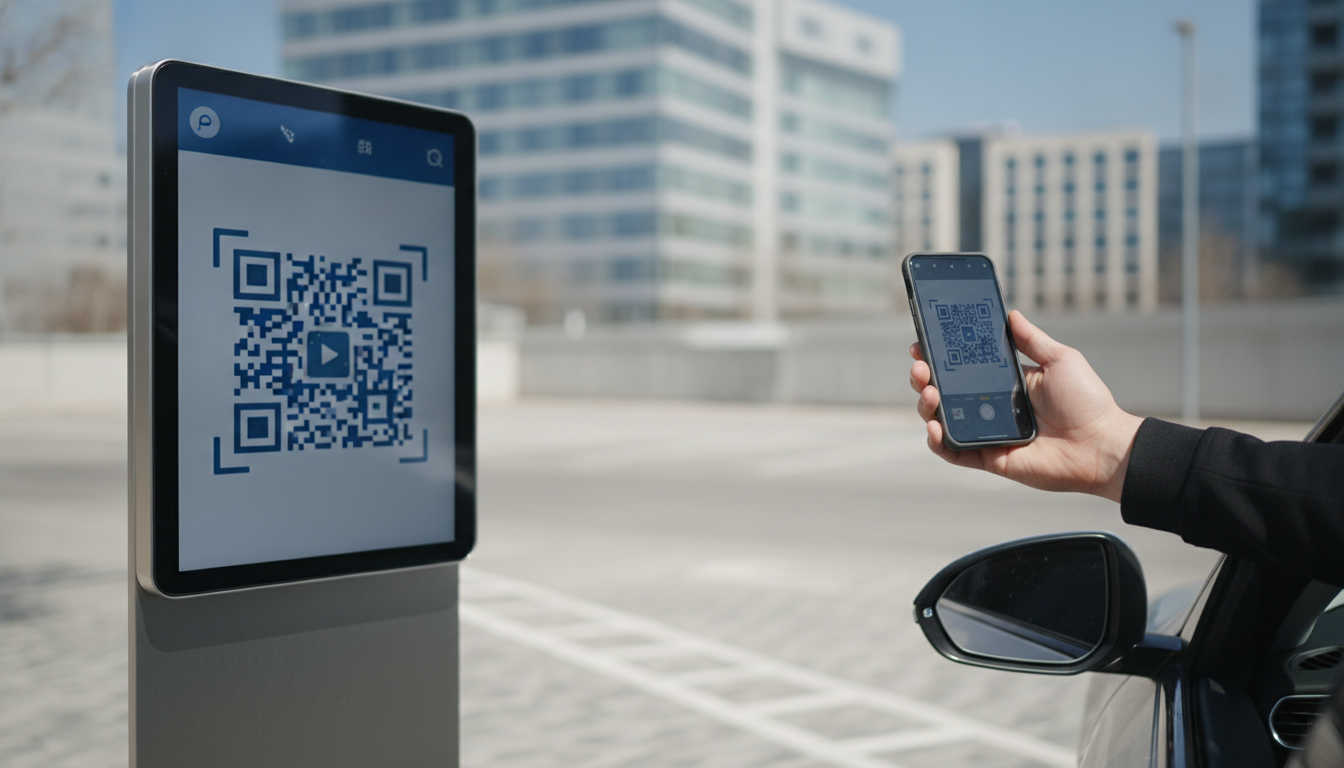
Direct answer: For downtown lot operators, payment kiosk dependence usually means a bank of multi-space pay stations covering blocks of transient and commuter parking, each one a maintenance and cash-collection liability. Reducing dependence means shifting routine transactions to pay-by-plate and license plate recognition (LPR) enforcement, while keeping at least one accessible, non-smartphone payment option per zone — a requirement in many city parking ordinances, not just good practice.
Downtown lots serve a mixed population in a way a suburban or single-use lot doesn’t: all-day commuters who know the system, short-term errand parkers who don’t, and out-of-town visitors unfamiliar with local pay-by-plate apps at all. That mix is why a downtown kiosk-reduction plan looks different from a garage or a private lot — the question isn’t just “can we remove hardware,” it’s “who gets stranded if we do.”
Start from who actually uses the kiosk today
Multi-space pay stations downtown typically serve three kinds of transactions: short-term transient parkers paying by the hour, permit holders validating a reserved space, and cash payers who either don’t have a smartphone or don’t want to install a new app for a single visit. Before removing any hardware, separate usage by these three groups, because the group driving most kiosk traffic determines whether digital-first actually reduces load or just shifts a queue from the machine to a support line.
Reduction path with an equity fallback
| Stage | What changes | Fallback retained |
|---|---|---|
| Baseline | Multi-space pay station per block face; LPR patrol confirms payment against the station’s session list | None needed; kiosk is the only path |
| Pay-by-plate rollout | Zone-based app and SMS payment added, tied to a published zone number | Existing kiosks remain in place during the transition period |
| Consolidation | Kiosk count reduced per block, spaced so no accessible space is more than a short walk from one | At least one kiosk per zone retained for cash and non-smartphone payment |
| Steady state | Most transactions app-based; remaining kiosks maintained as the accessible option, not a legacy holdover | Kiosk uptime monitored the same as any primary payment channel |
Move from signal to outcome
- Baseline kiosk usage by zone and hour before removing anything, including the share of cash transactions specifically.
- Publish zone numbers clearly on signage and at remaining kiosks, since pay-by-plate and pay-by-zone systems fail most often on driver confusion about which zone code applies.
- Coordinate the reduction with LPR patrol routes, since enforcement needs to know which zones still rely on kiosk session data versus app data, and reconcile both against a single record.
- Keep a published, ADA-accessible payment option in every zone, sized to the slowest observed cash volume, not the average.
Where this has to stop or slow down
Don’t consolidate kiosks below what your city’s parking ordinance requires for non-app payment access — many municipalities specifically require an option that doesn’t depend on a smartphone or a bank card, and that requirement typically applies to privately operated downtown lots serving public parking, not just city-owned meters. Confirm your specific city and state requirements independently, since they vary and change. Also hold off on full consolidation in zones with high visitor or tourist traffic, where drivers are least likely to already have a local parking app installed.
What to observe during the transition
- Cash and non-app payment share by zone, tracked over enough weeks to smooth out day-of-week variation
- Support calls or in-person complaints tied specifically to kiosk removal in a zone
- LPR-flagged unpaid sessions that turn out to be app-payment sync delays, not real nonpayment
- Walk distance from any point in a zone to the nearest remaining kiosk
Acceptance file before expanding
- Confirm the purpose and non-goals for kiosk reduction in this specific zone, not the whole downtown footprint at once.
- Verify ADA and non-smartphone accessibility requirements independently for your city and state.
- Use current usage data, not a plan built on the busiest kiosk in the system.
- Retain evidence of accessible-option availability for every zone, in case of a compliance question.
Related PLACA.AI planning resources
Implementation questions
Can a downtown lot go fully app-based and remove all kiosks?
Usually not, and often not legally. Most city ordinances covering public-facing parking require a non-smartphone payment option, so plan for at least one accessible kiosk per zone as a permanent fixture, not a temporary bridge.
How do we know which zones are safe to consolidate first?
Start with zones showing the lowest cash and non-app usage in your baseline data — typically commuter-heavy zones where regular users have already adopted the app — and hold off on high-tourist or visitor-heavy zones.
How does LPR enforcement change when kiosks are reduced?
Patrol needs to reconcile against both kiosk session lists and app-based payment records in the same pass, since a zone in transition will have both data sources active at once.
Plan a limited workflow review
Bring kiosk usage by zone, your city’s accessible-payment requirements, and current LPR patrol routes. PLACA.AI can help evaluate a zone-by-zone reduction plan without assuming one block’s usage pattern applies downtown-wide.
Editorial refresh: September 18, 2026. Independently confirm current product capabilities, third-party features, pricing, contracts, governing requirements, and local rules before acting.
Data source: U.S. Department of Transportation