

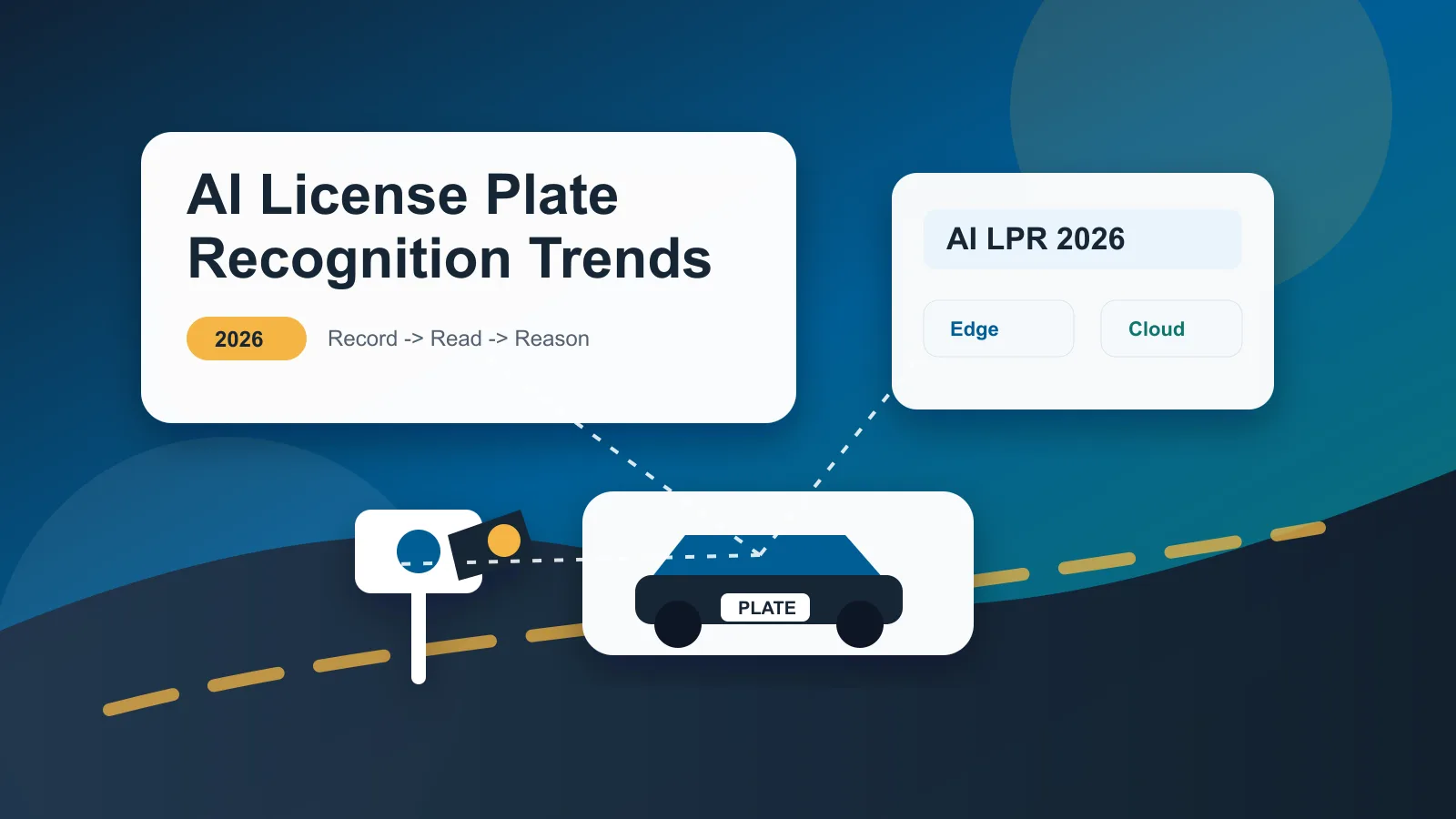
Quick Answer
AI license plate recognition is evolving beyond simply reading and storing plate numbers. Newer systems can combine plate recognition with vehicle type, color, make or model, real-time event detection, edge processing, and automated operational workflows.
The broader smart traffic camera market is projected to grow from approximately $2.4 billion in 2024 to $7.8 billion by 2030, representing a projected compound annual growth rate of 21.3%.[1] Industry research also estimates that more than 40% of new LPR installations now incorporate some form of AI-enhanced processing.[2]
For HOAs, apartments, schools, parking operators, towing companies, and commercial properties, the strategic question is no longer simply:
Can the camera read a license plate?
The better question is:
What can the system do with the vehicle information after the plate is recognized?
That shift—from plate capture to operational decision-making—is defining the next generation of LPR technology.
Why the LPR Market Is Changing
License plate recognition has been used for years in tolling, parking, law enforcement, and gated access. What is changing is the intelligence surrounding the plate read.
Traditional LPR systems generally performed one primary function: capture a plate number and compare it against a database. Modern platforms can use that plate read as the beginning of a larger workflow.
Depending on the application, the system may:
- Verify whether a vehicle is authorized
- Compare the plate with vehicle type or color
- Open or restrict a gate
- Notify school dismissal personnel
- Identify an expired parking permit
- Alert a towing operator to a violation
- Record a vehicle’s arrival or departure
- Route an event into property-management software
- Generate reports across multiple locations
Industry estimates place the LPR camera market at approximately $1.43 billion in 2025, with growth projected into 2026 and beyond.[3] That is separate from the larger smart traffic camera market, which includes traffic analytics, incident detection, enforcement, and other intelligent transportation applications.
The practical takeaway is straightforward: property owners are no longer comparing cameras alone. They are comparing complete vehicle-intelligence systems.
Three Generations of Vehicle Camera Technology
Understanding the evolution of traffic and access-control cameras makes it easier to compare platforms accurately.
Generation 1: Record
The first generation consisted of conventional surveillance cameras. These cameras recorded video for later review but could not independently recognize a plate, classify a vehicle, or trigger an operational response.
Someone had to watch the footage, locate the vehicle, and interpret what happened.
Generation 2: Read
The second generation added license plate recognition and optical character recognition.
These systems could automatically extract a plate number from a video image and use it for:
- Gate access
- Tolling
- Parking entry and exit
- Watchlists
- Vehicle searches
- Enforcement records
This eliminated much of the manual work involved in reviewing recorded video.
Generation 3: Reason
The third generation adds AI-driven video analytics, multidimensional vehicle data, edge processing, event detection, and software integration.
Instead of returning only a plate number, an advanced system may return a structured vehicle event containing:
- Plate number
- Jurisdiction or state
- Vehicle type
- Vehicle color
- Make or model
- Direction of travel
- Entry or exit location
- Date and time
- Associated permit, resident, parent, guest, or violation
- Confidence score
- Supporting vehicle and plate images
The industry progression can therefore be described as:
Record → Read → Reason
The value of the third generation is not that a camera has been labeled “AI.” Its value is that the platform can convert a vehicle observation into a faster, more reliable operational decision.
Seven AI License Plate Recognition Trends to Watch in 2026
1. AI Is Becoming Part of the Core System
AI is increasingly being built into the underlying recognition process rather than sold only as a separate analytics module.
Industry estimates indicate that more than 40% of new LPR installations incorporate AI-enhanced processing, while a broader share of intelligent traffic camera systems use AI for vehicle classification, incident detection, and predictive analysis.[2]
For buyers, however, the term AI-powered should not be accepted without explanation.
Ask the vendor exactly what the AI performs:
- Does it improve plate detection?
- Does it classify vehicle type and color?
- Does it identify unusual events?
- Does it improve image selection?
- Does it reduce duplicate reads?
- Does it match vehicles against permits or authorized users?
- Does it automate an operational workflow?
A system should be evaluated by the decisions it improves—not by how often the word “AI” appears in its marketing.
2. Edge and Cloud Processing Are Working Together
Modern LPR systems increasingly use a hybrid edge-cloud architecture.
Edge processing takes place near or inside the camera. It can be used to detect the vehicle, locate the plate, select a useful frame, and perform an initial recognition without sending the entire video stream to a distant server.
This can provide several advantages:
- Lower response time
- Reduced bandwidth consumption
- Continued local operation during temporary connectivity issues
- Less need to transmit continuous raw video
- Faster gate or access-control decisions
The cloud can then handle broader functions such as:
- Multisite dashboards
- Long-term reporting
- User and property management
- Permit databases
- Notifications
- Workflow automation
- Cross-camera searches
- Software integrations
The strongest architecture is not necessarily edge-only or cloud-only. It is the architecture that assigns each task to the most appropriate processing layer.
3. A Vehicle Is Becoming More Than Its Plate Number
One of the most meaningful technology shifts is the move toward multidimensional vehicle recognition.
Advanced systems can capture attributes such as:
- Plate number
- Vehicle type
- Body color
- Brand or model
- Travel direction
- Movement pattern
- Entry and exit event
This additional information can improve verification.
For example, suppose a permit database lists a white SUV, but a recognized plate appears on a black sedan. A plate-only system may authorize the vehicle because the plate matches. A multidimensional system can identify the inconsistency and route the event for additional review.
This does not eliminate errors, but it gives the platform more information with which to evaluate an event.
For gated communities and apartment properties, this can help identify:
- Shared or transferred permits
- Potential plate swapping
- Vehicles entering under the wrong account
- Repeat unauthorized vehicles
- Differences between registered and observed vehicles
For towing and parking operators, it can create a stronger evidence package than a plate number by itself.
4. Automated Vehicle Workflows Are Replacing Manual Checks
Automation is becoming one of the largest value drivers behind LPR adoption.
Historically, many vehicle-related processes depended on manual observation:
- A guard checked a printed resident list
- A parking attendant inspected permits
- A tow-truck driver compared vehicles against a spreadsheet
- A school employee waited for a parent to provide a name
- A property manager searched hours of recorded video
AI LPR can reduce these manual steps by connecting recognition results to a defined workflow.
Examples include:
Access control
A recognized resident vehicle can be verified against an authorization list before a gate is opened.
School dismissal
An arriving vehicle can be associated with an approved parent or guardian, allowing dismissal personnel to begin preparing the student before the vehicle reaches the loading area.
Parking enforcement
A recognized plate can be compared against paid parking sessions, permits, assigned spaces, or time restrictions.
Towing operations
An enforcement platform can identify a vehicle that appears to violate a property rule and send the event for human confirmation before action is taken.
Valet operations
A plate read can help check in a vehicle, associate it with a customer, and assist staff when the vehicle is requested.
The technology is most valuable when it reduces repetitive work while preserving an appropriate review process for uncertain or consequential decisions.
5. Solar, Cellular, and Flexible Camera Designs Are Expanding Deployment Options
Traditional LPR projects often require power, network cabling, trenching, poles, and extensive civil work. Those infrastructure requirements can make deployment difficult at:
- Secondary entrances
- Remote parking lots
- Construction sites
- Older communities
- Self-storage facilities
- Temporary enforcement locations
- Properties without existing network infrastructure
The availability of solar-powered, cellular, mobile, and modular camera designs is expanding the range of feasible deployment locations.
The Milesight industry report, for example, identifies fixed, mobile, integrated, and solar-powered camera form factors designed for different operating environments.[4]
Solar is not suitable for every site. The design must account for:
- Available sunlight
- Camera power consumption
- Cellular signal strength
- Battery capacity
- Seasonal weather
- Expected vehicle volume
- Required video retention
- Mounting and maintenance access
However, where those conditions are favorable, solar and wireless deployment can reduce the need for trenching and shorten installation timelines.
6. Privacy and Data Governance Are Becoming Purchase Criteria
LPR systems process information associated with vehicle movement. Buyers should therefore evaluate privacy and data governance before deployment—not after a complaint or security incident.
Important questions include:
- What information is collected?
- Are full vehicle images retained?
- How long are plate records stored?
- Who controls the retention period?
- Which users can search vehicle records?
- Are user actions logged?
- Is the information shared with third parties?
- Is law-enforcement sharing automatic or customer-controlled?
- Can records be exported?
- How are access permissions revoked?
- How is stored information protected?
- Does the platform support different policies for schools, HOAs, parking, and commercial properties?
Privacy advocates and government researchers have raised concerns about retention, widespread sharing, public access, and the aggregation of vehicle-location information.[5][6]
A property-focused access-control platform should therefore provide clearly defined:
- Retention settings
- Role-based permissions
- Audit histories
- Customer-controlled access
- Documented sharing policies
- Purpose-specific data collection
For schools, privacy controls become especially important because vehicle events may be connected to student arrival or dismissal activity.
7. Open Integration Is Becoming More Important Than Closed Hardware
An LPR camera rarely operates alone.
A complete deployment may need to connect with:
- Existing gate operators
- Barrier arms
- Video-management systems
- Property-management software
- Parking-payment platforms
- Towing databases
- School dismissal applications
- Visitor-management systems
- Cloud dashboards
- Notification services
- Access-control relays
- ONVIF or RTSP video streams
- APIs and webhooks
The industry is moving from isolated cameras toward connected systems in which the camera becomes one source of operational data.
This creates an important buying distinction:
Closed platform: The customer must purchase a specific camera, server, software package, and integration ecosystem from one vendor.
Open platform: The system can work with compatible cameras, standard video protocols, third-party software, and existing infrastructure.
Interoperability remains a significant industry challenge. Different communication protocols, data structures, and proprietary platforms can increase deployment cost and prevent systems from sharing information effectively.[7]
Before choosing a platform, buyers should determine whether it can integrate with what they already own—or whether it requires an unnecessary complete replacement.
What These Trends Mean for Different Property Types
HOAs and Gated Communities
HOAs can use LPR for resident verification, guest management, entry and exit records, gate automation, and after-the-fact vehicle searches.
The most relevant trends are:
- Multidimensional vehicle verification
- Integration with existing gate equipment
- Solar deployment at secondary entrances
- Customer-controlled data retention
- Automated alerts for unauthorized vehicles
Read more: HOA License Plate Recognition Systems
Apartments and Multifamily Communities
Apartment properties must manage residents, visitors, vendors, delivery drivers, temporary vehicles, and parking restrictions.
An integrated platform can help reduce dependence on windshield stickers, paper permits, and manually updated gate lists.
Read more: AI License Plate Recognition for Apartments
K–12 Schools
At schools, LPR can support a defined dismissal workflow rather than functioning as a general surveillance system.
A recognized vehicle may be matched with an approved pickup account, allowing staff to:
- Confirm arrival
- Identify the authorized parent or guardian
- Notify dismissal personnel
- Organize the pickup sequence
- Record pickup activity
- Manage exceptions requiring staff review
Read more: Automating School Student Dismissal
Towing and Parking Enforcement
For towing and parking operators, the central benefit is workflow efficiency.
A platform can compare recognized vehicles with:
- Resident permits
- Paid parking sessions
- Visitor registrations
- Assigned spaces
- Time restrictions
- Do-not-tow lists
- Property-specific enforcement rules
The system should still provide a human confirmation step where local regulations, property policies, or contractual requirements make review appropriate.
Read more: Parking Enforcement Software for Towing Companies
Self-Storage Facilities
Self-storage facilities often have extended perimeters, limited staffing, and entrances that may be far from existing network infrastructure.
LPR can support:
- Automated entry records
- Tenant vehicle association
- After-hours alerts
- Entry and exit searches
- Gate integration
- Remote or solar-powered deployment
Read more: AI License Plate Recognition for Self-Storage
Real-World Accuracy Depends on More Than AI
Accuracy claims must be evaluated in context.
Rain, fog, snow, glare, poor lighting, motion blur, reflective plates, dirty plates, unusual fonts, camera angle, and inadequate pixel density can all affect recognition performance.[8]
Even an advanced recognition model cannot fully compensate for a badly positioned camera.
From an implementation perspective, reliable LPR begins with:
- Correct camera placement
- Appropriate lens selection
- Sufficient plate pixel density
- Controlled capture angle
- Proper shutter and exposure settings
- Nighttime illumination
- Defined vehicle speed and capture range
- Testing with local plate formats
- Reliable network and power design
- A workflow for low-confidence results
This is why a properly engineered installation often matters more than a vendor’s headline accuracy percentage.
A responsible vendor should be willing to demonstrate performance using:
- The customer’s actual entrance
- Local license plates
- Day and night conditions
- Expected vehicle speeds
- The proposed mounting distance
- The intended camera angle
- The property’s real network conditions
Comparing Three Generations of Vehicle Camera Systems
| Capability | Passive Video | Basic LPR/OCR | AI-Enabled LPR Platform |
|---|---|---|---|
| Records vehicle video | Yes | Yes | Yes |
| Automatically reads plates | No | Yes | Yes |
| Identifies vehicle type or color | No | Limited | Frequently available |
| Performs local edge processing | No | Sometimes | Increasingly common |
| Generates structured vehicle events | No | Basic | Yes |
| Connects events to operational workflows | No | Limited | Yes |
| Detects inconsistencies between plate and vehicle | No | No | Possible |
| Integrates with third-party platforms | Limited | Vendor-dependent | A core evaluation criterion |
| Supports automated alerts and actions | No | Basic | Yes |
| Requires human review for uncertain events | Yes | Sometimes | Still recommended |
The PLACA Implementation Perspective
The future of LPR is not one expensive camera performing every function. It is a flexible platform that connects the right camera to the right workflow.
PLACA is designed around that operating model:
- Compatible video and LPR inputs
- Property-specific rules
- Centralized cloud management
- Vehicle and plate event records
- Role-based operational workflows
- Gate and access-control integration
- Towing and parking enforcement
- School pickup management
- Valet vehicle workflows
- Multisite reporting
For buyers, the key performance indicator should not be the number of AI features listed on a specification sheet.
It should be the measurable operational outcome:
- How many manual checks are eliminated?
- How quickly can an event be verified?
- How much staff time is recovered?
- How reliably are authorized vehicles identified?
- How easily can the platform work with existing infrastructure?
- How clearly can administrators control access and retention?
- How effectively does the system handle uncertain results?
That is where modern LPR produces business value.
How to Evaluate an AI LPR Platform
Before selecting a system, ask the vendor to address these seven areas:
Recognition performance
Request evidence under your actual lighting, weather, distance, angle, and vehicle-speed conditions.
Edge processing
Determine which functions occur locally and which require cloud connectivity.
Vehicle attributes
Confirm whether the system recognizes only the plate or can also capture vehicle type, color, make, or model.
Workflow automation
Ask what happens after a plate is recognized and which manual steps can be reduced.
Deployment flexibility
Evaluate fixed, cellular, mobile, and solar options based on the site.
Privacy controls
Review retention, permissions, audit logs, data sharing, and deletion policies.
Integration
Confirm compatibility with existing cameras, gates, relays, VMS platforms, parking systems, and APIs.
Frequently Asked Questions
How is AI LPR different from conventional plate recognition?
Conventional LPR generally reads and stores a plate number. AI-enabled platforms may add vehicle classification, event detection, image selection, anomaly identification, and automated decision workflows.
Can AI LPR completely replace a gate guard?
It can automate many routine verification tasks, but complete replacement depends on the property, operating hours, visitor process, emergency procedures, and acceptable risk. A human escalation path remains advisable for uncertain events.
Does an LPR system require replacing an existing gate?
Not necessarily. Many deployments can integrate with existing gate operators through relays, APIs, access-control panels, or other interfaces. Compatibility should be confirmed through a site assessment.
Can LPR work without wired internet or electrical power?
Some sites can use cellular connectivity and solar power. Feasibility depends on sunlight, battery capacity, signal strength, recording requirements, camera power demand, and expected traffic.
What information does an LPR system store?
This varies by platform. Records may include a plate number, plate image, vehicle image, location, date, time, travel direction, vehicle attributes, permit association, and system action.
Can AI eliminate false plate reads?
No. AI can improve recognition and use additional vehicle attributes to support verification, but no system eliminates errors in every environment. Low-confidence events should be reviewed appropriately.
Does bad weather affect LPR?
Yes. Rain, snow, fog, glare, low light, and dirty or obscured plates can reduce image quality and recognition performance. Camera positioning, illumination, exposure, and system design are critical.
Is LPR useful for smaller properties?
Yes. Modular software, cellular cameras, and solar deployment options can make LPR practical for smaller communities, schools, parking areas, and single-location businesses.
Conclusion
The most important AI license plate recognition trend in 2026 is not a single camera feature.
It is the transformation of LPR from a plate-reading device into a connected vehicle-operations platform.
The strongest systems combine:
- Reliable image capture
- AI-enhanced recognition
- Edge and cloud processing
- Vehicle attribute analysis
- Automated workflows
- Flexible deployment
- Privacy controls
- Open integration
For organizations evaluating LPR, the goal should not be to purchase the camera with the longest feature list. The goal should be to deploy a system that produces accurate, secure, and actionable vehicle information within the organization’s actual workflow.
Explore PLACA.AI or request a demonstration using your property’s real entrance, vehicles, and operating requirements.
—
Sources
- Strategic Market Research — Smart Traffic Camera Market
- MarketGrowthReports — License Plate Recognition Camera Market
- Global Growth Insights — LPR Cameras Market
- Milesight, AI-Powered Smart Traffic Cameras: Market Trends, Technologies, and Future of Intelligent Transportation
- American Civil Liberties Union — License Plate Readings Shouldn’t Be Public Data
- Congressional Research Service — Automated License Plate Readers: Background and Legal Issues
- Adeniran et al. — Adoption of Intelligent Transport Systems in Urban Transportation Planning
- Patsnap — Optimizing Environmental Conditions for LPR Effectiveness