

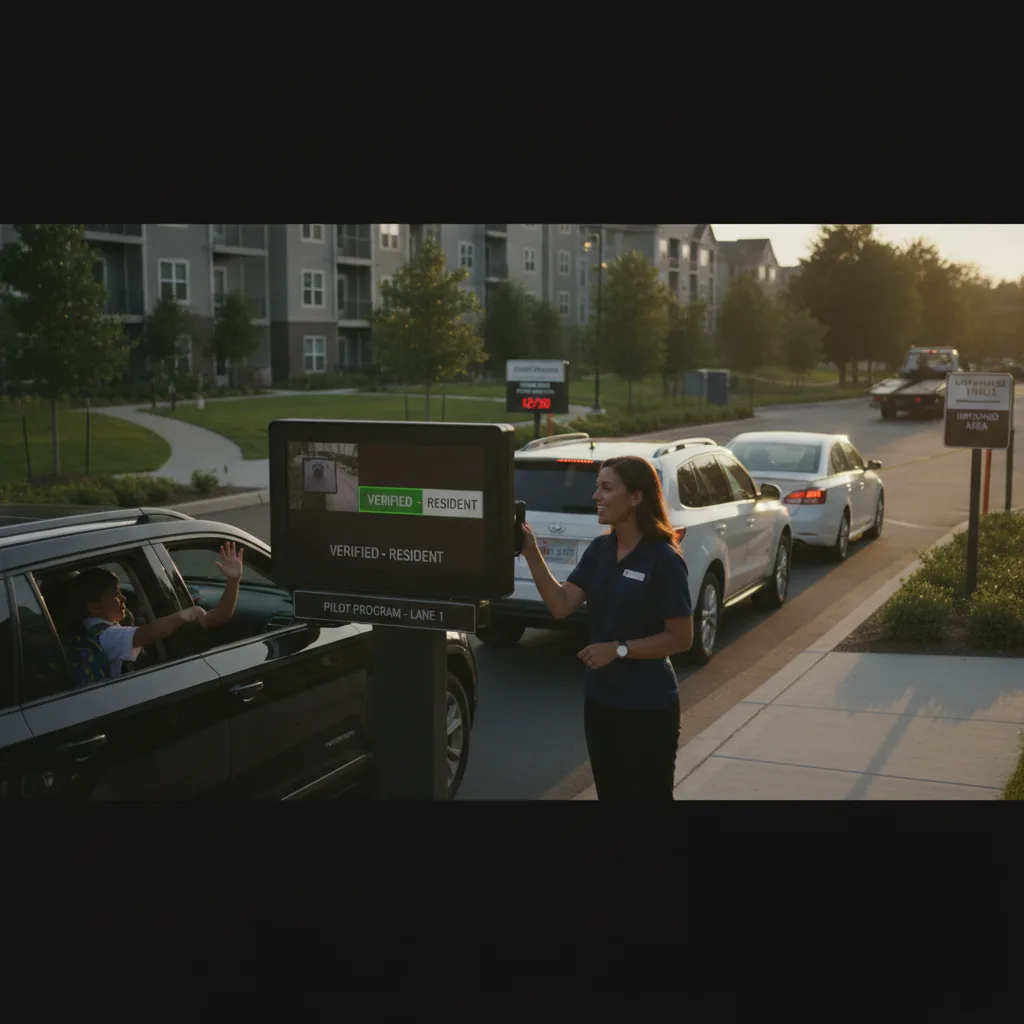
Direct answer: HOA boards protect limited guest spaces by adopting one written policy – by board vote, recorded in the minutes – that ranks guest use, recurring-service use, and resident overflow, and then applying it the same way regardless of who’s asking. The hardest part isn’t writing the policy; it’s holding the line when a director personally knows the resident who wants an exception. Guest-space disputes that end up in front of an attorney almost always trace back to inconsistent enforcement, not an unclear rule.
This guide is for HOA boards – the elected, volunteer homeowners who govern the association under its declaration (CC&Rs) and bylaws. That volunteer structure is the source of most guest-parking conflict: directors live in the community, know the residents involved by name, and have to make enforcement calls about their own neighbors.
Why boards, specifically, struggle with this
A hired manager or gate staffer enforcing a guest-parking rule against a stranger is a straightforward transaction. A volunteer director enforcing the same rule against someone they carpool with, or whose kids play with theirs, is a different situation entirely – and residents can tell the difference. Courts in a number of states have recognized a legal concept sometimes called selective or arbitrary enforcement: an association that enforces a restriction against some owners but not others, without a documented reason, can weaken or lose its practical ability to enforce that restriction at all. For a board, that’s the real cost of letting a guest-space rule bend for a friend – it’s not just one uncomfortable conversation, it’s a precedent the next dispute will point to.
What’s actually competing for the same spaces
“Guest parking” usually isn’t one use case – it’s several, competing for the same limited inventory:
| Use | Typical duration | Common conflict |
|---|---|---|
| Short-term guest | Hours to a few days | Overstays past the posted limit |
| Recurring service vehicle | Regular but brief (caregiver, nurse, contractor) | Treated as a one-off guest instead of a standing exception |
| Resident overflow | Ongoing | A household with more cars than assigned spaces uses guest spots as unofficial extra parking |
The third row causes the most friction, because it isn’t a stranger’s car – it’s a neighbor’s third vehicle, parked there for weeks, quietly narrowing what’s left for actual guests. A policy that only addresses “guests” and never names resident overflow as its own category will keep losing spaces to it.
Writing a policy that survives a personal relationship
- Put it to a vote, in the minutes. A guest-parking policy adopted informally by a manager or a single director isn’t defensible the same way a board resolution is.
- Name the categories separately. Short guest, recurring service, and resident overflow each get their own rule, rather than one vague “guest parking” line that residents interpret however suits them.
- Build in recusal. When a case involves a director’s own household, close friend, or family member, that director should step back from the decision – and the minutes should note that they did.
- Log every exception with a reason. An exception granted for a documented reason (a medical situation, a one-time move) is defensible. An unrecorded exception is what a future dispute points to as proof of inconsistency.
Related PLACA.AI planning resources
Questions boards ask before adopting a guest-parking policy
Does a guest-parking rule need to be in the CC&Rs, or can the board just adopt it?
Most declarations give the board authority to adopt reasonable rules governing common-area use, including guest parking, without amending the CC&Rs itself – but boards should confirm that authority exists in their own governing documents before relying on it.
What should happen when a director has a personal stake in a case?
They should recuse themselves and let the rest of the board or a designated committee decide, with the recusal noted in the record.
How should resident overflow be distinguished from a legitimate guest?
By vehicle history, not by who’s asking – a car that’s present on a recurring, ongoing basis belongs in the resident-overflow category regardless of whose name is on the registration.
Plan a limited workflow review
Bring your current guest-parking rule (if one exists), a recent dispute, and the board’s exception history. PLACA.AI can help evaluate a bounded pilot without assuming another property’s workflow is the right answer.
Editorial refresh: September 18, 2026. Independently confirm current product capabilities, third-party features, pricing, contracts, governing requirements, and local rules before acting.
Internal Resources
- How Repo and Tow Operators Can Identify Repeat Violators With Mobile LPR Workflows
- How Texas HOAs Can Manage Unauthorized Commercial Vehicles Without Creating Resident Friction
- How Texas HOAs Can Improve Resident Vehicle Registration Without Creating Resident Friction
- How Florida Associations Can Respond To Fire Lane Parking Complaints Without Creating Resident Friction
- How Venue Parking Managers Can Move From Paper Tickets To Ticketless Valet With License Plate Recognition
Data source: Community Associations Institute