

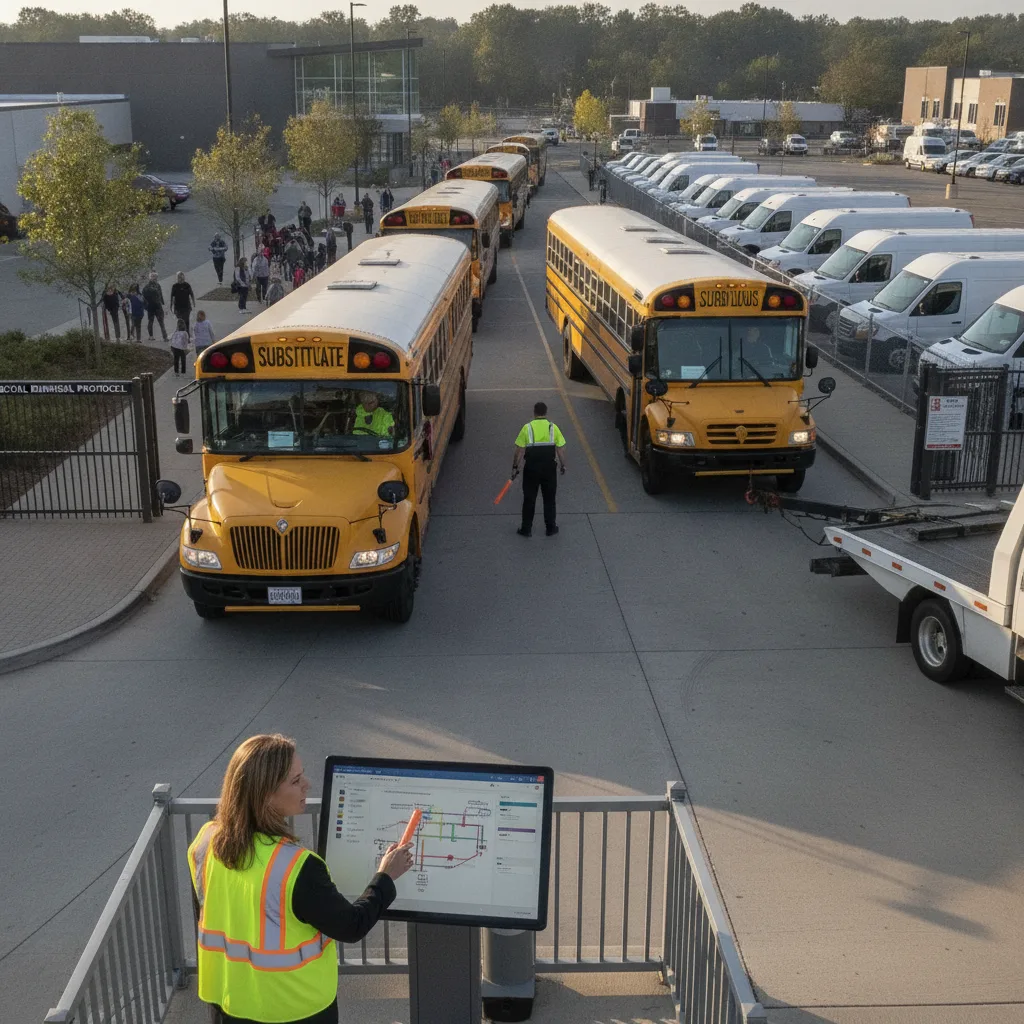
How School Transportation Directors Can Avoid Substitute Teacher Dismissal Gaps With Better Vehicle-Based Workflows
Direct answer: Substitute-day dismissal gaps happen because transportation mode information lives in a classroom teacher’s head and a paper folder, not in a system a substitute can find in ten seconds. Give every substitute a printed or digital transportation roster tied to the same vehicle-verification check used at the carline and bus loading zone, require a headcount reconciliation against the bus manifest before any bus pulls away, and route same-day mode-change notes through the front office instead of directly to the classroom.
Key Takeaways
- The regular classroom teacher is usually the only person who reliably remembers which students ride which bus, walk, or get picked up by car — and that knowledge disappears the day they’re out.
- Substitute teachers typically get five to ten minutes of handoff information, most of it about instruction, not dismissal logistics.
- A vehicle-based check at the carline and a manifest-based headcount at the bus loading zone both need to work independently of who is teaching the classroom that day.
- Same-day mode changes (a parent note sent in that morning) are the highest-risk category because they arrive after the substitute’s handoff is already complete.
Why This Gap Shows Up Specifically on Substitute Days
Most elementary and many secondary classrooms run dismissal off a transportation card or a laminated list taped near the door: bus number, car rider, walker, YMCA or daycare van. The regular teacher has that list memorized by October. A substitute walking in cold does not, and depending on the campus, that list may live in a sub folder that gets buried under lesson plans, in a classroom management app the substitute was never given login credentials for, or simply in the outgoing teacher’s memory with no written backup at all.
Transportation directors feel this problem downstream, not upstream. The classroom teacher’s confusion turns into a bus idling at the curb because the manifest count doesn’t match who showed up, a radio call asking whether a student who’s supposed to be on Route 14 is actually still in the building, or a parent in the carline who was told their child “already left on the bus” when the child was in fact a car rider that day. Each of these costs minutes at the loading zone, and minutes at one campus cascade into late arrivals at every other stop on that route.
Where the Handoff Actually Breaks
There are three points in a substitute day where dismissal mode information can get lost, and they don’t get equal attention from most campuses.
| Checkpoint | Who Normally Confirms It | What Happens If It’s Skipped |
|---|---|---|
| Morning attendance and transportation card check | Classroom teacher, from memory or a taped list | Substitute has no reliable source for dismissal mode all day |
| Substitute folder / dismissal card handoff | Front office or team lead, at drop-off | Substitute is dismissing on guesswork or asking the student |
| Same-day mode-change notes | Parent note routed through the front office | Change never reaches the substitute; student goes to default mode |
| End-of-day headcount vs. bus manifest | Driver and campus staff at the loading zone | Bus leaves with a missing rider or an extra rider who boarded the wrong bus |
Notice that the fourth checkpoint is the only one that happens outside the classroom entirely. That’s deliberate, and it’s the one transportation directors can control directly even when they have no influence over how a given campus staffs its substitute folders. A manifest reconciliation at the loading zone, backed by a vehicle or badge check that doesn’t depend on the substitute’s memory, catches errors that started three steps earlier.
What a Redundant Check Looks Like in Practice
The fix isn’t to make substitutes better at memorizing rosters in one morning — that’s not a realistic ask. The fix is to stop treating the classroom teacher as the single point of failure for dismissal mode. A carline system that matches the vehicle against a registered pickup list, independent of what the substitute believes the child’s dismissal mode is, will flag a car-rider student who the substitute assumed was a walker. A bus manifest scan at the loading zone does the same thing for bus assignments: it doesn’t care whether the adult supervising dismissal is the homeroom teacher or a first-day substitute, because the check runs against the district’s transportation record, not the substitute’s notes.
This is also where a lot of transportation directors already have relevant infrastructure without realizing it applies to substitute days specifically. Campuses that have separated bus and carline traffic with distinct verification points tend to catch mode mismatches earlier, because the two dismissal streams aren’t competing for the same staff attention at the same curb.
Building the Substitute-Day Checklist
- Require a printed or digital transportation roster to be part of the standard sub folder — not an optional extra — with bus number, car rider status, and walker/daycare van noted per student, refreshed weekly rather than relying on a stale printout from August.
- Route same-day mode-change notes to the front office instead of directly to the classroom, and have office staff update the roster the substitute is using before dismissal, not after.
- Assign a hallway or loading-zone monitor whose only job on substitute days is reconciling headcount against the bus manifest before any bus is released.
- Give substitutes a one-line dismissal script for the loading zone: “If a student isn’t on your list for this bus, send them to the office, don’t guess.”
- Track substitute-day dismissal problems separately from normal-day metrics so the pattern is visible to transportation and not just anecdotal from angry parent calls.
Metrics That Actually Show Improvement
Scan counts and app logins don’t tell you whether substitute-day dismissal is safer. These do:
- Bus dwell time at the loading zone on substitute days versus normal days
- Number of “missing rider” or “extra rider” calls logged by drivers per month
- Same-day mode-change notes received after 2:00 p.m., and how many reached the substitute in time
- Radio or phone calls to the transportation office specifically tied to substitute-covered classrooms
If a campus can’t produce even a rough count of the last item, that’s usually the clearest sign the substitute folder and loading-zone reconciliation aren’t actually happening consistently, whatever the written policy says.
Common Questions From Transportation Directors
Should the fix live with the classroom teacher’s sub plans or with transportation?
Both, but transportation should not depend on the classroom half working. The loading-zone headcount and vehicle check need to function as an independent backstop, because sub-plan quality varies by teacher, by campus, and by how much notice the absence had.
What about students whose dismissal mode changes only on substitute days by coincidence?
Treat every same-day change as high-risk regardless of why the regular teacher is out. The office routing step matters more than the reason for the absence.
How does this connect to bus route timing across a district?
A single stuck dismissal at one campus delays every downstream stop on that route. Reducing dwell time on substitute days protects the whole route schedule, not just the one campus where the confusion happened.
Internal Resources
Related Resources
For a deeper commercial overview, see Placa.ai’s student pickup / school dismissal solution. Technical teams may also want to review related automation workflows and compare them with supporting use cases.
Field Questions Operators Ask
What should school administrators, district operations teams, and campus safety leaders confirm before evaluating avoid substitute teacher dismissal gaps school pickup line automation?
They should confirm the exact rule they want to enforce, the vehicle data needed to support that rule, who reviews exceptions, and what outcome will prove the workflow is better than the current manual process.
What is the most useful first use case for student pickup / school dismissal?
A practical first use case is when a school starts with authorized pickup vehicle matching for one dismissal lane before changing the entire parent pickup process. That keeps the pilot narrow enough to train staff, check data quality, and measure whether the process actually improves.
Which questions would an operator usually ask about avoid substitute teacher dismissal gaps school pickup line automation?
Operators usually ask what happens when a plate is misread, how temporary vehicles are handled, whether staff can review the evidence, how long records are kept, and how the workflow prevents unfair enforcement.
What data should the team collect, and what should it avoid collecting?
Collect only the operational data needed for the workflow: plate, time, location, permit or account match, event history, and reviewer notes. Avoid collecting unrelated personal details or keeping records longer than the policy requires.
What does Placa.ai usually recommend as the safest rollout path?
Placa.ai’s opinion is that teams should start with a written policy, a limited pilot, a warning or education period, and a clear human review step before enforcement decisions become routine.
How can a team make the article’s advice unique to its own operation?
Add the real failure points staff see every week, the current workaround, one example dispute or bottleneck, the policy language used today, and the metric leadership already cares about.
What is a useful field example for this topic?
A useful example is a team comparing manual notes against plate-based event history for the same workflow. If the plate record reduces lookup time, missing evidence, or repeated manual checks, the workflow has a stronger business case.
How should exceptions be handled?
Exceptions should be documented in the same system as normal events. Temporary permits, rental cars, caregivers, vendors, emergency situations, and data entry corrections all need a review path that staff can explain later.
Which metrics prove the workflow is helping?
The best metrics are operational: fewer disputes, faster review time, fewer unauthorized vehicles, shorter queues, more complete evidence, fewer manual lookups, and fewer staff hours spent reconciling spreadsheets or paper notes.
When should a team avoid automating this workflow?
A team should wait if the policy is unclear, the vehicle data is outdated, staff do not know who owns exceptions, or leadership cannot define what success should look like after the pilot.
Plan Your School Pickup Line Automation Rollout
If your team is evaluating avoid substitute teacher dismissal gaps school pickup line automation, Placa.ai can help map the policy, vehicle data, and operating workflow before you roll it out.
Data source: National Center for Education Statistics