

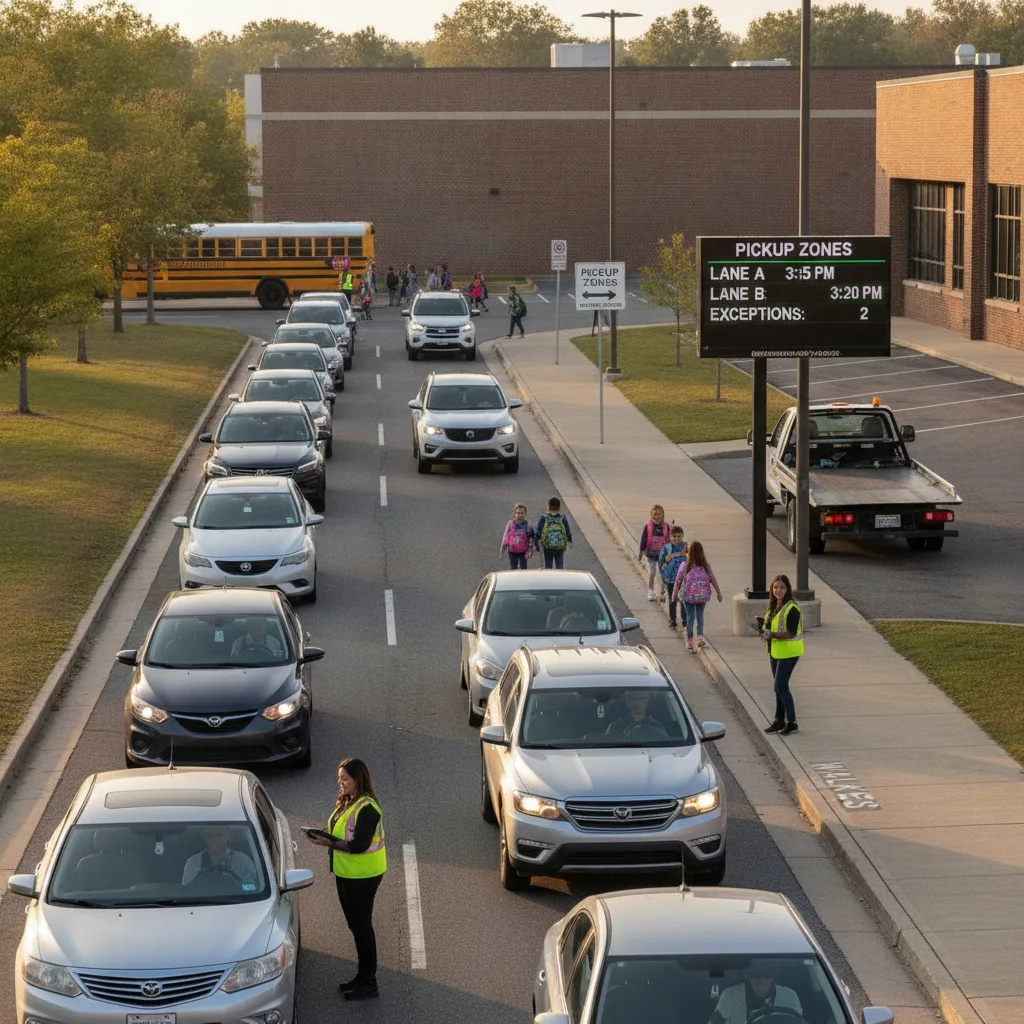
A school pickup safety log should track first-week dismissal by lane, time, risk, and owner: carline backups, bus conflicts, walkers, crosswalk issues, illegal parking, late transportation changes, and release exceptions. Review it every afternoon, assign one fix before the next day, and keep vehicle recognition under staff control.
Key Takeaways
- The first week should be treated as an operations audit, not just a communication problem.
- A useful log separates vehicle flow, student release, pedestrian safety, bus movement, and parent exceptions.
- Every logged issue needs a named owner, next-day action, and threshold for escalation.
- Vehicle recognition can reduce radio calls and car-tag confusion, but staff still approve the student release.
- Do not collect more parent, student, or vehicle data than the dismissal workflow actually needs.
What This Workflow Involves
This workflow gives a school team a practical way to turn the first five pickup and dismissal days into a daily improvement loop. The school assigns one person to own the log, then positions staff at the carline entrance, loading zone, bus loop, walker gate, crosswalk, front office, and any known illegal-parking pinch point.
Each observer records what happened in plain operational language: time, location, mode, issue, immediate safety risk, delay cause, release concern, staff action, parent communication gap, and recommended fix. The goal is not to blame families or staff. The goal is to find the few frictions that will repeat tomorrow unless someone changes the process.
The log should be reviewed the same afternoon. A principal, operations lead, transportation contact, front-office lead, and school resource officer or traffic partner can sort issues into three groups: fix before tomorrow, monitor for three days, or escalate to district, traffic engineering, or law enforcement.
Why This Problem Is Showing Up Now
Current back-to-school material shows schools preparing families for dismissal changes before the 2026-2027 year begins. Mountain View Elementary’s July 21, 2026 checklist says the school dismisses more than 850 students across buses, car line, afterschool program, and clubs, uses one dismissal system, asks families to select default transportation by July 29, and notes that the school resource officer will assist with first-week procedures.
Chandler Police announced a back-to-school traffic safety campaign on July 17, 2026. The department said its campaign would run from July 20 through July 31 and focus on school-zone speeding, pedestrian yielding, illegal parking around campuses, and stopped school-bus violations. Those are exactly the kinds of risks a campus log should capture before they become routine complaints.
Madison Avenue Elementary’s July 2026 newsletter gives another public example. The school planned to begin dismissal procedures ten minutes early during the first two weeks so staff and students could practice procedures and confirm students were in the correct line. It also used car rider ID cards and a front-office ID process when a pickup person did not have the card.
The Core Operational Problem
The hard part of first-week dismissal is that several workflows fail at once. A parent may park in the wrong place because they are trying to help a nervous student. A bus may be delayed because the carline blocks the loop. A walker may cross where staff are not positioned yet. A family may send a late transportation change through the wrong channel. A substitute staff member may not know the release rule.
Without a log, these issues become anecdotes: the line was bad, parents were confused, buses were late, or the parking lot was unsafe. With a log, the school can see patterns by time, lane, and decision point. That makes the next day’s fix concrete.
Use PLACA.AI’s school pickup line license plate recognition guide to evaluate whether vehicle recognition belongs in the process, but use the safety log first to define the operational problem.
School Pickup Safety Log Fields
| Field | What to record | Why it matters |
|---|---|---|
| Time window | Arrival, early queue, first release, peak release, late pickup | Shows whether the issue is a launch problem or a capacity problem |
| Location | Carline entrance, merge point, loading zone, bus loop, crosswalk, walker gate, parking lot, office | Turns complaints into a map of risk points |
| Mode | Car rider, bus rider, walker, biker, after-school program, special transportation | Prevents carline fixes from creating bus or walker risk |
| Observed issue | Backup, illegal parking, wrong lane, missing tag, late change, unclear pickup authority, pedestrian conflict | Creates consistent language across observers |
| Immediate risk | Delay only, pedestrian exposure, vehicle conflict, release uncertainty, bus obstruction | Prioritizes safety over convenience |
| Owner | Principal, assistant principal, transportation, front office, SRO, district operations, communications | Stops the same problem from being discussed but never assigned |
| Next action | Change cone layout, update parent message, add staff post, adjust release script, review late-change rule | Makes the log a daily action tool |
First-Five-Days Review Cadence
Day one is for visibility. Record every major mismatch between the published plan and what families actually do. Do not redesign the whole process after one chaotic afternoon unless there is a clear safety hazard.
Day two is for repeat issues. If the same location, role, or message fails twice, assign an owner and change one thing before the third dismissal. Examples include moving a staff member to a merge point, adding a parent text, separating bus and carline traffic earlier, or changing the late-pickup office script.
Day three is for threshold decisions. If a problem causes pedestrian exposure, bus obstruction, or repeated release uncertainty, escalate it. That may mean district operations, law enforcement, facilities, transportation, or a temporary staff reassignment.
Days four and five are for stabilization. Keep what worked, retire temporary first-week practices that are no longer needed, and decide whether the campus needs a more formal technology pilot, parent communication process, or route redesign.
Where Vehicle Recognition Fits
Vehicle recognition is useful only after the school knows which problem it is solving. If the issue is radio call overload, it can help staff identify arriving vehicles earlier. If the issue is car-tag confusion, it can pair a vehicle arrival with a student record before the loading zone. If the issue is unauthorized pickup, it can support staff verification but should not replace staff approval.
The automated school student dismissal workflow should keep humans in the release decision. A plate match can tell staff that a known vehicle is present, but the school still needs current authorization records, custody flags, exception handling, and a staff-controlled release step.
If the first-week log shows the problem is mainly lane design, signage, or parking overflow, do not buy technology to solve the wrong thing. Fix the physical workflow first, then test a one-lane recognition pilot where it can remove a specific bottleneck.
Evidence And Source Context
Mountain View Elementary’s 2026-27 back-to-school checklist is useful because it shows how many moving parts a real campus coordinates before day one: default transportation selection, bus app setup, first-day parking limits, car tags, and SRO support.
Chandler Police’s July 2026 back-to-school traffic safety campaign identifies the same risk categories schools should track locally: speeding, crosswalk yielding, illegal parking, and stopped school-bus violations. A campus log should not replace enforcement, but it can show where the school’s own process is contributing to unsafe conditions.
Madison Avenue Elementary’s 2026-2027 back-to-school newsletter gives a concrete first-week operations example: early dismissal practice, two car rider lines, car rider ID cards, front-office ID checks, and a cutoff for last-minute transportation changes.
Risks, Limits, And Exceptions
A safety log should not collect personal details that are not needed for operations. Most issues can be recorded by location, time, lane, and issue type. If a release exception involves a student, custody note, medical accommodation, or safety concern, follow district policy for protected records instead of placing sensitive details in a shared traffic log.
The log also should not become an automatic discipline or enforcement tool. Families will make mistakes during the first week. Staff may need to redirect traffic, clarify rules, or hold a student until identity is verified. Those actions should be documented carefully, but the purpose is safer dismissal, not manufacturing violations.
Finally, a campus should know when the problem is outside its control. Public-road congestion, signal timing, crosswalk engineering, and recurring illegal parking may need city, police, or district transportation involvement. The log helps make that request specific.
Worked Example: Three-Day Pattern At A Busy Elementary School
A 700-student elementary school starts the year with one carline, one bus loop, two walker gates, and a front-office pickup exception process. On day one, observers note that parents are parking in a nearby lot and walking students across the carline to avoid the queue. On day two, the same behavior blocks the bus loop exit and creates a pedestrian conflict at 3:02 p.m.
The assistant principal reviews the log and assigns three next-day actions. Communications sends a short parent message explaining why the off-site pickup shortcut is closed. Facilities moves cones to make the walker route clearer. The SRO stands at the conflict point for day three while staff redirect families to the official line.
By day four, the conflict is lower, but the log shows that late transportation changes are still reaching teachers instead of the front office. The next fix is not more cones. It is a cutoff reminder, a front-office script, and a staff-facing release rule so a student is not sent to the wrong place during the afternoon rush.
Frequently Asked Questions
Who should own the school pickup safety log?
One administrator or operations lead should own the log, but observers should include carline, bus, walker, front-office, and safety staff. A single owner prevents scattered notes from becoming separate versions of the truth.
Should parents see the full log?
Parents usually need the resulting procedure updates, not an internal operational log. Share clear changes, reasons, and expectations, but keep protected student information, personnel notes, and safety-sensitive details inside the appropriate district process.
Can license plate recognition replace car rider tags?
Not by itself. Plate recognition can help identify arriving vehicles faster, but schools still need current authorized-pickup records, custody restrictions, substitute pickup handling, and a staff-controlled release step.
What should be fixed first after day one?
Fix immediate safety risks first: pedestrian exposure, bus obstruction, unsafe crossing, unclear release authority, or traffic movement that staff cannot control. Pure delay should be measured, but it may settle after families learn the routine.
How long should a first-week log continue?
Run the detailed log for the first five dismissal days, then convert recurring issues into a lighter weekly review until the process stabilizes. Restart the detailed log after major schedule, route, construction, staffing, or technology changes.
Related PLACA Resources
- Start with the school pickup line license plate recognition guide when the log points to vehicle-identification problems.
- Use the automated school student dismissal workflow to connect vehicle arrival, staff approval, release rules, and audit trails.
- Review school pickup line statistics and operational benchmarks when the team needs to compare wait times, staffing, and parent-flow assumptions.
Next Step
Before the first dismissal day, create one shared log, assign observers to each movement point, and schedule a 20-minute same-day review. After five days, use the evidence to decide whether the campus needs communication changes, lane redesign, staff reassignment, or a focused vehicle-recognition pilot.
Internal Resources
- How School Transportation Directors Can Avoid Substitute Teacher Dismissal Gaps With Better Vehicle-Based Workflows
- How Repo and Tow Operators Can Train Drivers On Mobile LPR With Mobile LPR Workflows
- How Front Office Staff Can Standardize Dismissal Across Campuses With Better Vehicle-Based Workflows
- How Front Office Staff Can Verify Authorized Pickup Vehicles With Better Vehicle-Based Workflows
- How Campus Safety Teams Can Prevent Late Dismissal Bottlenecks With Better Vehicle-Based Workflows