

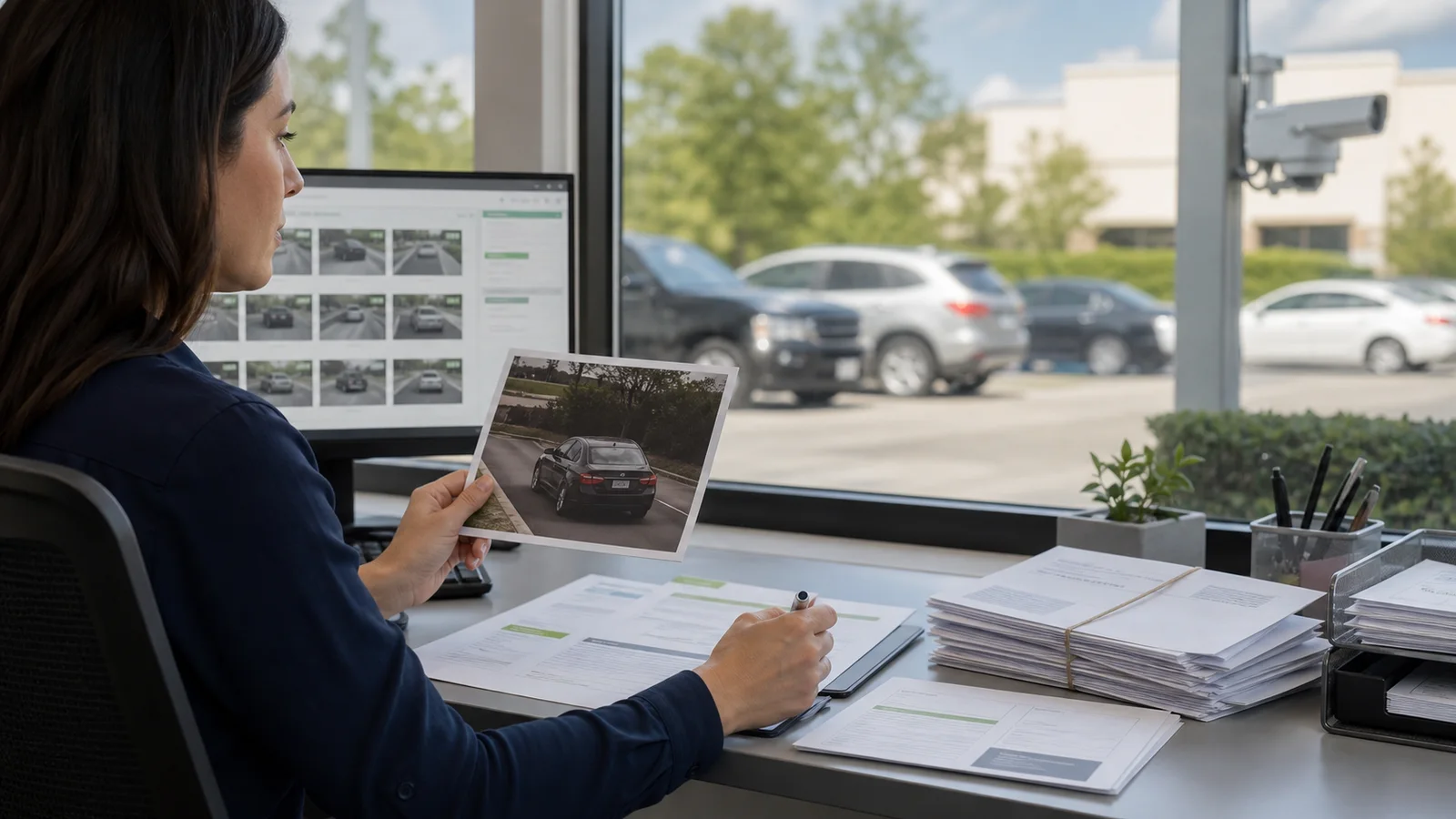
A registered owner parking notice workflow should verify the LPR event, unpaid session, lawful lookup purpose, vendor access, notice evidence, appeal route, and deletion rule before a private parking operator mails a charge or escalates collection.
Key Takeaways
- A plate read is not the same as a complete mailed-notice record.
- Registered-owner lookup should have a documented purpose, named vendor path, minimum data rule, and retention limit.
- Fresh July 2026 DPPA commentary and state legislative activity make owner-data handling a current operating issue for private parking teams.
- The notice packet should prove the parking event and the data path without collecting unnecessary personal information.
- When the plate, payment, zone, or lookup record is uncertain, the case should go to review before a mailed charge, late fee, collection step, boot, or tow referral.
What This Workflow Involves
This workflow starts when an LPR camera or patrol scan identifies a vehicle that appears unpaid, overstayed, outside a valid permit, or otherwise in violation of a posted private parking rule. Before the operator seeks registered-owner information, the case should already contain the location, plate image, OCR result, state, date, time, applicable posted term, payment search, and reviewer identity.
The next step is owner-information control. The operator should know who requests motor-vehicle-record information, which vendor or portal is used, what permissible purpose is being asserted, which fields are returned, who can see those fields, and how the information is deleted or de-identified when the notice is closed.
The final output is a notice packet, not a loose invoice. The packet should connect the plate event, payment status, lookup purpose, mailed-notice language, appeal instructions, support record, and final disposition. If any of those pieces are missing, the case should pause until a human reviewer resolves the gap.
Why This Problem Is Showing Up Now
Private parking enforcement has moved from windshield tickets and attended booths toward gateless lots, mobile payment, cameras, and mailed notices. That shift creates a practical question drivers ask in public forums: is this private parking notice real, and how did the sender get enough information to mail it?
On July 10, 2026, Polsinelli published a fresh update on Driver’s Privacy Protection Act litigation, warning that DPPA risk can extend beyond state DMVs to downstream users of DMV-sourced information. That matters for parking operators because many mailed-notice workflows depend on an intermediary, processor, data provider, or mailing vendor.
Pennsylvania also moved in the opposite direction from a pure risk story by creating a formal statutory path for private parking lots in Act No. 36 of 2026. The official bill page says the law provides for private parking lots. Public parking-industry discussion describes the new path as a PennDOT-administered owner-information process tied to unpaid private parking notices. The useful operating lesson is simple: some states may define a specific pathway, while others require a different legal analysis. Operators should not assume one workflow works everywhere.
The Core Operational Problem
The core problem is evidence and data-use drift. The parking team may see a straightforward unpaid visit. The driver may see a surprise letter from an unfamiliar processor. The vendor may see a data transaction. Counsel may see a DPPA, state-law, contract, and notice-language question. If those views are not connected, the operator cannot explain the case cleanly.
A better process separates three decisions. First, is the parking charge supported by the site evidence and payment record? Second, is registered-owner information necessary and permitted for this case? Third, does the mailed notice explain the charge, the evidence, the official payment route, and the appeal path without overstating consequences?
For operators building LPR, payment, and notice workflows together, the parking operator payment and enforcement workflow hub is the right PLACA starting point. The owner-lookup step should sit after payment and exception review, not before them.
Evidence And Source Context
A public Reddit parking discussion shows the driver-side language: a person received a private parking notice and questioned whether the payment site looked legitimate. That post is not factual authority about any operator. It is useful because it shows the public trust problem mailed notices create when the driver does not recognize the sender.
The strongest current legal-risk source is Polsinelli’s July 10, 2026 update on DPPA litigation. It describes plaintiffs increasingly using the DPPA against businesses that collect, buy, sell, or use vehicle or driver-related data, including information obtained through intermediaries.
The federal DPPA text is the primary statutory reference for permitted disclosure and use of personal information from motor vehicle records. A public complaint filed in June 2026 against parking and data-processing defendants also alleges that LPR plate reads were used to obtain protected information for mailed parking invoices. Those allegations are not findings. They are a reminder that the operator’s evidence, purpose, vendor path, and deletion record matter.
A current public privacy notice from Level Parking provides a useful disclosure example. It states that registered-owner information may be obtained to deliver a parking-charge notice, describes limited access and logging, and says registered-owner information is not used for marketing. Operators should not copy another company’s policy. They should use examples like this to identify the kinds of questions their own counsel, vendor, and support team must answer.
Registered Owner Parking Notice Workflow Checklist
| Checkpoint | Operator question | Record to retain |
|---|---|---|
| Parking event | Does the LPR image and OCR result support the plate, state, location, and time? | Plate image, OCR result, reviewer note, confidence indicator |
| Payment search | Was the plate, zone, account, QR session, app payment, validation, and grace window checked first? | Payment lookup timestamp and outcome |
| Lookup purpose | Why is registered-owner information necessary for this case? | Purpose code, counsel-approved SOP, request timestamp |
| Vendor path | Which processor, data provider, portal, or mailing vendor touches the information? | Vendor list, contract reference, access log |
| Minimum data | What fields are needed to deliver and resolve the notice? | Returned-field list and masking rule |
| Notice packet | Does the mailed notice show the charge basis, official payment route, appeal route, and deadline? | Notice template version and mailed date |
| Deletion | When is owner information deleted, de-identified, or retained for a documented dispute? | Retention clock, closure date, deletion proof |
Before Requesting Owner Information
The cleanest owner-data workflow starts with a stronger parking record. Check whether the vehicle was actually in the lot, whether the posted terms applied, whether the payment system had a delayed feed, whether the driver used the wrong plate or zone, and whether a grace rule or short-stay exception applies.
This is where many disputes can be prevented. If the LPR image is blurry, the plate state is uncertain, the lot zone is ambiguous, or the payment record shows a plausible match under another saved vehicle, the case should not jump straight to a mailed notice. Use the LPR exception queue before enforcement to route uncertain events to human review before the lookup step.
The operator should also define who may approve lookup requests. A practical rule is to require a reviewed unpaid event, a current notice purpose, and a system record showing why lesser data is insufficient. That record matters later if the driver, property owner, processor, or regulator asks why personal information was used.
What The Mailed Notice Should Make Clear
A mailed notice should reduce uncertainty, not create more of it. It should identify the property, date, time, vehicle, parking rule, amount, official payment route, support contact, appeal path, and deadline. It should avoid vague threats, inflated language, hidden processor identities, and payment links that look unrelated to the property.
The notice should also separate a parking charge from legal conclusions. Private parking rules, municipal citations, collections, booting, and towing can follow different laws and contracts. If a consequence is not approved for that site and state, it should not appear as pressure copy in the notice.
For timing disputes, pair the notice workflow with the parking grace period workflow for LPR lots. A mailed notice is easier to defend when the operator can show that payment delay, wrong-zone payment, short stay, and payment-system failure were checked before owner information was used.
Privacy, Security, And Limits
This article is not legal advice. The DPPA, state law, local ordinances, contract terms, and private-property notice rules can change the correct process. A parking operator should have counsel review the lookup purpose, vendor contracts, notice template, fee language, retention rule, and appeal path before relying on mailed notices.
The privacy rule should be practical: collect the least owner information needed, limit it to the notice and appeal purpose, log access, block marketing use, avoid broad sharing, and delete or de-identify the record when the documented purpose ends. If a vendor cannot explain how it receives, uses, logs, and deletes owner information, the operator should treat that as a launch blocker.
Do not turn legal risk into fear marketing. The point is not that every mailed private parking notice is wrong. The point is that a good operator should be able to prove why the parking charge exists, why owner information was needed, who touched it, and how the driver can challenge the case.
Worked Example: Unpaid Visit, Unknown Owner
A vehicle enters a downtown private lot at 7:42 p.m. The sign requires app payment within ten minutes. The LPR system records the plate at entry and exit, but no payment appears under that plate, nearby plate variations, or the relevant zone by the next morning.
Without a controlled workflow, the operator exports the plate to a vendor, receives owner information, and mails a notice. Support later learns that the LPR system misread one character and the driver’s app payment was under the correct plate. The operator now has an avoidable notice, an avoidable owner-data lookup, and a frustrated driver.
With a better workflow, the case first goes through payment and exception review. The reviewer checks image confidence, common character substitutions, payment lag, and nearby transactions. Because the matched payment is found, the case closes without owner lookup. If no payment had been found, the reviewer would approve a purpose-coded lookup, record the vendor path, mail a clear notice, and start the retention clock.
Frequently Asked Questions
Can a private parking operator mail a notice to a registered owner?
Possibly, but the answer depends on federal DPPA rules, state law, vendor pathway, property terms, and notice language. Operators should not rely on a generic national answer; counsel should approve the site-specific workflow.
Should every unpaid LPR event trigger an owner lookup?
No. First check payment status, zone selection, grace rules, OCR confidence, plate-state uncertainty, duplicate sessions, and support holds. Owner lookup should be a documented escalation, not the first review step.
What should vendors prove before handling owner information?
They should be able to explain the data source, permissible-use basis, access controls, logs, subcontractors, mailing process, retention schedule, deletion process, and whether the information is excluded from marketing or unrelated analytics.
How can operators make mailed notices look legitimate?
Use consistent property branding, plain language, an official payment domain, a support phone or email, the evidence summary, appeal instructions, and the processor identity. Avoid pressure language that makes the notice look like a scam.
What if the driver says the notice is wrong?
Route the case to the evidence packet. Review the LPR image, plate read, state, location, time, payment searches, lookup record, and notice history. Close, correct, waive, uphold, or escalate based on documented facts.
Related PLACA Resources
- Start with the parking operator payment and enforcement workflow hub when mapping payment, LPR, support, and notice records.
- Use the LPR exception queue before enforcement to hold uncertain plate events before owner lookup.
- Review the parking grace period workflow for LPR lots before mailing notices for short stays or delayed payments.
Next Step
Pull five recent mailed notices and trace each one backward. If the team cannot show the LPR evidence, payment search, lookup purpose, vendor path, notice version, appeal record, and deletion rule from one case file, fix the workflow before sending more registered-owner notices.