

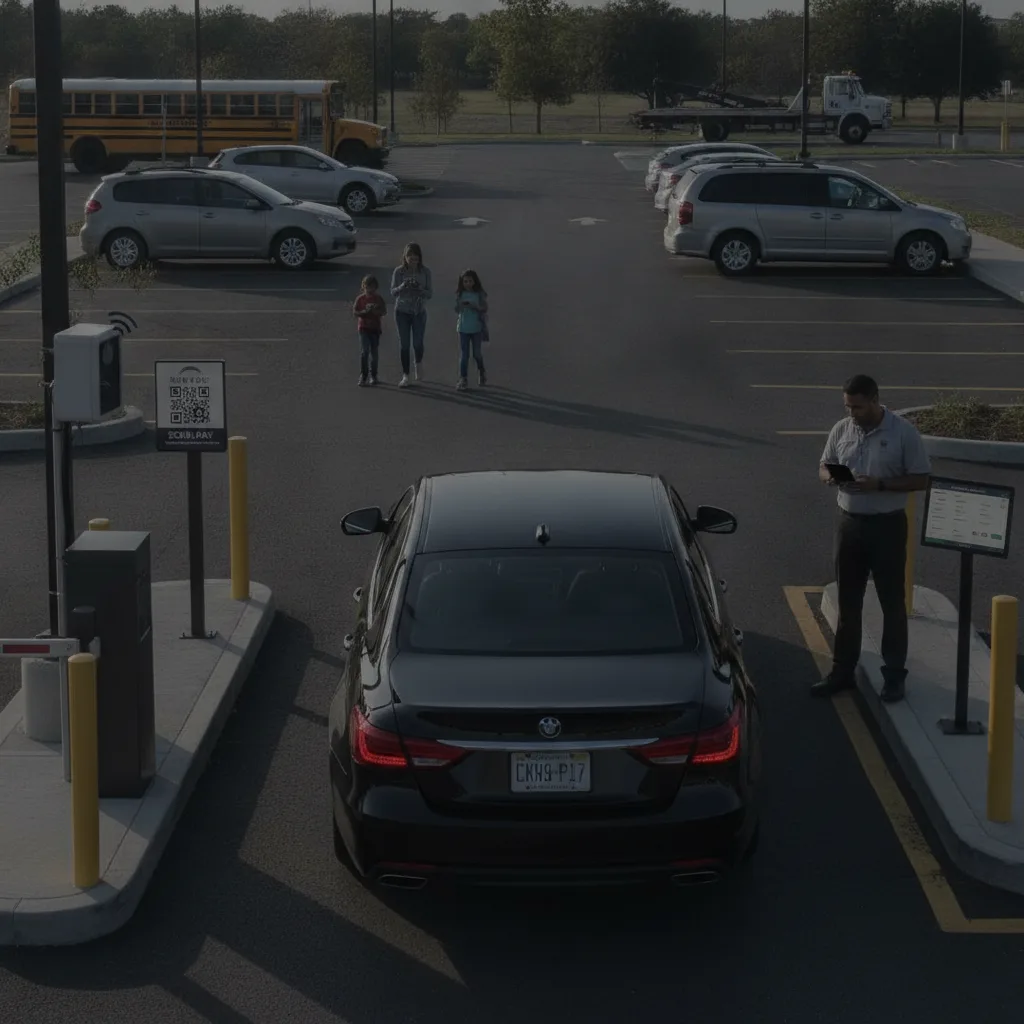
A parking grace period workflow should define what happens between LPR entry, driver review of terms, mobile payment, exit, and enforcement. Before a charge goes out, the operator should check short-stay duration, payment start time, plate or zone mismatch, app failure notes, prior warnings, and appeal evidence.
Key Takeaways
- LPR and ANPR systems record entry and exit events. They do not automatically prove when the driver read the terms, found a space, opened the payment flow, or accepted the parking contract.
- Operators need separate rules for arrival consideration, paid-session grace, payment-system delay, pickup/drop-off stops, and enforcement exceptions.
- Fresh July 2026 public discussions show drivers challenging charges for very short stays and for delays between entry and payment.
- Official and industry code discussions in the UK are useful policy signals, but U.S. operators still need local counsel and site-specific rules.
- The best workflow protects revenue by making enforcement more defensible, not by forgiving every violation.
What This Workflow Involves
This workflow starts by separating three clocks that often get blended together. The camera clock starts when the vehicle crosses the entry camera. The driver clock starts when the driver can reasonably see the terms, find a space, and begin payment. The enforcement clock starts only after the operator has checked whether the visit fits a chargeable rule.
That distinction matters because a camera event is not the same as a completed parking decision. A driver may enter the wrong lot, circle because every marked bay is full, stop briefly for pickup, lose phone signal, update a payment app, select the wrong plate, or pay under a zone that takes several minutes to appear in the enforcement system. Some of those events are abuse. Some are ordinary friction. The operator’s job is to tell the difference before sending a charge.
The output is a written lot policy plus a review queue. Each LPR visit is matched against payment sessions, vehicle records, zone rules, stay length, evidence images, and site exceptions. If the visit is cleanly unpaid and outside the allowed windows, enforcement proceeds. If the record shows a timing mismatch, the visit goes to review before a citation, invoice, tow request, or escalation letter is generated.
Why This Problem Is Showing Up Now
Cashless parking has made payment more convenient for many drivers, but it has also made the first few minutes of a visit more complicated. A driver may need to scan a QR code, download or open an app, enter a plate, select a zone, confirm a card, and wait for the payment session to synchronize. LPR sees only the vehicle movement unless the operator connects those steps into one record.
Public complaints are becoming more specific. In a July 2026 public driving discussion, one driver described receiving a private parking charge after being on site for less than a minute and asked whether that was worth appealing. In another recent public discussion, commenters focused on the difference between arrival consideration time and end-of-session grace. Those posts are not proof that any specific charge was invalid. They are useful because they show the language support teams will hear: I did not park, I needed time to read the sign, I was picking someone up, the app delayed me, or I paid before I left.
Regulators and consumer bodies are also scrutinizing payment timing. A recent UK Competition and Markets Authority letter to government raised concerns about private parking charge practices where ANPR records entry and exit but the payment or contract timing may be understood differently by the driver. The UK private parking code conversation is not a U.S. rulebook, but it is a strong signal that operators should design the timing workflow before disputes force the issue.
The Core Operational Problem
The core problem is not whether parking operators should enforce payment. They should. The problem is whether the enforcement record explains why the charge is fair when the driver says the camera timestamp does not match the actual parking decision.
A lot that relies only on entry and exit time can appear efficient while pushing hidden labor into appeals, refunds, online complaints, chargebacks, and property-manager escalations. A lot that never enforces short unpaid visits loses revenue and teaches repeat abusers where the gaps are. The middle path is a clear policy that defines which mismatches are reviewed, which are warned, and which move directly to enforcement.
For parking operators using LPR, QR, and mobile payment together, the parking operator LPR and QR payment hub should be the planning center. The timing rule should live beside the signage, payment, enforcement, and support workflows rather than inside one person’s judgment.
Evidence And Source Context
The strongest fresh source for this article is not a driver story. It is the public policy record around payment timing. A recent Competition and Markets Authority letter about private parking consumer issues discusses how ANPR entry and exit records can interact with payment timing, contract start expectations, and short overstays. That is a useful warning for any operator automating charges from camera timestamps.
The UK government’s private parking code consultation also separates consideration time from grace time, while the British Parking Association notes that its sector code is actively monitored through a current code framework. Those sources do not control U.S. private lots, but they show the operational distinction a buyer should ask vendors to support.
A U.S. example points in the same direction. New York City’s pay-by-plate code recognizes scenarios where payment evidence shortly after a notice can support cancellation. Private operators should not copy municipal code without counsel, but they can borrow the control principle: payment evidence, timing evidence, and cancellation logic should be defined before disputes arrive.
Parking Grace Period Workflow Checklist
| Checkpoint | Operator question | Record to keep |
|---|---|---|
| Arrival consideration | How long can a vehicle remain while the driver reads terms, finds a bay, decides not to park, or leaves? | Site policy, posted terms, short-stay threshold, camera timestamps |
| Payment start | Does the paid session begin at entry, at app confirmation, at machine receipt, or at another defined event? | Payment-provider rule, receipt timestamp, plate and zone match |
| Payment lag | How long can a successful payment take to appear in the enforcement dashboard? | Integration log, sync delay note, provider status page or support ticket |
| Plate or zone mismatch | Should a near-match plate, saved old plate, wrong zone, or temporary plate trigger review before a charge? | Plate image, OCR confidence, payment record, exception reason |
| Short pickup or turn-in | Is the visit too short to treat as a normal paid parking session? | Duration band, entry/exit images, no-repeat-abuse check |
| App or QR failure | Did the driver attempt payment through an official channel that failed or delayed? | Support note, screenshot upload path, payment attempt log |
| Escalation rule | When does a reviewed exception become a warning, waived charge, valid charge, tow request, or manager review? | Disposition code, reviewer, timestamp, driver-facing explanation |
How To Set The Arrival Rule
Start with the physical site. A simple surface lot with clear entry signage, open spaces, strong mobile signal, and one payment method can use a tighter window than a garage with multiple levels, weak signal, several zones, construction, or confusing exits. The policy should reflect what a reasonable driver must do before payment is possible.
Do not hide this rule from staff. Enforcement agents, customer support, property managers, and the payment vendor should use the same vocabulary. A consideration period is about deciding whether to stay and accept the terms. A grace period is often used for time after a valid parking period expires. A payment-delay exception is about a successful or attempted payment that does not immediately match the LPR visit. Local terminology varies, so the editor should confirm the exact wording before publication or customer-facing use.
For lots that depend on app speed, review the mobile parking payment processing guide before setting a window. If a normal driver needs two or three minutes to complete the payment flow, the enforcement rule should not assume payment was possible in ten seconds.
When A Short Stay Should Go To Review
Short stays are not automatically free. They can include delivery abuse, repeat pickup loops, blocked access, illegal loading, or drivers who use the lot as a shortcut. But a very short stay is also a weak record for an ordinary parking charge if the driver could not reasonably read the terms, find a space, and decide whether to stay.
A practical rule is to create bands instead of one hard cutoff. For example, visits under a very short threshold may be suppressed unless they involve a restricted lane or repeated abuse. Visits in the next band may receive a warning or manual review. Longer unpaid visits can move to normal enforcement if the evidence packet is complete.
The review screen should show the entry image, exit image, total duration, prior visit history, payment search results, zone map, and any support notes. If the reviewer has to open four systems and guess, the rule will not survive busy operating days.
How To Reconcile Payment Timing
Payment reconciliation should answer one question: did this driver make a good-faith payment that covers the visit the camera recorded? The answer may require more than an exact timestamp match.
Check the plate first. Drivers often save old plates, use temporary plates, mistype one character, or choose a family member’s vehicle in a mobile app. Next, check the zone and lot. A payment in the adjacent lot may not cover the visit, but it can explain why the driver believed payment was made. Then check the payment start and end times against the LPR visit, including known provider delays.
New York City’s pay-by-plate code is one useful public example of timing design. It recognizes scenarios where parking time is purchased shortly after a notice is issued and defines evidence that can support cancellation. Private operators should not copy municipal law blindly, but the principle is useful: define what payment evidence can stop a charge before support staff improvise.
Risks, Limitations, And Exceptions
This article is not legal advice. Parking charges, invoices, citations, penalties, towing authority, disabled-parking rules, fire-lane enforcement, consumer disclosures, and appeal rights vary by city, state, country, property type, and contract. A human editor should verify any jurisdiction-specific language before publication.
Do not use the workflow to weaken safety rules. A vehicle blocking a fire lane, gate, accessible route, loading dock, bus lane, or emergency path may require faster action than an ordinary unpaid parking session. The policy should define those exceptions separately.
Also avoid fear-based messaging. The purpose is not to tell operators that every charge will become a legal dispute. The purpose is to reduce uncertainty and make the enforceable charges easier to defend. Drivers are more likely to accept enforcement when the operator can explain the rule, show the evidence, and correct obvious timing mistakes quickly.
Worked Example: Paid Three Minutes After Entry
A mixed-use lot uses LPR at entry and exit plus QR signs for payment. A driver enters at 2:00 p.m., parks, scans the official QR code, enters the plate, and pays at 2:03 p.m. The enforcement system receives the payment at 2:06 p.m. At 2:05 p.m., a patrol agent sees the vehicle in the lot and the dashboard still shows no active payment.
Without a timing workflow, the agent issues a charge. The driver sends a receipt, support reverses the charge, and the property manager receives a complaint about unfair enforcement. The operator collects no extra revenue and loses trust.
With a defined rule, the visit enters a payment-lag queue. The agent sees that the plate is pending provider sync and waits for the configured reconciliation window. When the payment arrives, the record is marked valid and no charge is sent. If the payment never arrives, the same record can still support enforcement because the operator waited, checked, and documented the result.
Frequently Asked Questions
Should every LPR parking lot offer the same grace window?
No. A garage, surface lot, event lot, campus permit area, and private tow-enforcement property can need different rules. The window should reflect signage clarity, payment method, mobile signal, site complexity, local rules, and abuse patterns.
Can a driver be charged if they enter and leave without parking?
That depends on the site rules and local law, but operators should be careful. If the visit is too short for a reasonable person to read terms and accept the parking contract, the charge may be hard to defend. A short-stay review band reduces that risk.
What if a driver pays after the camera records entry?
The policy should define when payment starts and what delay is acceptable. Many mobile and QR workflows naturally create a gap between entry and payment confirmation. The operator should reconcile the successful payment before treating that gap as nonpayment.
How should support handle wrong-plate or wrong-zone payments?
Use a documented exception path. Check whether the payment clearly belongs to the same visit, whether the plate error is minor, whether the zone is adjacent or unrelated, and whether the driver has repeated the same issue. The outcome may be waiver, warning, corrected account, or valid charge.
Does this replace an LPR enforcement exception queue?
No. This is the payment-clock policy. An LPR exception queue handles plate confidence, evidence quality, permit records, and enforcement review. The two workflows should connect, but they solve different problems.
Related PLACA Resources
- Use the parking operator LPR and QR payment hub to plan the full payment, enforcement, and support workflow.
- Review the mobile parking payment processing guide when payment speed, app friction, and receipt timing drive disputes.
- See the parking enforcement software workflow guide when a charge can escalate into patrol, notice, or towing activity.
Next Step
Before sending another automated parking charge, write down the timing rule your staff already applies informally. Then test the parking grace period workflow against ten recent disputed visits: short stays, late payments, wrong plates, wrong zones, app delays, and clean nonpayment. If the rule cannot explain each outcome, fix the workflow before adding more enforcement volume.
Internal Resources
- Parking Signage Disclosure Checklist for Private Lots
- Parking System Outage Workflow for LPR Enforcement
- In-Car Parking Payments: Operator Reconciliation Checklist
- California ALPR Policy Checklist for Parking and Property Operators
- How Repo and Tow Operators Can Verify Permits Faster With Mobile LPR Workflows