

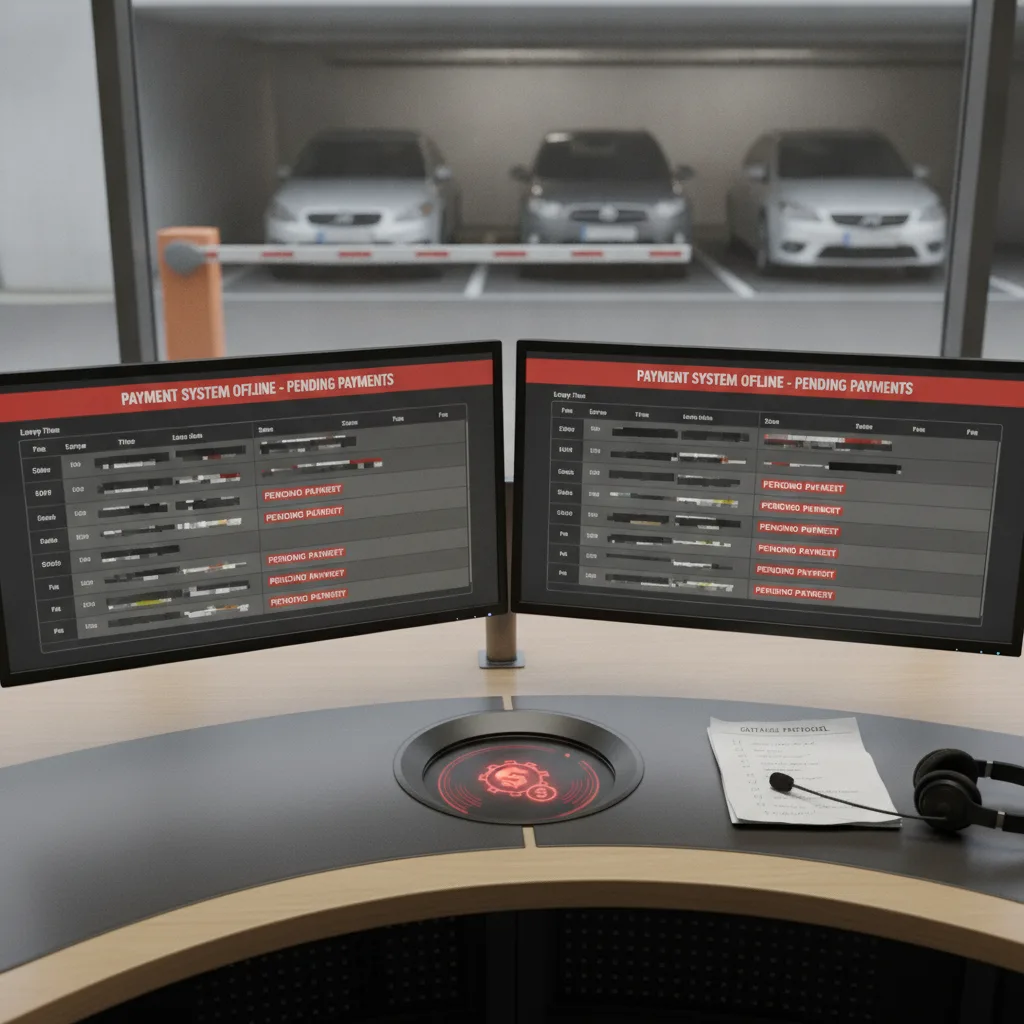
A parking system outage workflow should pause enforcement that depends on unreliable payment data, preserve LPR and payment evidence, publish verified fallback payment instructions, backfill transactions after recovery, and review driver cases before late fees, citations, towing, or collections resume.
Key Takeaways
- A payment outage is not just an IT issue; it changes what enforcement staff can fairly prove.
- LPR events can keep recording vehicle presence, but they should not trigger payment-based penalties while the payment record is unavailable or unreliable.
- The operator needs a written hold rule, fallback payment message, transaction backfill process, and case-review queue before the next outage.
- Cyber-related downtime requires evidence preservation and careful communication, not speculation about causes or blame.
- The goal is to protect revenue and trust by separating clean nonpayment from cases affected by a system failure.
What This Workflow Involves
This process starts as soon as staff can no longer trust the normal payment or enforcement feed. The failure may be a mobile app outage, QR payment failure, wallet processor delay, citation lookup outage, permit database interruption, webhook backlog, or cyber incident that takes systems offline. The operator should declare an incident, name an owner, and decide which enforcement actions are safe to continue.
The first decision is scope. If only receipt lookup is slow, staff may keep ordinary enforcement but route appeals to a longer review window. If the payment app is down across the property, payment-based citations should stop until a fallback route is active. If the payment database or wallet feed may be compromised, the operator should preserve records, restrict access, and avoid changing data until technical and legal reviewers confirm the recovery path.
The second decision is communication. Drivers need to know whether payment is unavailable, which official alternatives still work, whether enforcement is paused for payment-related cases, and how to submit a record if they attempted to pay. Staff need a shorter internal rule: what to issue, what to hold, what to document, and who can approve exceptions.
Why This Problem Is Showing Up Now
Fresh July 2026 reporting showed how quickly a parking payment outage can become an enforcement and trust problem. The Star reported on July 30, 2026 that a cyberattack disrupted parking and enforcement systems serving 48 local councils plus other public and privately operated sites. The same report described affected transactions, heavy support volume, and compensation questions after core services were restored.
Another July 30 report described the provider rebuilding systems rather than simply restoring the compromised environment. That recovery context matters for parking operators because payment downtime is not always a short app glitch. When a security event is possible, the response may involve isolating servers, resetting access, preserving forensic evidence, validating data integrity, and bringing services back in stages.
Public driver discussions show the customer-side language operators should expect. Recent public posts describe people trying to extend parking, add wallet balance, use backup channels, or dispute a fine after an app failed or a payment stayed pending. Those posts are not factual authority about any operator. They are useful because they show the questions support teams hear: Did I try to pay? Was the app down? Why did enforcement continue? What proof should I send?
The Core Operational Problem
The hard part is source-of-truth failure. During normal operations, payment records, LPR events, wallet status, permit records, and enforcement dashboards are supposed to agree. During an outage, one system may keep working while another stops. A camera can still read plates. A patrol app can still show vehicles. But if the payment source is unavailable, the operator may not know whether the driver paid, attempted to pay, selected the wrong fallback, or was unable to use the official route at all.
Continuing ordinary enforcement during that uncertainty pushes cost into appeals, refunds, chargebacks, property-manager complaints, and public reviews. Stopping every enforcement action can create a different problem: deliberate nonpayment, blocked access, expired permits, and safety violations. The practical answer is not all-or-nothing. It is an incident rule that pauses payment-dependent escalation while preserving urgent safety and access exceptions.
For teams running LPR, QR, mobile payment, and support together, the parking operator payment and enforcement workflow hub should be the planning center. Outage handling belongs beside payment reconciliation, signage, exception review, and escalation policy.
Evidence And Source Context
The strongest fresh evidence is The Star’s July 30, 2026 report on compensation after a parking system outage. It described a cyberattack affecting parking systems, local councils, privately operated sites, user credits, transactions, support messages, and enforcement verification. The operational lesson is narrow: when staff cannot verify parking payment, enforcement decisions need a documented hold and recovery process.
A second The Star report, also published July 30, 2026, described rebuilding and securing the platform after the incident. That source supports a recovery checklist that includes isolation, credential reset, forensic preservation, testing, and staged restoration. A July 1 Malay Mail report adds public-sector context that affected councils were instructed to suspend summons while the system was being restored.
For general incident-response framing, NIST’s official incident response guidance is useful because it treats response and recovery as coordinated functions. Parking operators do not need to turn a lot manager into a cybersecurity team, but they do need an operational bridge between technical recovery and customer-facing enforcement decisions.
Parking System Outage Workflow Checklist
| Checkpoint | Operator question | Record to keep |
|---|---|---|
| Declare the incident | What system failed, when was it detected, and who owns the response? | Incident start time, owner, affected systems |
| Set enforcement scope | Which actions pause: payment citations, late fees, collections, booting, tow referral, or all payment-dependent notices? | Hold rule, effective time, exception list |
| Preserve evidence | Which LPR events, payment attempts, webhook logs, support tickets, and status messages must be retained? | Evidence export, access log, retention note |
| Publish fallback routes | Which official channels still work, and what should drivers avoid? | Status page, signs, support script, timestamp |
| Separate safety exceptions | Which violations still need action even if payment systems are down? | Fire lane, accessible route, blocked gate, emergency lane policy |
| Backfill transactions | How will successful, pending, duplicated, failed, refunded, or missing payments be reconciled? | Transaction report, processor reference, reviewer |
| Review affected notices | Which citations or fees were issued during the incident window? | Case list, disposition code, driver response |
| Close the incident | What changed before normal enforcement resumes? | Recovery memo, restored services, lessons learned |
What To Pause And What To Keep Running
Pause actions that depend on payment truth. That usually includes automatic unpaid-session notices, late fees, payment-related citations, boot escalation, collections transfer, and tow referrals tied to unpaid parking. If the operator cannot see whether drivers could pay or whether payments synchronized, those cases need a hold.
Keep safety and access rules separate. A vehicle blocking a fire lane, gate, accessible route, loading dock, emergency path, reserved operational space, or active driveway may still require immediate action. The record should state why the action was not payment-dependent and which evidence supported it.
The hold should have a clock. For example: all payment-based enforcement events from the incident start time through verified restoration enter review. Normal enforcement resumes only after the payment provider, operator, and support lead agree that records are searchable, payments can be matched, and fallback messages have been removed or updated.
How To Handle Driver Payment Attempts
Do not ask drivers for unnecessary personal data. A privacy-safe report can include the approximate time, location, visible error message, payment channel, receipt reference, last four characters of a transaction reference when appropriate, and whether another official route was attempted. It should not require full card numbers, full wallet screenshots, unrelated account history, or private identity documents unless counsel requires something specific.
Support should classify each case as paid, attempted payment, pending payment, duplicate payment, failed payment, no official route used, unrelated complaint, or insufficient evidence. That classification matters because each outcome needs a different response. A paid or duplicate case may need correction or refund. A plausible attempt during the incident window may need a warning or waiver. A clean nonpayment outside the incident window may remain enforceable.
For normal timing disputes outside an outage, use the parking grace period workflow for LPR lots. The outage rule should not replace ordinary grace-period policy; it should override only when the official payment path or verification feed was unreliable.
Fallback Payment And Notice Rules
Every operator should decide fallback routes before the outage. If SMS, web, kiosk, phone support, attendant payment, validation desk, or pay-on-exit remains available, publish exactly which route is official. If no route is reliable, say that payment-dependent enforcement is paused for the affected window and explain how the operator will reconcile cases after recovery.
Signs and support scripts should be timestamped. A message posted at 9:00 a.m. may be wrong by noon if the provider restores one channel but not another. The record should show what drivers were told at each stage, because that message becomes part of the fairness review later.
For operators evaluating mobile payment vendors, the mobile parking payment processing guide should be expanded internally with outage requirements: status visibility, payment-attempt logs, support exports, webhook replay, refund handling, and clear service-level commitments.
Risks, Limits, And Legal Review
This article is not legal advice. Parking citations, private invoices, contractual parking charges, municipal penalties, towing, booting, refund rights, compensation, and cyber incident notification duties vary by jurisdiction and property type. A human editor should verify all legal language before publication.
Do not blame a vendor publicly until the facts are verified. During a cyber incident, premature explanations can create legal, reputational, and security problems. Keep customer messages focused on what drivers should do, what enforcement is paused, what records are preserved, and when the next update will arrive.
Also avoid turning the incident into a permanent waiver policy. The operator should correct cases affected by the system failure while preserving a clear path for deliberate nonpayment, repeat misuse, safety violations, and cases outside the incident window.
Worked Example: App Down, LPR Still Running
A private downtown garage uses LPR at entry and exit, QR signs for transient parking, and a mobile payment app for monthly overflow permits. At 10:12 a.m., support receives several reports that the app will not accept wallet top-ups. At 10:25 a.m., enforcement staff confirm that payment status is not updating in the patrol dashboard, though LPR reads continue arriving.
The garage declares an incident. Payment-based citations and late fees are paused from 10:00 a.m. forward. Fire lane, blocked gate, and accessible-route enforcement remain active. The operator posts a status message at the entrance and on the help page, lists a phone payment backup, and tells drivers not to submit full card screenshots. LPR events continue to be stored, but unpaid-session notices are held.
At 1:40 p.m., the provider restores payment lookup. The operator exports all LPR events and payment attempts during the incident window, backfills valid sessions, flags duplicate top-ups for refund review, and reviews any notices issued before the hold rule was communicated. Normal enforcement resumes only after support can find receipts by plate, zone, and time. The incident closes with a short memo documenting what failed and what will change before the next outage.
Frequently Asked Questions
Should parking enforcement stop completely during an app outage?
Not always. Payment-based notices should usually pause when payment or verification data is unreliable. Safety and access violations may still need action if they do not depend on payment status.
What is the first record to preserve?
Preserve the incident window: when the issue began, when it was detected, which systems were affected, which driver messages were posted, and which LPR or enforcement events occurred during that period.
Should drivers get automatic refunds after downtime?
Not automatically. The operator should reconcile payments, duplicate charges, failed attempts, valid parking sessions, and issued notices. Refunds, credits, warnings, or waivers should follow a documented rule reviewed by the appropriate owner.
Can LPR prove nonpayment when the payment app is down?
LPR can prove vehicle presence, location, timing, and evidence quality. It cannot prove the driver had a working official payment path or that a payment feed was accurate during an outage.
What should operators test before the next outage?
Test status-page updates, backup payment routes, webhook replay, receipt lookup, support scripts, transaction export, citation holds, refund review, and the exact step that resumes normal enforcement.
Related PLACA Resources
- Start with the parking operator payment and enforcement workflow hub when mapping payment, LPR, support, and escalation records.
- Use the mobile parking payment processing guide to evaluate payment speed, provider handoffs, and receipt visibility.
- Review the parking grace period workflow for LPR lots for normal timing disputes that are not caused by provider downtime.
Next Step
Before the next provider issue, write a one-page incident card: affected systems, enforcement hold rule, fallback payment routes, support evidence requirements, transaction backfill owner, and criteria for resuming normal notices. If staff cannot apply that card in five minutes, the outage response is still too vague.