

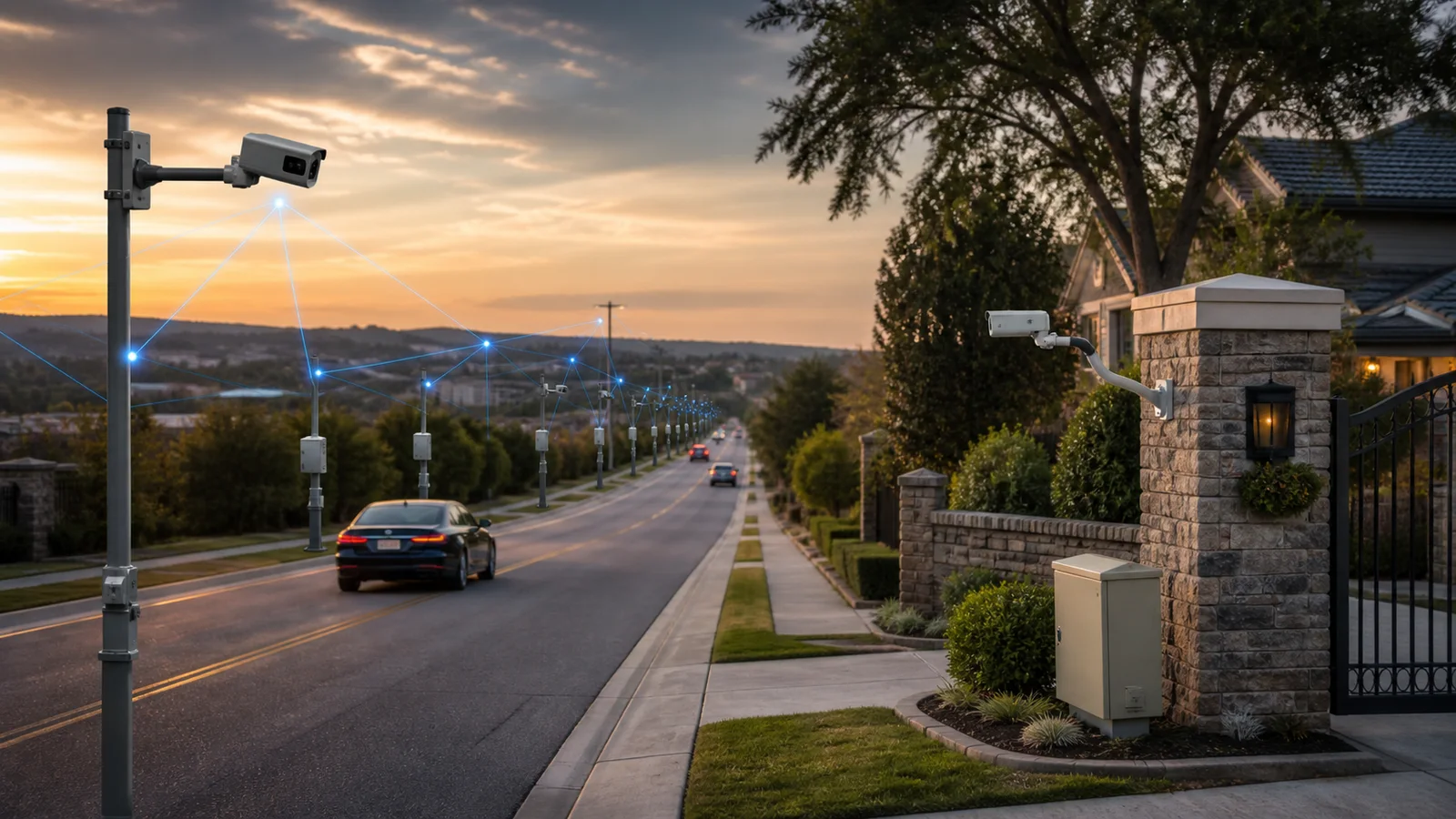
President Trump Flock Safety cameras scrutiny has intensified national conversation about automated license plate recognition (ALPR) technology used to monitor public roadways. PLACA.AI has closely followed this development, and we believe it is an important moment to clarify where our approach differs fundamentally from the centralized, wide-area surveillance model that is now under review.
Key Takeaways
- Federal scrutiny of Flock Safety-style ALPR networks centers on data retention, third-party access, and lack of individualized suspicion before scanning.
- PLACA.AI’s model is fundamentally different: cameras are deployed at private, gated points of entry (schools, HOAs, apartment communities), not on public roads to track the general population.
- Data stays local to the property and its authorized administrators; it is not pooled into a nationwide, cross-jurisdictional searchable database.
- Purpose limitation matters: our systems exist to verify authorized entry, not to build movement profiles of the public.
What President Trump Said About Flock Safety Cameras
Recent public remarks from President Trump have drawn attention to the scale and reach of Flock Safety’s ALPR camera network, which spans thousands of municipalities and enables cross-jurisdictional plate searches. The remarks reflect a broader, bipartisan unease about how quickly this technology has expanded with limited public debate about retention periods, audit access, and law enforcement data-sharing agreements.
What This Workflow Involves
Flock Safety’s core workflow places fixed ALPR cameras on public roads and highways, capturing every passing vehicle’s plate, location, and timestamp regardless of whether the vehicle or driver is suspected of anything. That data is uploaded to a shared cloud network, searchable by thousands of participating law-enforcement agencies nationwide, often without a warrant.
The Pros
Proponents argue that wide-area ALPR networks help solve crimes faster, recover stolen vehicles, and locate missing persons by creating a searchable trail of vehicle movement across jurisdictions.
| Factor | Wide-Area Public ALPR (Flock-style) | Private Point-of-Entry LPR (PLACA.AI-style) |
|---|---|---|
| Coverage | Public roads, continuous tracking | Single gated entry point |
| Data pooling | Cross-jurisdictional shared network | Local to the property only |
| Purpose | General surveillance / investigation | Authorized-entry verification |
| Retention | Often 30+ days, broad access | Property-controlled, limited access |
Why This Problem Is Showing Up Now
ALPR camera networks expanded rapidly over the past several years with relatively little public oversight. As deployments scaled into the thousands, the aggregate surveillance capability crossed a threshold that is now prompting scrutiny from officials across the political spectrum.
The Core Operational Problem
The central issue is not the camera technology itself, but the absence of a boundary around where and why it is used. When ALPR systems monitor public roadways indiscriminately and pool the data into a searchable nationwide index, the technology shifts from a tool of verification to a tool of mass tracking.
Is Flock Safety Unconstitutional?
Courts have not reached a definitive nationwide answer. Some legal scholars argue that persistent, warrantless tracking of vehicle movements across a wide area may implicate Fourth Amendment concerns similar to those raised in Carpenter v. United States, which addressed cell-site location data. Others note that plates are, by design, visible in public and that current law has generally treated ALPR capture as distinct from other forms of location tracking. This is an active and unsettled area of law.
The China Surveillance-State Warning
Critics have drawn comparisons between expansive, centralized ALPR networks and the surveillance infrastructure used in authoritarian states, warning that a searchable, nationwide vehicle-tracking system — regardless of original intent — creates the technical capability for mass monitoring of a population’s movements.
Camera and Platform Vulnerabilities
Security researchers have also raised concerns about vulnerabilities in some ALPR camera deployments, including exposed camera feeds and inconsistent access controls, which can compound the privacy risk of a large centralized data pool.
A Localized Alternative
PLACA.AI’s approach is built around a different principle: cameras are deployed only at defined, private points of entry — a school pickup line, an HOA gate, an apartment community entrance — and the data they capture is used solely to verify that an arriving vehicle is authorized to be there. There is no public-road monitoring, no cross-property data pooling, and no searchable nationwide index.
Ten Safeguards
- Cameras positioned only at private, defined entry points — not public roads.
- Data stays local to the property and its designated administrators.
- No participation in a shared, cross-jurisdictional searchable network.
- Clear purpose limitation: entry verification, not general surveillance.
- Defined, property-controlled data retention periods.
- Access logs for who queried what data and when.
- No law-enforcement data-sharing agreements by default.
- Encryption of stored plate data.
- Ability for property administrators to export or delete records.
- Transparent disclosure to residents/parents about what is collected and why.
PLACA’s Position
We support the use of LPR technology for narrowly scoped, purpose-limited applications like verifying authorized entry to a school, gated community, or apartment complex. We do not support — and do not build — wide-area public surveillance networks that track the general population’s movements without individualized cause. The distinction between “verifying who is allowed in” and “tracking where everyone goes” is, in our view, the line that should guide policy on this technology.
FAQ
Does PLACA.AI share data with Flock Safety or similar networks?
No. PLACA.AI data stays local to the property and its administrators and is not pooled into any third-party or cross-jurisdictional network.
Is PLACA.AI’s technology the same as Flock Safety’s?
Both use license plate recognition, but the deployment model is fundamentally different — private point-of-entry verification versus public-road, wide-area tracking.
Could PLACA.AI’s cameras be used for public surveillance?
No. Our cameras are deployed only at defined private entry points for authorized-entry verification, not on public roads.
Internal Resources
- Best License Plate Recognition Camera for Gated Communities
- PLACA.AI Files Patent for AI-Powered School Pickup Line System That Requires Staff Approval Before Every Student Release
Data source: Student Privacy Policy Office (U.S. Dept. of Education)