

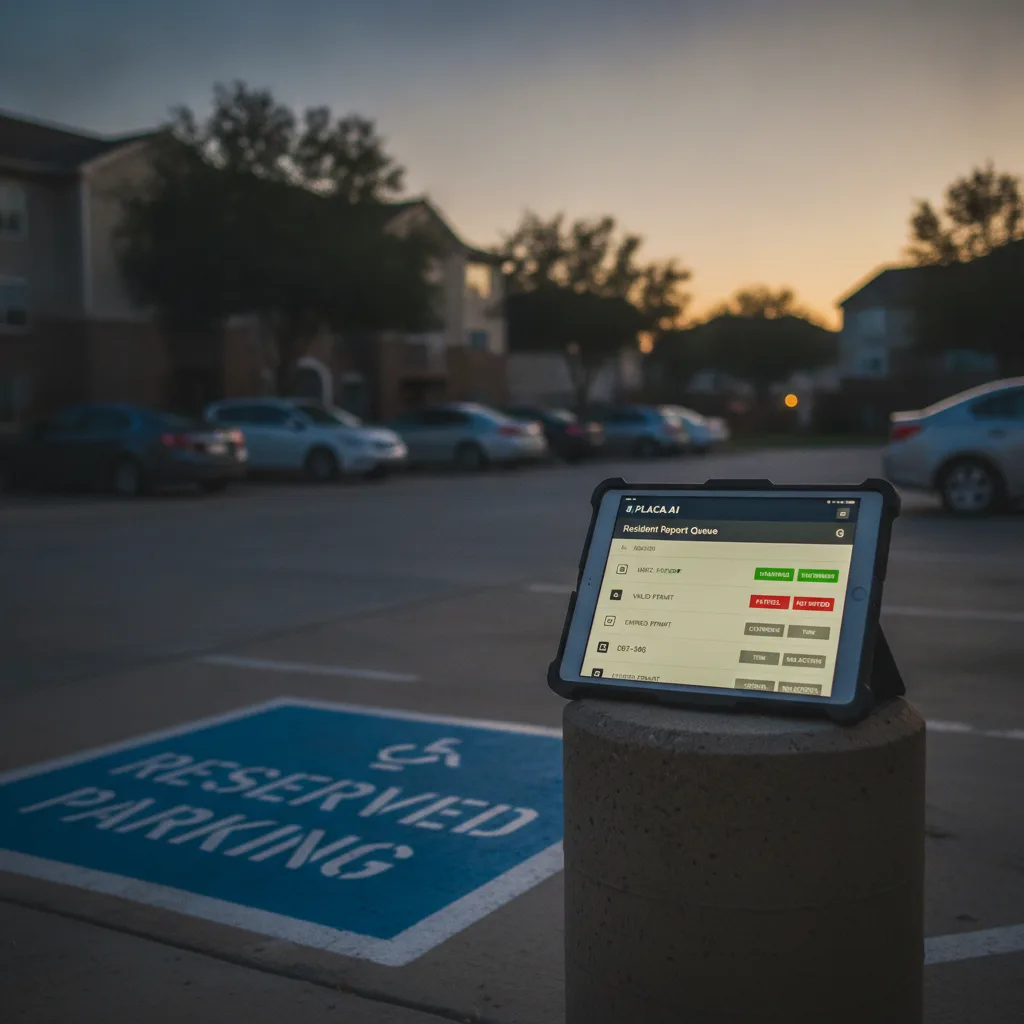
A resident parking report workflow should turn a neighbor complaint into a verified case, not an automatic tow. Apartment and HOA teams should capture the plate, photo, location, policy rule, permit or guest status, safety risk, and patrol decision before sending a warning, citation, tow request, or no-action response.
Key Takeaways
- Resident-submitted parking reports are intake signals. They still need verification before enforcement.
- The minimum evidence packet should include plate, photo, location, timestamp, claimed rule violation, and reporter eligibility.
- Staff should cross-check the reported vehicle against permits, guest passes, temporary authorizations, paid assigned spaces, and recent rule changes.
- After-hours reporting needs a written dispatch rule so residents know when a report becomes an emergency, patrol ticket, next-business-day review, or no action.
- LPR works best when it supports the triage record rather than replacing human review of edge cases.
What This Workflow Involves
This process starts when a resident flags a vehicle in an assigned space, fire lane, loading area, visitor zone, garage, or permit-only lot. The report should collect a plate number, vehicle description, photo, location, timestamp, resident account, and the parking rule the resident believes was violated.
The manager or enforcement partner then routes the report through a short verification path. Is the reporter connected to the affected space or community? Is the reported plate already registered? Is there an active guest pass, temporary permit, rental-car record, contractor authorization, maintenance exception, or safe-list entry? Is the location a safety issue that needs immediate escalation, or a policy issue that can wait for patrol review?
The result should be a logged disposition, not an informal text message. A report can become a warning, citation, tow authorization request, resident follow-up, duplicate closure, false-report review, or no-action record. The resident should receive a status update that explains the decision category without disclosing private vehicle-owner data.
Why This Problem Is Showing Up Now
Resident reporting is becoming more formal because multifamily and HOA parking systems are moving from stickers and office calls into portals, mobile apps, virtual permits, and license plate recognition. Reliant Parking’s August 15, 2026 explainer on resident self-reporting describes residents flagging unauthorized vehicles through a structured app or portal, with useful reports typically including plate, vehicle description, space or address, and a photo.
That shift is helpful, but it also creates new expectations. When a resident submits a report, the resident may assume the community has promised instant towing. In practice, the report still has to move through enforcement rules, patrol availability, local towing requirements, lease language, signage, and management authority. Reliant’s explainer makes the same distinction: a submission identifies a potential problem, while enforcement still depends on verification and policy.
Fresh buyer guidance points in the same direction. ParkingPass’s August 14, 2026 multifamily parking software guide tells managers to evaluate resident and guest experience, enforcement tools, photo records, vehicle history, integrations, data protection, signage, testing, training, and usage reports. Those are operational controls, not just software features.
Towing visibility also keeps resident expectations high. MySA’s August 28, 2026 towing explainer covered common questions about private-property tows and drop fees in Texas. The official Texas Department of Licensing and Regulation towing consumer information shows why communities need jurisdiction-specific review around private-property notices, proof of ownership or authorization, drop fees, tow tickets, and hearings.
The Core Operational Problem
The core problem is that resident urgency and enforcement authority are not the same thing. A resident may be right that an unauthorized car is blocking a paid assigned space. The towing company may still require manager authorization. The manager may need proof that the space is assigned to the resident, the reported plate lacks authorization, the signage supports enforcement, and the community’s after-hours policy allows action.
Without a defined intake path, each complaint becomes a one-off judgment call. One leasing agent may forward a screenshot to patrol. Another may tell the resident to call the towing number. A weekend emergency line may accept a ticket but lack authority to dispatch. A towing vendor may refuse action without a manager request. A resident may then see the same vehicle again and conclude that the community does not enforce its own rules.
The fix is not to tow faster by default. The fix is to define what evidence turns a complaint into a case, what checks happen before enforcement, who can authorize each action, and what message closes the loop with the resident. That is where PLACA.AI can connect resident intake, plate recognition, virtual permits, guest passes, patrol review, and audit logs into a more defensible workflow.
Resident Parking Report Workflow Checklist
| Step | What to verify | Why it matters |
|---|---|---|
| 1. Confirm reporter context | Resident account, unit, assigned-space relationship, and contact method. | Prevents anonymous or unrelated complaints from driving enforcement. |
| 2. Capture vehicle evidence | Plate, state if visible, vehicle description, photo, timestamp, and exact location. | Creates a reviewable record instead of a vague complaint. |
| 3. Match the rule | Reserved-space rule, permit-only rule, visitor rule, fire-lane rule, loading-zone rule, or garage rule. | Keeps the response tied to the policy residents were given. |
| 4. Check authorizations | Resident permits, guest passes, temporary permits, rental or loaner records, contractors, vendors, and safe-list entries. | Reduces false citations and mistaken tow requests. |
| 5. Triage urgency | Safety block, ADA access issue, fire lane, paid assigned-space displacement, repeat abuse, or routine review. | Separates emergency dispatch from patrol queue or next-business-day handling. |
| 6. Choose disposition | Warning, citation, tow request, patrol watch, resident follow-up, duplicate closure, false-report review, or no action. | Shows residents and staff that the report reached a decision. |
| 7. Log audit trail | Reviewer, time, data checked, decision reason, photos, LPR reads, and message sent. | Supports later dispute resolution and vendor oversight. |
How LPR Supports Resident Reports
LPR should support resident reports by filling in objective context. If the resident submits a partial plate, the system may show recent reads for that zone. If the report concerns a visitor space, the system can compare the plate against active guest passes. If a vehicle appears in a paid assigned space repeatedly, the system can help staff see whether this is a repeat event, a temporary authorization, or a mistaken report.
The HOA license plate recognition camera guide explains the broader community use case, while AI license plate recognition for apartments covers multifamily plate-based parking control. For this topic, the key is narrower: the camera record should strengthen the case file and reduce ambiguity before a person decides whether enforcement is warranted.
That means managers should avoid using LPR as a black box. A defensible report record should show what plate was reported, what the camera read, what permit or guest-pass record was checked, what exception was found or ruled out, and who made the final decision. When the plate read is uncertain, the case should move into review rather than automatic punishment.
After-Hours Reports Need Their Own Rule
After-hours handling is where many parking disputes become resident-trust problems. A resident paying for a reserved space may expect the posted towing number to solve the issue immediately. The towing company may say management must request the tow. The emergency maintenance line may accept a ticket but not have parking authority. By morning, the resident feels ignored even if the team followed its internal policy.
Communities should define this rule before the next weekend dispute. Which parking events qualify for immediate escalation? Who can authorize a tow outside office hours? What evidence must the resident provide? Does the patrol company have authority to act from a resident report, or only after manager approval? If immediate action is unavailable, what substitute is offered: temporary overflow, reimbursement review, patrol flag, courtesy warning, or next-business-day investigation?
The answer should be visible in resident materials and staff scripts. It should also match the towing agreement, signage, lease addendum, and local rules. For enforcement partners, parking enforcement software for towing companies is useful only when authority, evidence, and authorization rules are clear enough to execute consistently.
Handling False, Duplicate, And Retaliatory Reports
Resident reporting creates value only if the community can trust the intake channel. Reports should usually be tied to an authenticated resident account, even if the status message sent back to the reporter is limited. If anonymous reporting is allowed for safety reasons, the community still needs a higher verification standard before enforcement.
Duplicate reports should be grouped into one case. That prevents a busy weekend from looking like ten separate violations when several residents report the same vehicle. Retaliatory or repeated false reports should be flagged for management review, not ignored silently. A resident who repeatedly submits misleading reports may need a warning about abuse of the reporting channel.
Privacy matters here. The resident does not need the other driver’s name, unit, guest host, or permit details. A good status message can say: reviewed, authorized vehicle; reviewed, warning issued; reviewed, patrol dispatched; reviewed, no enforceable violation; or duplicate report merged. That keeps residents informed without turning the parking system into a neighbor-surveillance feed.
How To Connect Reports To Exception Review
Some reports should go straight into an exception queue. A temporary tag, rental vehicle, unreadable plate, guest pass entered under a different plate format, contractor vehicle, medical visitor, move-in truck, or recent registration change can all look like violations from one photo. The LPR exception queue before parking enforcement explains how to review those edge cases before action.
For resident-initiated cases, the exception queue should answer three questions. First, does the community have a valid authorization record that the resident cannot see? Second, does the reported evidence actually match the violation? Third, would enforcement be consistent with the latest resident notice and rule-change process?
If the answer is uncertain, slow the case down. A temporary warning, manager review, or resident follow-up is usually better than a disputed tow. For broader policy changes, use the apartment parking rule change workflow before towing before shifting from complaint intake to stricter enforcement.
Implementation Plan For Property Managers
- Map the report types. List assigned-space complaints, guest-space abuse, fire-lane concerns, unauthorized overnight parking, contractor vehicles, garage access issues, loading-zone conflicts, and blocked ADA access.
- Define required evidence. Require plate, photo, location, timestamp, and rule category for non-emergency reports. Allow faster escalation for genuine safety blocks.
- Connect data sources. Link the case to resident account data, virtual permits, guest passes, temporary authorizations, LPR reads, patrol notes, and towing authorization records.
- Set response windows. Distinguish immediate safety response, same-day patrol review, next-business-day review, and resident education.
- Write disposition language. Prepare short status messages that tell the resident what happened without disclosing another household’s private information.
- Audit monthly. Review report volume, false reports, repeat locations, response times, citations, tow requests, and no-action reasons.
The resident parking solutions page is the right internal link when the goal is resident experience rather than patrol enforcement alone. The operational win is not only fewer unauthorized vehicles. It is fewer unresolved complaints, fewer surprise tows, and a clearer record when someone challenges the decision.
Frequently Asked Questions
Does a resident report mean the vehicle should be towed immediately?
No. A resident report should trigger verification. Towing should depend on the posted rules, lease or community policy, local law, manager or patrol authority, evidence quality, and whether the vehicle has an active authorization.
What evidence should residents submit?
The report should capture the plate, vehicle description, photo, location, timestamp, and the rule category. For assigned spaces, the resident should also identify the affected space or account relationship.
How should staff handle reports about assigned spaces after hours?
Staff should follow a written after-hours rule. The rule should define who can authorize immediate action, when a report waits for patrol or office review, and what temporary option is offered when a paid space is blocked.
Can resident reporting be anonymous?
Anonymous reporting can be allowed for safety concerns, but routine parking enforcement usually needs an authenticated resident account or stronger verification. Anonymous reports should not become automatic citations or tow requests.
What should happen when the reported vehicle has an active guest pass or temporary authorization?
The case should close as authorized or move to manager review if the authorization is unclear. The reporting resident can receive a limited status update without seeing the guest host, driver identity, or private permit details.
How does LPR reduce false or incomplete reports?
LPR can compare the reported plate with recent reads, permit records, guest passes, and repeat-violation history. It reduces ambiguity when paired with human review and a logged decision path.
Next Step
Before opening resident-submitted reports to enforcement, build a one-page matrix with report type, required evidence, authorization checks, escalation path, disposition options, and resident status message. Then test it against three real scenarios: a paid assigned-space complaint, an active guest pass, and a temporary rental or loaner vehicle.